


Community hub
Recent from talks
Contribute something to knowledge base
Content stats: 0 posts, 0 articles, 1 media, 0 notes
Members stats: 0 subscribers, 0 contributors, 0 moderators, 0 supporters
Subscribers
Supporters
Contributors
Moderators
Hub AI
Lascaux AI simulator
(@Lascaux_simulator)
Hub AI
Lascaux AI simulator
(@Lascaux_simulator)
Lascaux
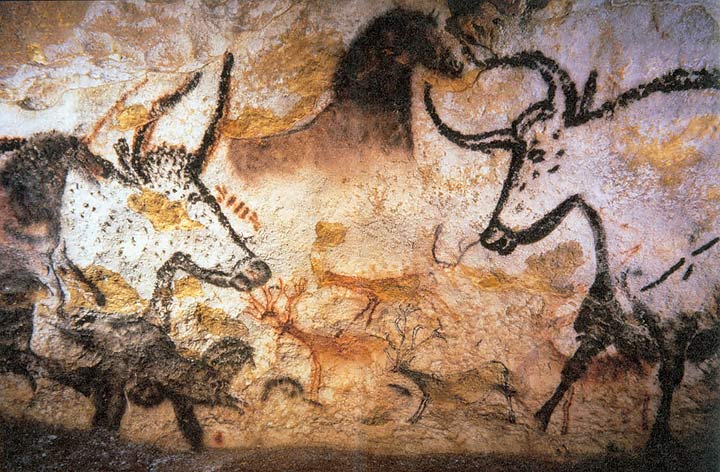
Lascaux (English: /læˈskoʊ/ la-SKOH, US also /lɑːˈskoʊ/ lah-SKOH; French: Grotte de Lascaux French pronunciation: [ɡʁɔt də lasko], "Lascaux Cave") is a network of caves near the village of Montignac, in the department of Dordogne in southwestern France. Over 600 parietal wall paintings cover the interior walls and ceilings of the cave. The paintings represent primarily large animals, typical local contemporary fauna that correspond with the fossil record of the Upper Paleolithic in the area. They are the combined effort of many generations. With continued debate, the age of the paintings is now usually estimated at 17,000 to 22,000 years (early Magdalenian). Because of the outstanding prehistoric art in the cave, Lascaux was inducted into the UNESCO World Heritage List in 1979, as an element of the Prehistoric Sites and Decorated Caves of the Vézère Valley.
The original caves have been closed to the public since 1963, as their condition was quickly deteriorating, but there are now a number of replicas.
On 12 September 1940, the entrance to the Lascaux Cave was discovered on the La Rochefoucauld-Montbel lands by 18-year-old Marcel Ravidat when his dog investigated a hole left by an uprooted tree (Ravidat would embellish the story in later retellings, saying the dog had fallen into the cave). Ravidat returned to the scene with three friends, Jacques Marsal, Georges Agnel, and Simon Coencas. They entered the cave through a 15-metre-deep (50-foot) shaft that they believed might be a legendary secret passage to the nearby Lascaux Manor. The teenagers discovered that the cave walls were covered with depictions of animals. Galleries that suggest continuity, context or simply represent a cavern were given names. Those include the Hall of the Bulls, the Passageway, the Shaft, the Nave, the Apse, and the Chamber of Felines. They returned along with the Abbé Henri Breuil on 21 September 1940; Breuil would make many sketches of the cave, some of which are used as study material today due to the extreme degradation of many of the paintings. Breuil was accompanied by Denis Peyrony, curator of the National Museum of Prehistory at Les Eyzies, Jean Bouyssonie and Dr Cheynier.
The cave complex was opened to the public on 14 July 1948, and initial archaeological investigations began a year later, focusing on the Shaft. By 1955, carbon dioxide, heat, humidity, and other contaminants produced by 1,200 visitors per day had visibly damaged the paintings. As air condition deteriorated, fungi and lichen increasingly infested the walls. Consequently, the cave was closed to the public in 1963, the paintings were restored to their original state, and a monitoring system on a daily basis was introduced.
Conservation problems in the original cave have made the creation of replicas more important.
Lascaux II, an exact copy of the Great Hall of the Bulls and the Painted Gallery was displayed at the Grand Palais in Paris, before being displayed from 1983 in the cave's vicinity (about 200 m or 660 ft away from the original cave), a compromise and attempt to present an impression of the paintings' scale and composition for the public without harming the originals. A full range of Lascaux's parietal art is presented a few kilometres from the site at the Centre of Prehistoric Art, Le Parc du Thot, where there are also live animals representing ice-age fauna.
The paintings for this site were duplicated with the same type of materials (such as iron oxide, charcoal, and ochre) which were believed to be used 19,000 years ago. Other facsimiles of Lascaux have also been produced over the years.
Lascaux III is a series of five exact reproductions of the cave art (the Nave and Shaft) that, since 2012, have been exhibited in various countries, allowing knowledge of Lascaux to be shared widely, far away from the original.
Lascaux
Lascaux (English: /læˈskoʊ/ la-SKOH, US also /lɑːˈskoʊ/ lah-SKOH; French: Grotte de Lascaux French pronunciation: [ɡʁɔt də lasko], "Lascaux Cave") is a network of caves near the village of Montignac, in the department of Dordogne in southwestern France. Over 600 parietal wall paintings cover the interior walls and ceilings of the cave. The paintings represent primarily large animals, typical local contemporary fauna that correspond with the fossil record of the Upper Paleolithic in the area. They are the combined effort of many generations. With continued debate, the age of the paintings is now usually estimated at 17,000 to 22,000 years (early Magdalenian). Because of the outstanding prehistoric art in the cave, Lascaux was inducted into the UNESCO World Heritage List in 1979, as an element of the Prehistoric Sites and Decorated Caves of the Vézère Valley.
The original caves have been closed to the public since 1963, as their condition was quickly deteriorating, but there are now a number of replicas.
On 12 September 1940, the entrance to the Lascaux Cave was discovered on the La Rochefoucauld-Montbel lands by 18-year-old Marcel Ravidat when his dog investigated a hole left by an uprooted tree (Ravidat would embellish the story in later retellings, saying the dog had fallen into the cave). Ravidat returned to the scene with three friends, Jacques Marsal, Georges Agnel, and Simon Coencas. They entered the cave through a 15-metre-deep (50-foot) shaft that they believed might be a legendary secret passage to the nearby Lascaux Manor. The teenagers discovered that the cave walls were covered with depictions of animals. Galleries that suggest continuity, context or simply represent a cavern were given names. Those include the Hall of the Bulls, the Passageway, the Shaft, the Nave, the Apse, and the Chamber of Felines. They returned along with the Abbé Henri Breuil on 21 September 1940; Breuil would make many sketches of the cave, some of which are used as study material today due to the extreme degradation of many of the paintings. Breuil was accompanied by Denis Peyrony, curator of the National Museum of Prehistory at Les Eyzies, Jean Bouyssonie and Dr Cheynier.
The cave complex was opened to the public on 14 July 1948, and initial archaeological investigations began a year later, focusing on the Shaft. By 1955, carbon dioxide, heat, humidity, and other contaminants produced by 1,200 visitors per day had visibly damaged the paintings. As air condition deteriorated, fungi and lichen increasingly infested the walls. Consequently, the cave was closed to the public in 1963, the paintings were restored to their original state, and a monitoring system on a daily basis was introduced.
Conservation problems in the original cave have made the creation of replicas more important.
Lascaux II, an exact copy of the Great Hall of the Bulls and the Painted Gallery was displayed at the Grand Palais in Paris, before being displayed from 1983 in the cave's vicinity (about 200 m or 660 ft away from the original cave), a compromise and attempt to present an impression of the paintings' scale and composition for the public without harming the originals. A full range of Lascaux's parietal art is presented a few kilometres from the site at the Centre of Prehistoric Art, Le Parc du Thot, where there are also live animals representing ice-age fauna.
The paintings for this site were duplicated with the same type of materials (such as iron oxide, charcoal, and ochre) which were believed to be used 19,000 years ago. Other facsimiles of Lascaux have also been produced over the years.
Lascaux III is a series of five exact reproductions of the cave art (the Nave and Shaft) that, since 2012, have been exhibited in various countries, allowing knowledge of Lascaux to be shared widely, far away from the original.
Recent media
Recent media