



Community hub
Recent from talks
Knowledge base stats:
Talk channels stats:
Members stats:
Laser-induced breakdown spectroscopy
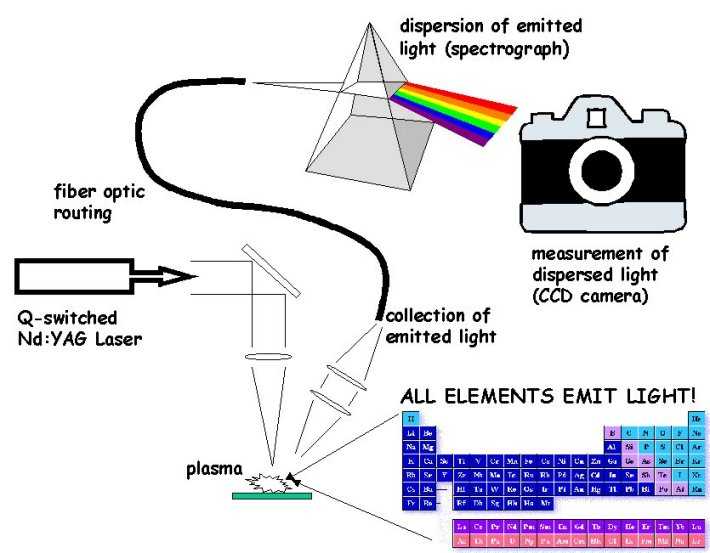
Laser-induced breakdown spectroscopy (LIBS) is a type of atomic emission spectroscopy which uses a highly energetic laser pulse as the excitation source. The laser is focused to form a plasma, which atomizes and excites samples. The formation of the plasma only begins when the focused laser achieves a certain threshold for optical breakdown, which generally depends on the environment and the target material.
From 2000 to 2010, the U.S. Army Research Laboratory (ARL) researched potential extensions to LIBS technology, which focused on hazardous material detection. Applications investigated at ARL included the standoff detection of explosive residues and other hazardous materials, plastic landmine discrimination, and material characterization of various metal alloys and polymers. Results presented by ARL suggest that LIBS may be able to discriminate between energetic and non-energetic materials.
Broadband high-resolution spectrometers were developed in 2000 and commercialized in 2003. Designed for material analysis, the spectrometer allowed the LIBS system to be sensitive to chemical elements in low concentration.
ARL LIBS applications studied from 2000 to 2010 included:
ARL LIBS prototypes studied during this period included:
LIBS is one of several analytical techniques that can be deployed in the field as opposed to pure laboratory techniques e.g. spark OES. As of 2015[update], recent research on LIBS focuses on compact and (man-)portable systems. Some industrial applications of LIBS include the detection of material mix-ups, analysis of inclusions in steel, analysis of slags in secondary metallurgy, analysis of combustion processes, and high-speed identification of scrap pieces for material-specific recycling tasks. Armed with data analysis techniques, this technique is being extended to pharmaceutical samples.
Following multiphoton or tunnel ionization the electron is being accelerated by inverse Bremsstrahlung and can collide with the nearby molecules and generate new electrons through collisions. If the pulse duration is long, the newly ionized electrons can be accelerated and eventually avalanche or cascade ionization follows. Once the density of the electrons reaches a critical value, breakdown occurs and high density plasma is created which has no memory of the laser pulse. So, the criterion for the shortness of a pulse in dense media is as follows: A pulse interacting with a dense matter is considered to be short if during the interaction the threshold for the avalanche ionization is not reached. At the first glance this definition may appear to be too limiting. Fortunately, due to the delicately balanced behavior of the pulses in dense media, the threshold cannot be reached easily.[citation needed] The phenomenon responsible for the balance is the intensity clamping through the onset of filamentation process during the propagation of strong laser pulses in dense media.
A potentially important development to LIBS involves the use of a short laser pulse as a spectroscopic source. In this method, a plasma column is created as a result of focusing ultrafast laser pulses in a gas. The self-luminous plasma is far superior in terms of low level of continuum and also smaller line broadening. This is attributed to the lower density of the plasma in the case of short laser pulses due to the defocusing effects which limits the intensity of the pulse in the interaction region and thus prevents further multiphoton/tunnel ionization of the gas.
Hub AI
Laser-induced breakdown spectroscopy AI simulator
(@Laser-induced breakdown spectroscopy_simulator)
Laser-induced breakdown spectroscopy
Laser-induced breakdown spectroscopy (LIBS) is a type of atomic emission spectroscopy which uses a highly energetic laser pulse as the excitation source. The laser is focused to form a plasma, which atomizes and excites samples. The formation of the plasma only begins when the focused laser achieves a certain threshold for optical breakdown, which generally depends on the environment and the target material.
From 2000 to 2010, the U.S. Army Research Laboratory (ARL) researched potential extensions to LIBS technology, which focused on hazardous material detection. Applications investigated at ARL included the standoff detection of explosive residues and other hazardous materials, plastic landmine discrimination, and material characterization of various metal alloys and polymers. Results presented by ARL suggest that LIBS may be able to discriminate between energetic and non-energetic materials.
Broadband high-resolution spectrometers were developed in 2000 and commercialized in 2003. Designed for material analysis, the spectrometer allowed the LIBS system to be sensitive to chemical elements in low concentration.
ARL LIBS applications studied from 2000 to 2010 included:
ARL LIBS prototypes studied during this period included:
LIBS is one of several analytical techniques that can be deployed in the field as opposed to pure laboratory techniques e.g. spark OES. As of 2015[update], recent research on LIBS focuses on compact and (man-)portable systems. Some industrial applications of LIBS include the detection of material mix-ups, analysis of inclusions in steel, analysis of slags in secondary metallurgy, analysis of combustion processes, and high-speed identification of scrap pieces for material-specific recycling tasks. Armed with data analysis techniques, this technique is being extended to pharmaceutical samples.
Following multiphoton or tunnel ionization the electron is being accelerated by inverse Bremsstrahlung and can collide with the nearby molecules and generate new electrons through collisions. If the pulse duration is long, the newly ionized electrons can be accelerated and eventually avalanche or cascade ionization follows. Once the density of the electrons reaches a critical value, breakdown occurs and high density plasma is created which has no memory of the laser pulse. So, the criterion for the shortness of a pulse in dense media is as follows: A pulse interacting with a dense matter is considered to be short if during the interaction the threshold for the avalanche ionization is not reached. At the first glance this definition may appear to be too limiting. Fortunately, due to the delicately balanced behavior of the pulses in dense media, the threshold cannot be reached easily.[citation needed] The phenomenon responsible for the balance is the intensity clamping through the onset of filamentation process during the propagation of strong laser pulses in dense media.
A potentially important development to LIBS involves the use of a short laser pulse as a spectroscopic source. In this method, a plasma column is created as a result of focusing ultrafast laser pulses in a gas. The self-luminous plasma is far superior in terms of low level of continuum and also smaller line broadening. This is attributed to the lower density of the plasma in the case of short laser pulses due to the defocusing effects which limits the intensity of the pulse in the interaction region and thus prevents further multiphoton/tunnel ionization of the gas.