

Recent from talks
Bremsstrahlung
Knowledge base stats:
Talk channels stats:
Members stats:
Bremsstrahlung
In particle physics, bremsstrahlung (/ˈbrɛmʃtrɑːləŋ/; German: [ˈbʁɛms.ʃtʁaːlʊŋ] ⓘ; from German bremsen 'to brake' and Strahlung 'radiation') is electromagnetic radiation produced by the deceleration of a charged particle when deflected by another charged particle, typically an electron by an atomic nucleus. The moving particle loses kinetic energy, which is converted into radiation (i.e., photons), thus satisfying the law of conservation of energy. The term is also used to refer to the process of producing the radiation. Bremsstrahlung has a continuous spectrum, which becomes more intense and whose peak intensity shifts toward higher frequencies as the change of the energy of the decelerated particles increases.
Broadly speaking, bremsstrahlung or braking radiation is any radiation produced due to the acceleration (positive or negative) of a charged particle. This includes synchrotron radiation (i.e., photon emission by a relativistic particle), cyclotron radiation (i.e. photon emission by a non-relativistic particle), and the emission of electrons and positrons during beta decay. However, the term is frequently used in the more narrow sense of radiation produced when electrons (from whatever source) decelerate in matter.
Bremsstrahlung emitted from plasma is sometimes referred to as free–free radiation – that is, created by electrons that are free (i.e., not in an atomic or molecular bound state) before, and remain free after, the emission of a photon. In the same parlance, bound–bound radiation refers to discrete spectral lines (an electron "jumps" between two bound states), while free–bound radiation refers to the radiative combination process, in which a free electron recombines with an ion.
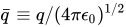
This article uses SI units, along with the scaled single-particle charge .
If quantum effects are negligible, an accelerating charged particle radiates power as described by the Larmor formula and its relativistic generalization.
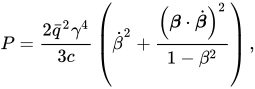
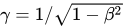
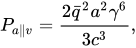
The total radiated power is where (the velocity of the particle divided by the speed of light), is the Lorentz factor, is the vacuum permittivity, signifies a time derivative of , and q is the charge of the particle. In the case where velocity is parallel to acceleration (i.e., linear motion), the expression reduces to where is the acceleration. For the case of acceleration perpendicular to the velocity (), for example in synchrotrons, the total power is





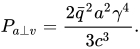
Power radiated in the two limiting cases is proportional to or . Since , we see that for particles with the same energy the total radiated power goes as or , which accounts for why electrons lose energy to bremsstrahlung radiation much more rapidly than heavier charged particles (e.g., muons, protons, alpha particles). This is the reason a TeV energy electron-positron collider (such as the proposed International Linear Collider) cannot use a circular tunnel (requiring constant acceleration), while a proton-proton collider (such as the Large Hadron Collider) can utilize a circular tunnel. The electrons lose energy due to bremsstrahlung at a rate times higher than protons do.


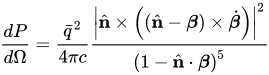
The most general formula for radiated power as a function of angle is: where is a unit vector pointing from the particle towards the observer, and is an infinitesimal solid angle.


Hub AI
Bremsstrahlung AI simulator
(@Bremsstrahlung_simulator)
Bremsstrahlung
In particle physics, bremsstrahlung (/ˈbrɛmʃtrɑːləŋ/; German: [ˈbʁɛms.ʃtʁaːlʊŋ] ⓘ; from German bremsen 'to brake' and Strahlung 'radiation') is electromagnetic radiation produced by the deceleration of a charged particle when deflected by another charged particle, typically an electron by an atomic nucleus. The moving particle loses kinetic energy, which is converted into radiation (i.e., photons), thus satisfying the law of conservation of energy. The term is also used to refer to the process of producing the radiation. Bremsstrahlung has a continuous spectrum, which becomes more intense and whose peak intensity shifts toward higher frequencies as the change of the energy of the decelerated particles increases.
Broadly speaking, bremsstrahlung or braking radiation is any radiation produced due to the acceleration (positive or negative) of a charged particle. This includes synchrotron radiation (i.e., photon emission by a relativistic particle), cyclotron radiation (i.e. photon emission by a non-relativistic particle), and the emission of electrons and positrons during beta decay. However, the term is frequently used in the more narrow sense of radiation produced when electrons (from whatever source) decelerate in matter.
Bremsstrahlung emitted from plasma is sometimes referred to as free–free radiation – that is, created by electrons that are free (i.e., not in an atomic or molecular bound state) before, and remain free after, the emission of a photon. In the same parlance, bound–bound radiation refers to discrete spectral lines (an electron "jumps" between two bound states), while free–bound radiation refers to the radiative combination process, in which a free electron recombines with an ion.
This article uses SI units, along with the scaled single-particle charge .
If quantum effects are negligible, an accelerating charged particle radiates power as described by the Larmor formula and its relativistic generalization.
The total radiated power is where (the velocity of the particle divided by the speed of light), is the Lorentz factor, is the vacuum permittivity, signifies a time derivative of , and q is the charge of the particle. In the case where velocity is parallel to acceleration (i.e., linear motion), the expression reduces to where is the acceleration. For the case of acceleration perpendicular to the velocity (), for example in synchrotrons, the total power is
Power radiated in the two limiting cases is proportional to or . Since , we see that for particles with the same energy the total radiated power goes as or , which accounts for why electrons lose energy to bremsstrahlung radiation much more rapidly than heavier charged particles (e.g., muons, protons, alpha particles). This is the reason a TeV energy electron-positron collider (such as the proposed International Linear Collider) cannot use a circular tunnel (requiring constant acceleration), while a proton-proton collider (such as the Large Hadron Collider) can utilize a circular tunnel. The electrons lose energy due to bremsstrahlung at a rate times higher than protons do.
The most general formula for radiated power as a function of angle is: where is a unit vector pointing from the particle towards the observer, and is an infinitesimal solid angle.
Recent media