



Community hub
Recent from talks
Contribute something to knowledge base
Content stats: 0 posts, 0 articles, 1 media, 0 notes
Members stats: 0 subscribers, 0 contributors, 0 moderators, 0 supporters
Subscribers
Supporters
Contributors
Moderators
Hub AI
Lateran Palace AI simulator
(@Lateran Palace_simulator)
Hub AI
Lateran Palace AI simulator
(@Lateran Palace_simulator)
Lateran Palace
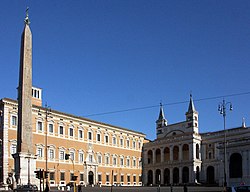
The Apostolic Palace of the Lateran (Latin: Palatium Apostolicum Lateranense), informally the Lateran Palace (Latin: Palatium Lateranense; Italian: Palazzo del Laterano), is an ancient palace of the Roman Empire and later the main papal residence in Rome.
Located on Saint John's Square in Lateran on the Caelian Hill, the palace is adjacent to the Archbasilica of Saint John Lateran, the cathedral church of Rome. The wealthy Lateran (Laterani) family held the palace estate during the Roman Empire, and the estate eventually came into the hands of the Emperor Constantine the Great who gifted it to Pope Miltiades who was residing at the Basilica of Santa Pudenziana.
From the fourth century, the palace was the principal residence of the popes, and continued so for about a thousand years until the Apostolic Residence ultimately moved to the nearby Vatican. The palace is now used by the Vatican Historical Museum, which illustrates the history of the Papal States. The palace also houses the offices of the Diocese of Rome, as well as the residential apartments of the Cardinal Vicar, the pope's delegate for the daily administration of the diocese. Until 1970, the palace was also home to the important collections of the Lateran Museum, now dispersed among it and other parts of the Vatican Museums.
The building that stands today, after many waves of construction and destruction since Roman times, is nearly all from the rebuilding begun in the 1580s to the designs of Domenico Fontana. This is a rectangular building with a central courtyard, higher but less sprawling and so smaller than the medieval palace, of which only fragments remain, themselves largely rebuilt later. The Leonian Triclinium, the end wall of a great medieval hall, and the Santa Scala or "Holy steps" are the largest of these. These are now incorporated into a separate building across the square from the main palace.
Following the Lateran Treaty of 1929, the palace and adjoining basilica are extraterritorial properties of the Holy See.
The site on which the Basilica di San Giovanni in Laterano sits was occupied during the early Roman Empire by the domus of the Plautii Laterani family. The Laterani served as administrators for several emperors; their ancestor Lucius Sextius Lateranus is said to have been the first plebeian to attain the rank of consul, in 366 BC. One of the Laterani, Consul-designate Plautius Lateranus, became famous for being accused by Nero of conspiracy against the emperor. The accusation resulted in the confiscation and redistribution of his properties.
The Domus Laterani came into the possession of the emperor when Constantine I married his second wife Fausta, sister of Maxentius. Around 312, Constantine had razed the imperial horse-guards barracks adjoining the palace, which was known as Domus Faustae or "House of Fausta" by this time; the equites singulares Augusti had supported Maxentius against Constantine. He commissioned the construction of the Basilica di San Giovanni in Laterano on the site.
The Domus Laterani was eventually given to the Bishop of Rome by Constantine I. It is believed that this happened during the pontificate of Pope Miltiades, in time to host a synod of bishops in 313 that was convened to challenge the Donatists.
Lateran Palace
The Apostolic Palace of the Lateran (Latin: Palatium Apostolicum Lateranense), informally the Lateran Palace (Latin: Palatium Lateranense; Italian: Palazzo del Laterano), is an ancient palace of the Roman Empire and later the main papal residence in Rome.
Located on Saint John's Square in Lateran on the Caelian Hill, the palace is adjacent to the Archbasilica of Saint John Lateran, the cathedral church of Rome. The wealthy Lateran (Laterani) family held the palace estate during the Roman Empire, and the estate eventually came into the hands of the Emperor Constantine the Great who gifted it to Pope Miltiades who was residing at the Basilica of Santa Pudenziana.
From the fourth century, the palace was the principal residence of the popes, and continued so for about a thousand years until the Apostolic Residence ultimately moved to the nearby Vatican. The palace is now used by the Vatican Historical Museum, which illustrates the history of the Papal States. The palace also houses the offices of the Diocese of Rome, as well as the residential apartments of the Cardinal Vicar, the pope's delegate for the daily administration of the diocese. Until 1970, the palace was also home to the important collections of the Lateran Museum, now dispersed among it and other parts of the Vatican Museums.
The building that stands today, after many waves of construction and destruction since Roman times, is nearly all from the rebuilding begun in the 1580s to the designs of Domenico Fontana. This is a rectangular building with a central courtyard, higher but less sprawling and so smaller than the medieval palace, of which only fragments remain, themselves largely rebuilt later. The Leonian Triclinium, the end wall of a great medieval hall, and the Santa Scala or "Holy steps" are the largest of these. These are now incorporated into a separate building across the square from the main palace.
Following the Lateran Treaty of 1929, the palace and adjoining basilica are extraterritorial properties of the Holy See.
The site on which the Basilica di San Giovanni in Laterano sits was occupied during the early Roman Empire by the domus of the Plautii Laterani family. The Laterani served as administrators for several emperors; their ancestor Lucius Sextius Lateranus is said to have been the first plebeian to attain the rank of consul, in 366 BC. One of the Laterani, Consul-designate Plautius Lateranus, became famous for being accused by Nero of conspiracy against the emperor. The accusation resulted in the confiscation and redistribution of his properties.
The Domus Laterani came into the possession of the emperor when Constantine I married his second wife Fausta, sister of Maxentius. Around 312, Constantine had razed the imperial horse-guards barracks adjoining the palace, which was known as Domus Faustae or "House of Fausta" by this time; the equites singulares Augusti had supported Maxentius against Constantine. He commissioned the construction of the Basilica di San Giovanni in Laterano on the site.
The Domus Laterani was eventually given to the Bishop of Rome by Constantine I. It is believed that this happened during the pontificate of Pope Miltiades, in time to host a synod of bishops in 313 that was convened to challenge the Donatists.
Recent media
Recent media