



Community hub
Recent from talks
Knowledge base stats:
Talk channels stats:
Members stats:
Lath and plaster
Lath and plaster is a building process used to finish mainly interior dividing walls and ceilings. It consists of narrow strips of wood (laths) which are nailed horizontally across the wall studs or ceiling joists and then coated in plaster. The technique derives from an earlier, more primitive process called wattle and daub.
Lath and plaster largely fell out of favour in the U.K. after the introduction of plasterboard in the 1930s. In Canada and the United States, wood lath and plaster remained in use until the process was replaced by transitional methods followed by drywall (the North American term for plasterboard) in the mid-twentieth century.[citation needed]
The wall or ceiling finishing process begins with wood or metal laths. These are narrow strips of wood, extruded metal, or split boards, nailed horizontally across the wall studs or ceiling joists. Each wall frame is covered in lath, tacked at the studs. Wood lath is typically about one inch (2.5 cm) wide by four feet (1.2 m) long by 1⁄4 inch (6 mm) thick. Each horizontal course of lath is spaced about 3⁄8 inch (9.5 mm) away from its neighboring courses. Metal lath is available in 27-inch (69 cm) by 8-foot (240 cm) sheets.
In Canada and the United States the laths were generally sawn, but in the United Kingdom and its colonies, riven or split hardwood laths of random lengths and sizes were often used. Early American examples featured split beam construction, as did examples put up in rural areas of the U.S. and Canada well into the second half of the 19th century. Splitting the timber along its grain greatly improved the laths' strength and durability. As Americans and Canadians expanded west, saw mills were not always available to create neatly planed boards and the first crop of buildings in any new western or northern settlement would be put up with split beam lath. In some areas of the U.K. reed mat was also used as a lath.
Temporary lath guides are then placed vertically to the wall, usually at the studs. Lime or gypsum plaster is then applied, typically using a wooden board as the application tool. The applier drags the board upward over the wall, forcing the plaster into the gaps between the lath and leaving a layer on the front the depth of the temporary guides, typically about 1⁄4 inch (6.4 mm). A helper feeds new plaster onto the board, as the plaster is applied in quantity. When the wall is fully covered, the vertical lath "guides" are removed, and their "slots" are filled in, leaving a fairly uniform undercoat.
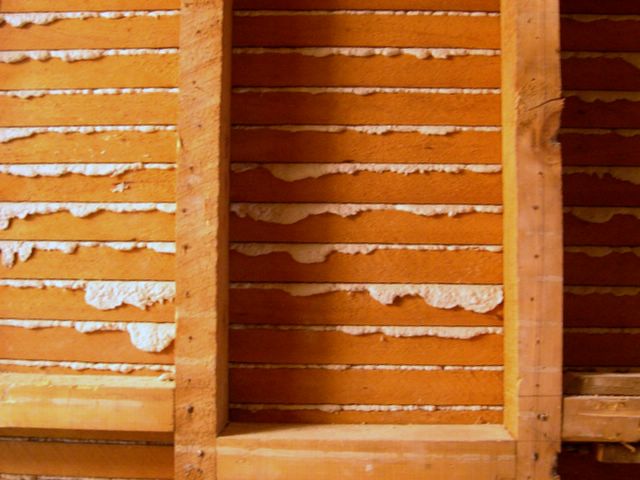
In three coat plastering it is standard to apply a second layer in the same fashion, leaving about 1⁄2 inch (13 mm) of rough, sandy plaster (called a brown coat or browning (UK)). A smooth, white finish coat goes on last. After the plaster is completely dry, the walls are ready to be painted. In this article's photo ("lath seen from the back...") the curls of plaster are called keys and are necessary to keep the plaster on the lath. Traditional lime based mortar/plaster often incorporates horsehair which reinforces the plasterwork, thereby helping to prevent the keys from breaking away.
In addition to wood lath, various types of metal lath began to be used toward the end of the 19th century. Metal lath is categorized according to weight, type of ribbing, and whether the lath is galvanized or not. Metal lathing was spaced across a 13.5-inch (340 mm) center, attached by tie wires using lathers' nippers. Sometimes, the mesh was dimpled to be self furring.
In use as early as 1900, rock lath (also known as "button board," "plaster board" or "gypsum-board lath"), is a type of gypsum wall board (essentially an early form of drywall) with holes spaced regularly to provide a 'key' for wet plaster. Rock lath was typically produced in sheets sized 2 by 4 feet (610 by 1,220 mm). The purpose of the four-foot length is so that the sheet of lath exactly spans three interstud voids (overlapping half a stud at each end of a four-stud sequence in standard construction), the studs themselves being spaced 16 inches (410 mm) apart on center (United States building code standard measurements). By the late 1930s, rock lath was the primary method used in residential plastering.
Hub AI
Lath and plaster AI simulator
(@Lath and plaster_simulator)
Lath and plaster
Lath and plaster is a building process used to finish mainly interior dividing walls and ceilings. It consists of narrow strips of wood (laths) which are nailed horizontally across the wall studs or ceiling joists and then coated in plaster. The technique derives from an earlier, more primitive process called wattle and daub.
Lath and plaster largely fell out of favour in the U.K. after the introduction of plasterboard in the 1930s. In Canada and the United States, wood lath and plaster remained in use until the process was replaced by transitional methods followed by drywall (the North American term for plasterboard) in the mid-twentieth century.[citation needed]
The wall or ceiling finishing process begins with wood or metal laths. These are narrow strips of wood, extruded metal, or split boards, nailed horizontally across the wall studs or ceiling joists. Each wall frame is covered in lath, tacked at the studs. Wood lath is typically about one inch (2.5 cm) wide by four feet (1.2 m) long by 1⁄4 inch (6 mm) thick. Each horizontal course of lath is spaced about 3⁄8 inch (9.5 mm) away from its neighboring courses. Metal lath is available in 27-inch (69 cm) by 8-foot (240 cm) sheets.
In Canada and the United States the laths were generally sawn, but in the United Kingdom and its colonies, riven or split hardwood laths of random lengths and sizes were often used. Early American examples featured split beam construction, as did examples put up in rural areas of the U.S. and Canada well into the second half of the 19th century. Splitting the timber along its grain greatly improved the laths' strength and durability. As Americans and Canadians expanded west, saw mills were not always available to create neatly planed boards and the first crop of buildings in any new western or northern settlement would be put up with split beam lath. In some areas of the U.K. reed mat was also used as a lath.
Temporary lath guides are then placed vertically to the wall, usually at the studs. Lime or gypsum plaster is then applied, typically using a wooden board as the application tool. The applier drags the board upward over the wall, forcing the plaster into the gaps between the lath and leaving a layer on the front the depth of the temporary guides, typically about 1⁄4 inch (6.4 mm). A helper feeds new plaster onto the board, as the plaster is applied in quantity. When the wall is fully covered, the vertical lath "guides" are removed, and their "slots" are filled in, leaving a fairly uniform undercoat.
In three coat plastering it is standard to apply a second layer in the same fashion, leaving about 1⁄2 inch (13 mm) of rough, sandy plaster (called a brown coat or browning (UK)). A smooth, white finish coat goes on last. After the plaster is completely dry, the walls are ready to be painted. In this article's photo ("lath seen from the back...") the curls of plaster are called keys and are necessary to keep the plaster on the lath. Traditional lime based mortar/plaster often incorporates horsehair which reinforces the plasterwork, thereby helping to prevent the keys from breaking away.
In addition to wood lath, various types of metal lath began to be used toward the end of the 19th century. Metal lath is categorized according to weight, type of ribbing, and whether the lath is galvanized or not. Metal lathing was spaced across a 13.5-inch (340 mm) center, attached by tie wires using lathers' nippers. Sometimes, the mesh was dimpled to be self furring.
In use as early as 1900, rock lath (also known as "button board," "plaster board" or "gypsum-board lath"), is a type of gypsum wall board (essentially an early form of drywall) with holes spaced regularly to provide a 'key' for wet plaster. Rock lath was typically produced in sheets sized 2 by 4 feet (610 by 1,220 mm). The purpose of the four-foot length is so that the sheet of lath exactly spans three interstud voids (overlapping half a stud at each end of a four-stud sequence in standard construction), the studs themselves being spaced 16 inches (410 mm) apart on center (United States building code standard measurements). By the late 1930s, rock lath was the primary method used in residential plastering.