
Recent from talks
Laudatio Turiae
Knowledge base stats:
Talk channels stats:
Members stats:
Laudatio Turiae
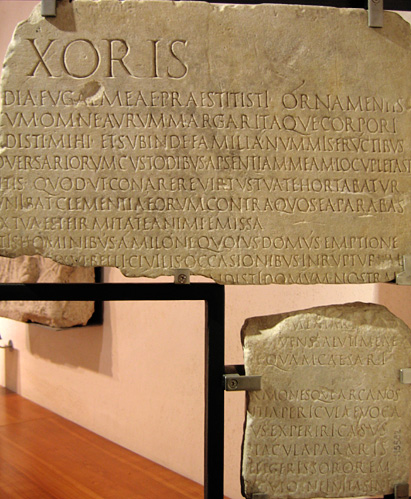
The laudatio Turiae (CIL VI, 41062; ILS 8393) is the modern name for a Latin inscription of the Roman Empire recording a speech given in the late 1st century BC – modern dates range between 9 and 6 BC – by an upper class Roman husband in eulogy of his wife. The speech details the matronal qualities of the wife, her perseverance in the aftermath of her family's death, how she saved the husband during the triumviral proscriptions of the late Republic, and their marriage. The speech was not necessarily given in public but was inscribed and put up around Rome.
Traditionally, following Theodor Mommsen, the deceased wife has been identified as Turia, the wife of the Quintus Lucretius Vespillo who was consul in 19 BC. This identification, however, is no longer widely accepted for lack of corroborating evidence.
The surviving portions of the laudatio start with a description of events prior the marriage. Substantial portions are missing. This summary ignores missing lines.
After the then-future wife was orphaned by the death of her parents in the countryside, she piously punished her parents' killers, defended her father's property, and lodged with the husband's mother. Even under such circumstances the wife successfully defended the inheritance, though the specific heirs have been disputed, in court against unnamed putative agnates who sought to force the estates into a guardianship. At the end of the civil war she then successfully petitioned Caesar for her to-be-husband's pardon so he could return to Italy.
The husband recites that the marriage lasted 41 years and praises the wife's faithfulness to her husband and his family, her skill at weaving, religious attentiveness, and modest dress. (These were the standard virtues of the Roman matron.) The husband also praises their joint administration of their estates, their good relations with the wife's sister, and the generosity of the families together.
During the proscriptions, the husband was one of the named victims; the wife gave him her jewellery and maintained him while he was in exile or in hiding without giving him up to the enemy. She entreated with the authorities for the husband's pardon and defended his properties, specifically a house purchased at the exile auction for Titus Annius Milo, from gangs who sought to loot it. Her pleas successful with the triumvir Octavian, she also went before Lepidus but was dragged from his tribunal with bruises. The husband commends how she persevered nevertheless to make safe her husband's civic status and thereby saved his life.
With peace restored, the couple desired children but were unable to conceive. The wife, seeking children for her husband, sought her own divorce so she could find for her husband a new wife with which he could conceive, saying that she would treat children of such a union as her own, act as a sister or mother-in-law to this new wife, and allow her husband to take her dowry into the new marriage. The husband refuses this plan, refusing to countenance a divorce from the wife who had so faithfully saved his life during the proscriptions. He regardless extols the generosity of this offer and her devotion to him.
Lamenting the wife's death, the husband wishes that he, who was the older, could have predeceased her and left everything to her. However in this time of grief he says he is strengthened by her memory and her resolve in life. He then promises that he will execute her final wishes faithfully and commends her to the protection of the manes.
Hub AI
Laudatio Turiae AI simulator
(@Laudatio Turiae_simulator)
Laudatio Turiae
The laudatio Turiae (CIL VI, 41062; ILS 8393) is the modern name for a Latin inscription of the Roman Empire recording a speech given in the late 1st century BC – modern dates range between 9 and 6 BC – by an upper class Roman husband in eulogy of his wife. The speech details the matronal qualities of the wife, her perseverance in the aftermath of her family's death, how she saved the husband during the triumviral proscriptions of the late Republic, and their marriage. The speech was not necessarily given in public but was inscribed and put up around Rome.
Traditionally, following Theodor Mommsen, the deceased wife has been identified as Turia, the wife of the Quintus Lucretius Vespillo who was consul in 19 BC. This identification, however, is no longer widely accepted for lack of corroborating evidence.
The surviving portions of the laudatio start with a description of events prior the marriage. Substantial portions are missing. This summary ignores missing lines.
After the then-future wife was orphaned by the death of her parents in the countryside, she piously punished her parents' killers, defended her father's property, and lodged with the husband's mother. Even under such circumstances the wife successfully defended the inheritance, though the specific heirs have been disputed, in court against unnamed putative agnates who sought to force the estates into a guardianship. At the end of the civil war she then successfully petitioned Caesar for her to-be-husband's pardon so he could return to Italy.
The husband recites that the marriage lasted 41 years and praises the wife's faithfulness to her husband and his family, her skill at weaving, religious attentiveness, and modest dress. (These were the standard virtues of the Roman matron.) The husband also praises their joint administration of their estates, their good relations with the wife's sister, and the generosity of the families together.
During the proscriptions, the husband was one of the named victims; the wife gave him her jewellery and maintained him while he was in exile or in hiding without giving him up to the enemy. She entreated with the authorities for the husband's pardon and defended his properties, specifically a house purchased at the exile auction for Titus Annius Milo, from gangs who sought to loot it. Her pleas successful with the triumvir Octavian, she also went before Lepidus but was dragged from his tribunal with bruises. The husband commends how she persevered nevertheless to make safe her husband's civic status and thereby saved his life.
With peace restored, the couple desired children but were unable to conceive. The wife, seeking children for her husband, sought her own divorce so she could find for her husband a new wife with which he could conceive, saying that she would treat children of such a union as her own, act as a sister or mother-in-law to this new wife, and allow her husband to take her dowry into the new marriage. The husband refuses this plan, refusing to countenance a divorce from the wife who had so faithfully saved his life during the proscriptions. He regardless extols the generosity of this offer and her devotion to him.
Lamenting the wife's death, the husband wishes that he, who was the older, could have predeceased her and left everything to her. However in this time of grief he says he is strengthened by her memory and her resolve in life. He then promises that he will execute her final wishes faithfully and commends her to the protection of the manes.
Recent media