


Community hub
Recent from talks
Knowledge base stats:
Talk channels stats:
Members stats:
Laue equations
In crystallography and solid state physics, the Laue equations relate incoming waves to outgoing waves in the process of elastic scattering, where the photon energy or light temporal frequency does not change upon scattering by a crystal lattice. They are named after physicist Max von Laue (1879–1960).
The Laue equations can be written as as the condition of elastic wave scattering by a crystal lattice, where is the scattering vector, , are incoming and outgoing wave vectors (to the crystal and from the crystal, by scattering), and is a crystal reciprocal lattice vector. Due to elastic scattering , three vectors. , , and , form a rhombus if the equation is satisfied. If the scattering satisfies this equation, all the crystal lattice points scatter the incoming wave toward the scattering direction (the direction along ). If the equation is not satisfied, then for any scattering direction, only some lattice points scatter the incoming wave. (This physical interpretation of the equation is based on the assumption that scattering at a lattice point is made in a way that the scattering wave and the incoming wave have the same phase at the point.) It also can be seen as the conservation of momentum as since is the wave vector for a plane wave associated with parallel crystal lattice planes. (Wavefronts of the plane wave are coincident with these lattice planes.)



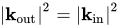


The equations are equivalent to Bragg's law; the Laue equations are vector equations while Bragg's law is in a form that is easier to solve, but these tell the same content.
Let be primitive translation vectors (shortly called primitive vectors) of a crystal lattice , where atoms are located at lattice points described by with , , and as any integers. (So indicating each lattice point is an integer linear combination of the primitive vectors.)





Let be the wave vector of an incoming (incident) beam or wave toward the crystal lattice , and let be the wave vector of an outgoing (diffracted) beam or wave from . Then the vector , called the scattering vector or transferred wave vector, measures the difference between the incoming and outgoing wave vectors.

The three conditions that the scattering vector must satisfy, called the Laue equations, are the following:
where numbers are integer numbers. Each choice of integers , called Miller indices, determines a scattering vector . Hence there are infinitely many scattering vectors that satisfy the Laue equations as there are infinitely many choices of Miller indices . Allowed scattering vectors form a lattice , called the reciprocal lattice of the crystal lattice , as each indicates a point of . (This is the meaning of the Laue equations as shown below.) This condition allows a single incident beam to be diffracted in infinitely many directions. However, the beams corresponding to high Miller indices are very weak and can't be observed. These equations are enough to find a basis of the reciprocal lattice (since each observed indicates a point of the reciprocal lattice of the crystal under the measurement), from which the crystal lattice can be determined. This is the principle of x-ray crystallography.


For an incident plane wave at a single frequency (and the angular frequency ) on a crystal, the diffracted waves from the crystal can be thought as the sum of outgoing plane waves from the crystal. (In fact, any wave can be represented as the sum of plane waves, see Fourier Optics.) The incident wave and one of plane waves of the diffracted wave are represented as


Hub AI
Laue equations AI simulator
(@Laue equations_simulator)
Laue equations
In crystallography and solid state physics, the Laue equations relate incoming waves to outgoing waves in the process of elastic scattering, where the photon energy or light temporal frequency does not change upon scattering by a crystal lattice. They are named after physicist Max von Laue (1879–1960).
The Laue equations can be written as as the condition of elastic wave scattering by a crystal lattice, where is the scattering vector, , are incoming and outgoing wave vectors (to the crystal and from the crystal, by scattering), and is a crystal reciprocal lattice vector. Due to elastic scattering , three vectors. , , and , form a rhombus if the equation is satisfied. If the scattering satisfies this equation, all the crystal lattice points scatter the incoming wave toward the scattering direction (the direction along ). If the equation is not satisfied, then for any scattering direction, only some lattice points scatter the incoming wave. (This physical interpretation of the equation is based on the assumption that scattering at a lattice point is made in a way that the scattering wave and the incoming wave have the same phase at the point.) It also can be seen as the conservation of momentum as since is the wave vector for a plane wave associated with parallel crystal lattice planes. (Wavefronts of the plane wave are coincident with these lattice planes.)
The equations are equivalent to Bragg's law; the Laue equations are vector equations while Bragg's law is in a form that is easier to solve, but these tell the same content.
Let be primitive translation vectors (shortly called primitive vectors) of a crystal lattice , where atoms are located at lattice points described by with , , and as any integers. (So indicating each lattice point is an integer linear combination of the primitive vectors.)
Let be the wave vector of an incoming (incident) beam or wave toward the crystal lattice , and let be the wave vector of an outgoing (diffracted) beam or wave from . Then the vector , called the scattering vector or transferred wave vector, measures the difference between the incoming and outgoing wave vectors.
The three conditions that the scattering vector must satisfy, called the Laue equations, are the following:
where numbers are integer numbers. Each choice of integers , called Miller indices, determines a scattering vector . Hence there are infinitely many scattering vectors that satisfy the Laue equations as there are infinitely many choices of Miller indices . Allowed scattering vectors form a lattice , called the reciprocal lattice of the crystal lattice , as each indicates a point of . (This is the meaning of the Laue equations as shown below.) This condition allows a single incident beam to be diffracted in infinitely many directions. However, the beams corresponding to high Miller indices are very weak and can't be observed. These equations are enough to find a basis of the reciprocal lattice (since each observed indicates a point of the reciprocal lattice of the crystal under the measurement), from which the crystal lattice can be determined. This is the principle of x-ray crystallography.
For an incident plane wave at a single frequency (and the angular frequency ) on a crystal, the diffracted waves from the crystal can be thought as the sum of outgoing plane waves from the crystal. (In fact, any wave can be represented as the sum of plane waves, see Fourier Optics.) The incident wave and one of plane waves of the diffracted wave are represented as