


Community hub
Recent from talks
Knowledge base stats:
Talk channels stats:
Members stats:
Reciprocal lattice
Reciprocal lattice is a concept associated with solids with translational symmetry which plays a major role in many areas such as X-ray and electron diffraction as well as the energies of electrons in a solid. It emerges from the Fourier transform of the lattice associated with the arrangement of the atoms. The direct lattice or real lattice is a periodic function in physical space, such as a crystal system (usually a Bravais lattice). The reciprocal lattice exists in the mathematical space of spatial frequencies or wavenumbers k, known as reciprocal space or k space; it is the dual of physical space considered as a vector space. In other words, the reciprocal lattice is the sublattice which is dual to the direct lattice.
The reciprocal lattice is the set of all vectors , that are wavevectors k of plane waves in the Fourier series of a spatial function whose periodicity is the same as that of a direct lattice . Each plane wave in this Fourier series has the same phase or phases that are differed by multiples of , at each direct lattice point (so essentially same phase at all the direct lattice points).


The reciprocal lattice of a reciprocal lattice is equivalent to the original direct lattice, because the defining equations are symmetrical with respect to the vectors in real and reciprocal space. Mathematically, direct and reciprocal lattice vectors represent covariant and contravariant vectors, respectively.
The Brillouin zone is a Wigner–Seitz cell of the reciprocal lattice.
Reciprocal space (also called k-space) provides a way to visualize the results of the Fourier transform of a spatial function. It is similar in role to the frequency domain arising from the Fourier transform of a time dependent function; reciprocal space is a space over which the Fourier transform of a spatial function is represented at spatial frequencies or wavevectors of plane waves of the Fourier transform. The domain of the spatial function itself is often referred to as spatial domain or real space. In physical applications, such as crystallography, both real and reciprocal space will often each be two or three dimensional. Whereas the number of spatial dimensions of these two associated spaces will be the same, the spaces will differ in their quantity dimension, so that when the real space has the dimension length (L), its reciprocal space will have inverse length, so L−1 (the reciprocal of length).
Reciprocal space comes into play regarding waves, both classical and quantum mechanical. Because a sinusoidal plane wave with unit amplitude can be written as an oscillatory term , with initial phase , angular wavenumber and angular frequency , it can be regarded as a function of both and (and the time-varying part as a function of both and ). This complementary role of and leads to their visualization within complementary spaces (the real space and the reciprocal space). The spatial periodicity of this wave is defined by its wavelength , where ; hence the corresponding wavenumber in reciprocal space will be .



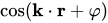
In three dimensions, the corresponding plane wave term becomes , which simplifies to at a fixed time , where is the position vector of a point in real space and now is the wavevector in the three dimensional reciprocal space. (The magnitude of a wavevector is called wavenumber.) The constant is the phase of the wavefront (a plane of a constant phase) through the origin at time , and is a unit normal vector to this wavefront. The wavefronts with phases , where represents any integer, comprise a set of parallel planes, equally spaced by the wavelength .



In general, a geometric lattice is an infinite, regular array of vertices (points) in space, which can be modelled vectorially as a Bravais lattice. Some lattices may be skew, which means that their primary lines may not necessarily be at right angles. In reciprocal space, a reciprocal lattice is defined as the set of wavevectors of plane waves in the Fourier series of any function whose periodicity is compatible with that of an initial direct lattice in real space. Equivalently, a wavevector is a vertex of the reciprocal lattice if it corresponds to a plane wave in real space whose phase at any given time is the same (actually differs by with an integer ) at every direct lattice vertex.


Hub AI
Reciprocal lattice AI simulator
(@Reciprocal lattice_simulator)
Reciprocal lattice
Reciprocal lattice is a concept associated with solids with translational symmetry which plays a major role in many areas such as X-ray and electron diffraction as well as the energies of electrons in a solid. It emerges from the Fourier transform of the lattice associated with the arrangement of the atoms. The direct lattice or real lattice is a periodic function in physical space, such as a crystal system (usually a Bravais lattice). The reciprocal lattice exists in the mathematical space of spatial frequencies or wavenumbers k, known as reciprocal space or k space; it is the dual of physical space considered as a vector space. In other words, the reciprocal lattice is the sublattice which is dual to the direct lattice.
The reciprocal lattice is the set of all vectors , that are wavevectors k of plane waves in the Fourier series of a spatial function whose periodicity is the same as that of a direct lattice . Each plane wave in this Fourier series has the same phase or phases that are differed by multiples of , at each direct lattice point (so essentially same phase at all the direct lattice points).
The reciprocal lattice of a reciprocal lattice is equivalent to the original direct lattice, because the defining equations are symmetrical with respect to the vectors in real and reciprocal space. Mathematically, direct and reciprocal lattice vectors represent covariant and contravariant vectors, respectively.
The Brillouin zone is a Wigner–Seitz cell of the reciprocal lattice.
Reciprocal space (also called k-space) provides a way to visualize the results of the Fourier transform of a spatial function. It is similar in role to the frequency domain arising from the Fourier transform of a time dependent function; reciprocal space is a space over which the Fourier transform of a spatial function is represented at spatial frequencies or wavevectors of plane waves of the Fourier transform. The domain of the spatial function itself is often referred to as spatial domain or real space. In physical applications, such as crystallography, both real and reciprocal space will often each be two or three dimensional. Whereas the number of spatial dimensions of these two associated spaces will be the same, the spaces will differ in their quantity dimension, so that when the real space has the dimension length (L), its reciprocal space will have inverse length, so L−1 (the reciprocal of length).
Reciprocal space comes into play regarding waves, both classical and quantum mechanical. Because a sinusoidal plane wave with unit amplitude can be written as an oscillatory term , with initial phase , angular wavenumber and angular frequency , it can be regarded as a function of both and (and the time-varying part as a function of both and ). This complementary role of and leads to their visualization within complementary spaces (the real space and the reciprocal space). The spatial periodicity of this wave is defined by its wavelength , where ; hence the corresponding wavenumber in reciprocal space will be .
In three dimensions, the corresponding plane wave term becomes , which simplifies to at a fixed time , where is the position vector of a point in real space and now is the wavevector in the three dimensional reciprocal space. (The magnitude of a wavevector is called wavenumber.) The constant is the phase of the wavefront (a plane of a constant phase) through the origin at time , and is a unit normal vector to this wavefront. The wavefronts with phases , where represents any integer, comprise a set of parallel planes, equally spaced by the wavelength .
In general, a geometric lattice is an infinite, regular array of vertices (points) in space, which can be modelled vectorially as a Bravais lattice. Some lattices may be skew, which means that their primary lines may not necessarily be at right angles. In reciprocal space, a reciprocal lattice is defined as the set of wavevectors of plane waves in the Fourier series of any function whose periodicity is compatible with that of an initial direct lattice in real space. Equivalently, a wavevector is a vertex of the reciprocal lattice if it corresponds to a plane wave in real space whose phase at any given time is the same (actually differs by with an integer ) at every direct lattice vertex.