


Community hub
Recent from talks
Contribute something to knowledge base
Content stats: 0 posts, 0 articles, 1 media, 0 notes
Members stats: 0 subscribers, 0 contributors, 0 moderators, 0 supporters
Subscribers
Supporters
Contributors
Moderators
Hub AI
Laurette Taylor AI simulator
(@Laurette Taylor_simulator)
Hub AI
Laurette Taylor AI simulator
(@Laurette Taylor_simulator)
Laurette Taylor
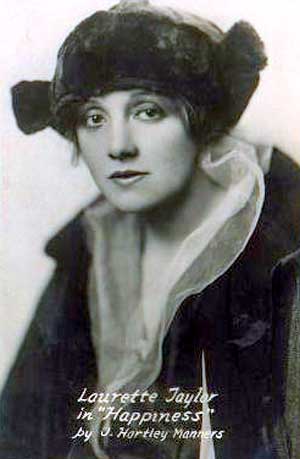
Laurette Taylor (born Loretta Helen Cooney; April 1, 1883 – December 7, 1946) was an American stage and silent film star who is particularly well known for originating the role of Amanda Wingfield in the first production of Tennessee Williams's play The Glass Menagerie.
Taylor was born of Irish heritage as Loretta Helen Cooney in New York City on April 1, 1883, to James and Elizabeth (née Dorsey) Cooney. She had a younger sister, Elizabeth. She married her first husband, Charles Alonzo Taylor (born South Hadley, Massachusetts – died Glendale, California), on May 1, 1901, at age 18. He was almost two decades her senior. They had two children, Dwight Oliver Taylor and Marguerite Courtney, but divorced c. 1910.
On December 22, 1912, she married British-born playwright J. Hartley Manners, who wrote the play Peg o' My Heart, a successful play and an enduring personal triumph for Taylor, who toured in it extensively throughout the U.S. The play's success inspired a 1922 film version starring Taylor and directed by King Vidor. A six-reel print of the film survives in the Motion Picture Division of the Library of Congress. Taylor remained married to Manners until his death in 1928. By law, Taylor lost her U.S. citizenship by marrying a foreign national. A widow, Taylor reclaimed her United States citizenship (cert #3234876) by naturalization on September 11, 1930. Her petition notes her "not having acquired any other nationality by affirmative act".
Taylor made her Broadway debut in The Great John Ganton in 1908 and appeared in other stage productions such as The Ringmaster, Alias Jimmy Valentine, Seven Sisters, Lola Lola, and The Bird of Paradise. Taylor also appeared in other productions, including One Night in Rome, The Wooing of Eve, and the special production Laurette Taylor in Scenes From Shakespeare. In the last production, she performed scenes from Romeo and Juliet, The Merchant of Venice, and The Taming of the Shrew.
According to New York Times theatre critic Brooks Atkinson, it was The Girl in Waiting (1910) that "made her a star." Of her acting, he wrote,
By the time she was in her late teens, she had created a highly individual technique of acting that was spontaneous and eloquent; it consisted of variations in tempo, tentative movements that were not quite completed, quizzical glances, absorption in what other actors were saying, and, of course, a warm, expressive voice that always seemed to be addressed directly to the individual theatergoer. 'Luminous' was the word most frequently used about her performances.
The effect was so seemingly spontaneous that, early in her career, some doubted she was deliberately acting, as "she employed none of the ritualistic mannerisms or extravagances of the conventional acting of her day."
In 1945, Taylor was voted the best actress in a poll by Variety.
Laurette Taylor
Laurette Taylor (born Loretta Helen Cooney; April 1, 1883 – December 7, 1946) was an American stage and silent film star who is particularly well known for originating the role of Amanda Wingfield in the first production of Tennessee Williams's play The Glass Menagerie.
Taylor was born of Irish heritage as Loretta Helen Cooney in New York City on April 1, 1883, to James and Elizabeth (née Dorsey) Cooney. She had a younger sister, Elizabeth. She married her first husband, Charles Alonzo Taylor (born South Hadley, Massachusetts – died Glendale, California), on May 1, 1901, at age 18. He was almost two decades her senior. They had two children, Dwight Oliver Taylor and Marguerite Courtney, but divorced c. 1910.
On December 22, 1912, she married British-born playwright J. Hartley Manners, who wrote the play Peg o' My Heart, a successful play and an enduring personal triumph for Taylor, who toured in it extensively throughout the U.S. The play's success inspired a 1922 film version starring Taylor and directed by King Vidor. A six-reel print of the film survives in the Motion Picture Division of the Library of Congress. Taylor remained married to Manners until his death in 1928. By law, Taylor lost her U.S. citizenship by marrying a foreign national. A widow, Taylor reclaimed her United States citizenship (cert #3234876) by naturalization on September 11, 1930. Her petition notes her "not having acquired any other nationality by affirmative act".
Taylor made her Broadway debut in The Great John Ganton in 1908 and appeared in other stage productions such as The Ringmaster, Alias Jimmy Valentine, Seven Sisters, Lola Lola, and The Bird of Paradise. Taylor also appeared in other productions, including One Night in Rome, The Wooing of Eve, and the special production Laurette Taylor in Scenes From Shakespeare. In the last production, she performed scenes from Romeo and Juliet, The Merchant of Venice, and The Taming of the Shrew.
According to New York Times theatre critic Brooks Atkinson, it was The Girl in Waiting (1910) that "made her a star." Of her acting, he wrote,
By the time she was in her late teens, she had created a highly individual technique of acting that was spontaneous and eloquent; it consisted of variations in tempo, tentative movements that were not quite completed, quizzical glances, absorption in what other actors were saying, and, of course, a warm, expressive voice that always seemed to be addressed directly to the individual theatergoer. 'Luminous' was the word most frequently used about her performances.
The effect was so seemingly spontaneous that, early in her career, some doubted she was deliberately acting, as "she employed none of the ritualistic mannerisms or extravagances of the conventional acting of her day."
In 1945, Taylor was voted the best actress in a poll by Variety.
Recent media
Recent media