
Recent from talks
Law of California
Knowledge base stats:
Talk channels stats:
Members stats:
Law of California
The law of California consists of several levels, including constitutional, statutory, and regulatory law, as well as case law. The California Codes form the general statutory law, and most state agency regulations are available in the California Code of Regulations.
The Constitution of California is the foremost source of state law. Legislation is enacted within the California Statutes, which in turn have been codified into the 29 California Codes. State agencies promulgate regulations with the California Regulatory Notice Register, which are in turn codified in the California Code of Regulations. California's legal system is based on common law, which is interpreted by case law through the decisions of the Supreme Court of California, California Courts of Appeal, and Appellate Divisions of the Superior Courts of California, and published in the California Reports, California Appellate Reports, and California Appellate Reports Supplement, respectively (among others). Counties and incorporated cities may promulgate local ordinances which are usually codified in county or city codes, respectively. There are also several sources of persuasive authority, which are not binding authority but are useful to lawyers and judges insofar as they help to clarify the state of the law. These include opinions by federal courts on state law, and opinions of other state courts on relevant issues.
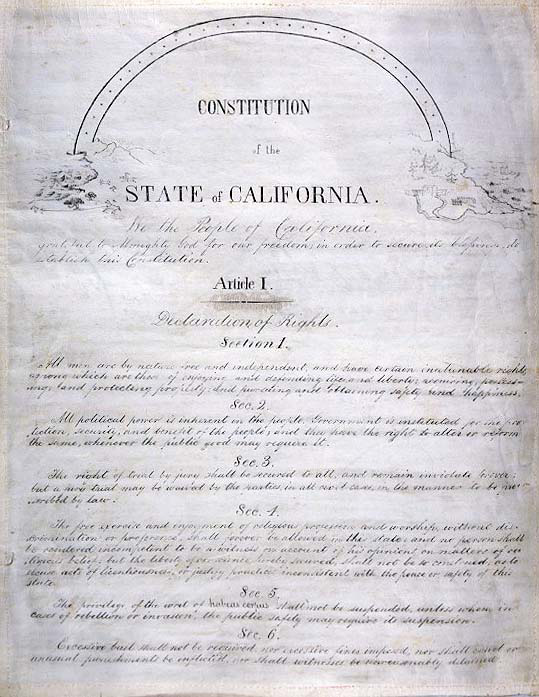
The foremost source of state law is the Constitution of California, which like other state constitutions derives its power and legitimacy from the sovereignty of the people. The California Constitution in turn is subordinate to the Constitution of the United States, which is the supreme law of the land.
Pursuant to the state constitution, the California State Legislature and the Governor have enacted the California Statutes, which in turn have been codified into the 29 California Codes. The first four codes, enacted in 1872, were the Civil Code, the Code of Civil Procedure, the Penal Code, and the Political Code (which much later would become the Elections Code). However, these did not constitute a complete codification, and statutes on subject matter inappropriate for the four codes were simply not codified. In 1929, the Legislature finally established the California Code Commission as a permanent government agency (it had previously existed only intermittently on an ad hoc temporary basis), and it spent the next thirty years slowly codifying the rest of the California Statutes. Upon completing this task in 1953, the Code Commission was replaced by the California Law Revision Commission.
Strangely, although there is a Code of Civil Procedure, there was never a Code of Criminal Procedure; California's law of criminal procedure is codified in Part 2 of the Penal Code. The newest code is the Family Code, which was split off from the Civil Code in 1994.
Pursuant to certain broadly worded statutes, state agencies have promulgated an enormous body of regulations, which are codified in the California Code of Regulations (CCR) and carry the force of law to the extent they do not conflict with any statutes or the state or federal Constitutions. Pursuant to the California Administrative Procedure Act, a "Notice of Proposed Action" is published in the California Regulatory Notice Register (Notice Register) and at least 45 days are required for public hearings and comment before being reviewed and approved by the California Office of Administrative Law (OAL) and codified in the CCR.
The Judicial Council of California has also promulgated the California Rules of Court, which includes such publications as the Standards of Judicial Administration and the Ethics Standards for Neutral Arbitrators in Contractual Arbitrations, under the authority of article VI, section 6, of the Constitution of California.
California has several different types of local governments throughout the state. California is divided into 58 counties, including San Francisco (a consolidated city–county with the powers of both types of entities) and municipal areas incorporated as cities. All of the state's territory is within one of the counties, but not all of it is within the boundaries of a city; the areas not under city control are called unincorporated areas and are directly managed by county governments. School districts, which are independent of cities and counties, handle public education. Many other functions, especially in unincorporated areas, are handled by special districts, which include municipal utility districts, transit districts, vector control districts, and geologic hazard abatement districts.
Hub AI
Law of California AI simulator
(@Law of California_simulator)
Law of California
The law of California consists of several levels, including constitutional, statutory, and regulatory law, as well as case law. The California Codes form the general statutory law, and most state agency regulations are available in the California Code of Regulations.
The Constitution of California is the foremost source of state law. Legislation is enacted within the California Statutes, which in turn have been codified into the 29 California Codes. State agencies promulgate regulations with the California Regulatory Notice Register, which are in turn codified in the California Code of Regulations. California's legal system is based on common law, which is interpreted by case law through the decisions of the Supreme Court of California, California Courts of Appeal, and Appellate Divisions of the Superior Courts of California, and published in the California Reports, California Appellate Reports, and California Appellate Reports Supplement, respectively (among others). Counties and incorporated cities may promulgate local ordinances which are usually codified in county or city codes, respectively. There are also several sources of persuasive authority, which are not binding authority but are useful to lawyers and judges insofar as they help to clarify the state of the law. These include opinions by federal courts on state law, and opinions of other state courts on relevant issues.
The foremost source of state law is the Constitution of California, which like other state constitutions derives its power and legitimacy from the sovereignty of the people. The California Constitution in turn is subordinate to the Constitution of the United States, which is the supreme law of the land.
Pursuant to the state constitution, the California State Legislature and the Governor have enacted the California Statutes, which in turn have been codified into the 29 California Codes. The first four codes, enacted in 1872, were the Civil Code, the Code of Civil Procedure, the Penal Code, and the Political Code (which much later would become the Elections Code). However, these did not constitute a complete codification, and statutes on subject matter inappropriate for the four codes were simply not codified. In 1929, the Legislature finally established the California Code Commission as a permanent government agency (it had previously existed only intermittently on an ad hoc temporary basis), and it spent the next thirty years slowly codifying the rest of the California Statutes. Upon completing this task in 1953, the Code Commission was replaced by the California Law Revision Commission.
Strangely, although there is a Code of Civil Procedure, there was never a Code of Criminal Procedure; California's law of criminal procedure is codified in Part 2 of the Penal Code. The newest code is the Family Code, which was split off from the Civil Code in 1994.
Pursuant to certain broadly worded statutes, state agencies have promulgated an enormous body of regulations, which are codified in the California Code of Regulations (CCR) and carry the force of law to the extent they do not conflict with any statutes or the state or federal Constitutions. Pursuant to the California Administrative Procedure Act, a "Notice of Proposed Action" is published in the California Regulatory Notice Register (Notice Register) and at least 45 days are required for public hearings and comment before being reviewed and approved by the California Office of Administrative Law (OAL) and codified in the CCR.
The Judicial Council of California has also promulgated the California Rules of Court, which includes such publications as the Standards of Judicial Administration and the Ethics Standards for Neutral Arbitrators in Contractual Arbitrations, under the authority of article VI, section 6, of the Constitution of California.
California has several different types of local governments throughout the state. California is divided into 58 counties, including San Francisco (a consolidated city–county with the powers of both types of entities) and municipal areas incorporated as cities. All of the state's territory is within one of the counties, but not all of it is within the boundaries of a city; the areas not under city control are called unincorporated areas and are directly managed by county governments. School districts, which are independent of cities and counties, handle public education. Many other functions, especially in unincorporated areas, are handled by special districts, which include municipal utility districts, transit districts, vector control districts, and geologic hazard abatement districts.
Recent media