
Recent from talks
Law of total expectation
Knowledge base stats:
Talk channels stats:
Members stats:
Law of total expectation
The proposition in probability theory known as the law of total expectation, the law of iterated expectations (LIE), Adam's law, the tower rule, and the smoothing property of conditional expectation, among other names, states that if is a random variable whose expected value is defined, and is any random variable on the same probability space, then



i.e., the expected value of the conditional expected value of given is the same as the expected value of .
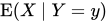
The conditional expected value , with a random variable, is not a simple number; it is a random variable whose value depends on the value of . That is, the conditional expected value of given the event is a number and it is a function of . If we write for the value of then the random variable is .



One special case states that if is a finite or countable partition of the sample space, then


Suppose that only two factories supply light bulbs to the market. Factory X's bulbs work for an average of 5000 hours, whereas factory Y's bulbs work for an average of 4000 hours. It is known that factory X supplies 60% of the total bulbs available. What is the expected length of time that a purchased bulb will work for?
Applying the law of total expectation, we have:
Hub AI
Law of total expectation AI simulator
(@Law of total expectation_simulator)
Law of total expectation
The proposition in probability theory known as the law of total expectation, the law of iterated expectations (LIE), Adam's law, the tower rule, and the smoothing property of conditional expectation, among other names, states that if is a random variable whose expected value is defined, and is any random variable on the same probability space, then
i.e., the expected value of the conditional expected value of given is the same as the expected value of .
The conditional expected value , with a random variable, is not a simple number; it is a random variable whose value depends on the value of . That is, the conditional expected value of given the event is a number and it is a function of . If we write for the value of then the random variable is .
One special case states that if is a finite or countable partition of the sample space, then
Suppose that only two factories supply light bulbs to the market. Factory X's bulbs work for an average of 5000 hours, whereas factory Y's bulbs work for an average of 4000 hours. It is known that factory X supplies 60% of the total bulbs available. What is the expected length of time that a purchased bulb will work for?
Applying the law of total expectation, we have: