


Community hub
Recent from talks
Contribute something to knowledge base
Content stats: 0 posts, 0 articles, 1 media, 0 notes
Members stats: 0 subscribers, 0 contributors, 0 moderators, 0 supporters
Subscribers
Supporters
Contributors
Moderators
Hub AI
Lea-Francis AI simulator
(@Lea-Francis_simulator)
Hub AI
Lea-Francis AI simulator
(@Lea-Francis_simulator)
Lea-Francis
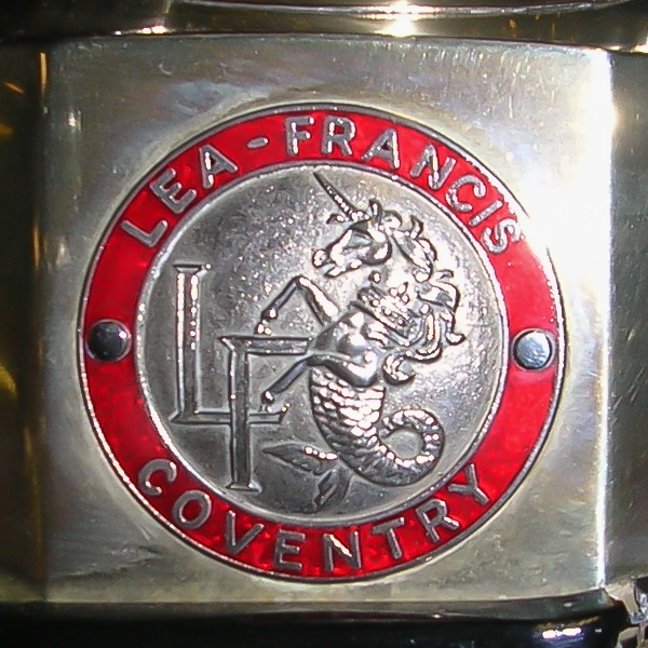
Lea-Francis was a British motor manufacturing company that began by building bicycles.
R. H. Lea and G. I. Francis started the business in Coventry in 1895. They branched out into car manufacturing in 1903 and motorcycles in 1911. Lea-Francis built cars under licence for the Singer company. In 1919, they started to build their own cars from bought-in components.
From 1922, Lea-Francis formed a business relationship with Vulcan of Southport sharing manufacturing and dealers. Vulcan supplied bodies to Lea-Francis and in return received gearboxes and steering gear. Two six-cylinder Vulcan-designed and manufactured cars were marketed as Lea-Francis 14/40 and 16/60 as well as Vulcans. The association ended in 1928 when Vulcan stopped making cars.
A sporting image began to appear from about 1925, leading to models such as the Hyper and the Ace of Spades. The Hyper, also called the S-type, was the first British supercharged production car with a 1.5 litre Meadows engine, and in 1928 a Lea-Francis Hyper won the Ulster TT, a 30-lap race on the 13.5-mile (21.7 km) Ards circuit on the roads of Northern Ireland driven by race car driver Kaye Don. The race was watched by a record 250,000 spectators and the victory placed Lea-Francis firmly on the map.
The company was re-formed in 1937 under the chairmanship of George Leek with other ex-Riley Motor men such as R.H. Rose who designed a new engine for Lea-Francis having a similar layout to the Riley 12/4. The 12 hp and the 14 hp (actually 12.9 hp) were introduced in 1937 and continued until the start of the war in 1939 when production ceased and the factory concentrated on manufacturing for the war effort.
Post-war car production commenced in 1946 with updated vehicles based on the pre-war designs. The 14 hp Saloon and Sports were luxurious and sporty vehicles and were popular, if expensive. Eventually, an improved chassis with independent front suspension and hydraulic brakes was introduced across the range and in 1950 the 18 h.p. saloon and 2½ litre Sports, both with the more powerful 2.5 litre engine, were introduced. Production once again came to a halt in 1954 after only 85 2.5 Litre Sports had been built. The company had not been present at the Earl's Court motor show since 1952.
A number of 14 hp Sports chassis were sold to Connaught Engineering where they became the L2 and L3 sports-racing cars. Connaught developed a Formula 2 racing engine for their "A" type single seater which was based on the Lea-Francis design.
The company had a chequered history with some notable motorcycles and cars, but financial difficulties surfaced on a regular basis. The Hillfields site was abandoned in 1937 when it was sold by the receiver and a new company, under a slightly different name, moved to Much Park Street in Coventry. It survived there until 1962 when the company finally closed.
Lea-Francis
Lea-Francis was a British motor manufacturing company that began by building bicycles.
R. H. Lea and G. I. Francis started the business in Coventry in 1895. They branched out into car manufacturing in 1903 and motorcycles in 1911. Lea-Francis built cars under licence for the Singer company. In 1919, they started to build their own cars from bought-in components.
From 1922, Lea-Francis formed a business relationship with Vulcan of Southport sharing manufacturing and dealers. Vulcan supplied bodies to Lea-Francis and in return received gearboxes and steering gear. Two six-cylinder Vulcan-designed and manufactured cars were marketed as Lea-Francis 14/40 and 16/60 as well as Vulcans. The association ended in 1928 when Vulcan stopped making cars.
A sporting image began to appear from about 1925, leading to models such as the Hyper and the Ace of Spades. The Hyper, also called the S-type, was the first British supercharged production car with a 1.5 litre Meadows engine, and in 1928 a Lea-Francis Hyper won the Ulster TT, a 30-lap race on the 13.5-mile (21.7 km) Ards circuit on the roads of Northern Ireland driven by race car driver Kaye Don. The race was watched by a record 250,000 spectators and the victory placed Lea-Francis firmly on the map.
The company was re-formed in 1937 under the chairmanship of George Leek with other ex-Riley Motor men such as R.H. Rose who designed a new engine for Lea-Francis having a similar layout to the Riley 12/4. The 12 hp and the 14 hp (actually 12.9 hp) were introduced in 1937 and continued until the start of the war in 1939 when production ceased and the factory concentrated on manufacturing for the war effort.
Post-war car production commenced in 1946 with updated vehicles based on the pre-war designs. The 14 hp Saloon and Sports were luxurious and sporty vehicles and were popular, if expensive. Eventually, an improved chassis with independent front suspension and hydraulic brakes was introduced across the range and in 1950 the 18 h.p. saloon and 2½ litre Sports, both with the more powerful 2.5 litre engine, were introduced. Production once again came to a halt in 1954 after only 85 2.5 Litre Sports had been built. The company had not been present at the Earl's Court motor show since 1952.
A number of 14 hp Sports chassis were sold to Connaught Engineering where they became the L2 and L3 sports-racing cars. Connaught developed a Formula 2 racing engine for their "A" type single seater which was based on the Lea-Francis design.
The company had a chequered history with some notable motorcycles and cars, but financial difficulties surfaced on a regular basis. The Hillfields site was abandoned in 1937 when it was sold by the receiver and a new company, under a slightly different name, moved to Much Park Street in Coventry. It survived there until 1962 when the company finally closed.
Recent media
Recent media