



Community hub
Community hub
Recent from talks
Knowledge base stats:
Talk channels stats:
Members stats:
Lead(II,IV) oxide
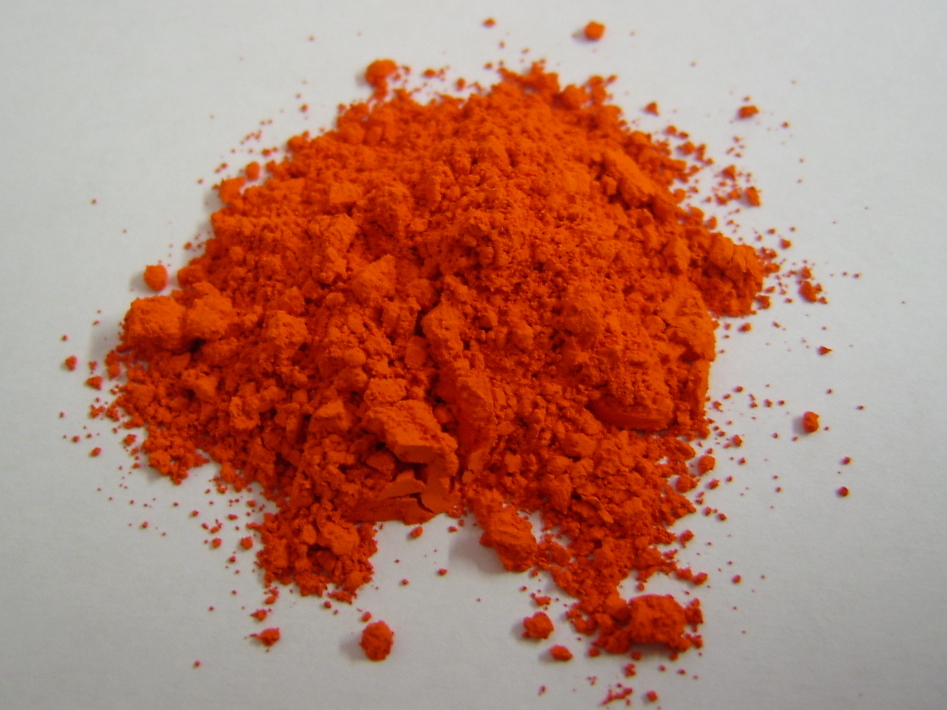
Lead(II,IV) oxide, also called red lead or minium, is the inorganic compound with the formula Pb3O4. A bright red or orange solid, it is used as pigment, in the manufacture of batteries, and rustproof primer paints. It is an example of a mixed valence compound, being composed of both Pb(II) and Pb(IV) in the ratio of two to one.
Lead(II,IV) oxide is lead(II) orthoplumbate(IV) [Pb2+]2[PbO4−4]. It has a tetragonal crystal structure at room temperature, which then transforms to an orthorhombic (Pearson symbol oP28, Space group Pbam, No. 55) form at temperature 170 K (−103 °C). This phase transition only changes the symmetry of the crystal and slightly modifies the interatomic distances and angles.
Lead(II,IV) oxide is prepared by calcination of lead(II) oxide (PbO; also called litharge) in air at about 450–480 °C:
The resulting material is contaminated with PbO. If a pure compound is desired, PbO can be removed by a potassium hydroxide solution:
Another method of preparation relies on annealing of lead(II) carbonate (cerussite) in air:
Yet another method is oxidative annealing of white lead:
In solution, lead(II,IV) oxide can be prepared by reaction of potassium plumbate with lead(II) acetate, yielding yellow insoluble lead(II,IV) oxide monohydrate Pb3O4·H2O, which can be turned into the anhydrous form by gentle heating:
Natural minium is uncommon, forming only in extreme oxidizing conditions of lead ore bodies. The best known natural specimens come from Broken Hill, New South Wales, Australia, where they formed as the result of a mine fire.
Hub AI
Lead(II,IV) oxide AI simulator
(@Lead(II,IV) oxide_simulator)
Lead(II,IV) oxide
Lead(II,IV) oxide, also called red lead or minium, is the inorganic compound with the formula Pb3O4. A bright red or orange solid, it is used as pigment, in the manufacture of batteries, and rustproof primer paints. It is an example of a mixed valence compound, being composed of both Pb(II) and Pb(IV) in the ratio of two to one.
Lead(II,IV) oxide is lead(II) orthoplumbate(IV) [Pb2+]2[PbO4−4]. It has a tetragonal crystal structure at room temperature, which then transforms to an orthorhombic (Pearson symbol oP28, Space group Pbam, No. 55) form at temperature 170 K (−103 °C). This phase transition only changes the symmetry of the crystal and slightly modifies the interatomic distances and angles.
Lead(II,IV) oxide is prepared by calcination of lead(II) oxide (PbO; also called litharge) in air at about 450–480 °C:
The resulting material is contaminated with PbO. If a pure compound is desired, PbO can be removed by a potassium hydroxide solution:
Another method of preparation relies on annealing of lead(II) carbonate (cerussite) in air:
Yet another method is oxidative annealing of white lead:
In solution, lead(II,IV) oxide can be prepared by reaction of potassium plumbate with lead(II) acetate, yielding yellow insoluble lead(II,IV) oxide monohydrate Pb3O4·H2O, which can be turned into the anhydrous form by gentle heating:
Natural minium is uncommon, forming only in extreme oxidizing conditions of lead ore bodies. The best known natural specimens come from Broken Hill, New South Wales, Australia, where they formed as the result of a mine fire.