



Community hub
Recent from talks
Contribute something to knowledge base
Content stats: 0 posts, 0 articles, 1 media, 0 notes
Members stats: 0 subscribers, 0 contributors, 0 moderators, 0 supporters
Subscribers
Supporters
Contributors
Moderators
Hub AI
Lenzburg Castle AI simulator
(@Lenzburg Castle_simulator)
Hub AI
Lenzburg Castle AI simulator
(@Lenzburg Castle_simulator)
Lenzburg Castle
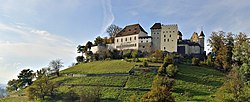
Lenzburg Castle (German: Schloss Lenzburg) is a castle located above the old part of the town of Lenzburg in the Canton of Aargau, Switzerland. It ranks among the oldest and most important of Switzerland. The castle stands on the almost circular castle hill (altitude: 504 m), which rises approximately 100 m (330 ft) over the surrounding plain but is only about 250 m (820 ft) in diameter. The oldest parts of the castle date to the 11th century, when the Counts of Lenzburg built it as their seat. The castle, its historical museum and the castle hill with its Neolithic burial grounds are listed as heritage sites of national significance.
The prominent hill was already a settlement site in prehistoric times. For example, in 1959 a Neolithic gravesite was uncovered in the carpark. There have also been small discoveries from the Roman and Alemannic eras.
A legend tells that there was once a dragon living in a cave in the hillside, who was defeated by two knights, Wolfram and Guntram. The grateful people made the two Counts of Lenzburg and gave them permission to build a castle on the hilltop.[citation needed]
A charter dated 1036 names one Ulrich, Count of Aargau. He was the Emperor's Vogt in Zürich and overseer of the abbeys of Beromünster and Schänis. The first definite record of the existence of a castle dates to 1077: Ulrich's grandson, also Ulrich, had taken the emperor's position in the Investiture Controversy and imprisoned two Papal legates for half a year. At that time the Counts of Lenzburg were among the most important feudal lords on the Swiss plateau and maintained close connections to the emperor.
The line died out in 1173. Ulrich IV, the last Count of Lenzburg, named Emperor Friedrich I Barbarossa as his personal heir in his will; they had been on the Second Crusade together. The emperor came to Lenzburg Castle and personally supervised the division of the estate, giving a majority of the lands to his son, the Count palatine Otto of Burgundy. However, after Otto's death in 1200, the House of Hohenstaufen was forced to withdraw from the Aargau. By way of two neighbouring aristocratic houses (Andechs-Merania and Chalon), in about 1230 Lenzburg castle came by marriage into the possession of the Counts of Kyburg. They then founded a fortified market settlement at the western base of the castle hill, today's town of Lenzburg.
Hartmann, the last Count of Kyburg, died in 1264 without male issue. Rudolph I, Count of Habsburg and later King of the Romans, placed the heir, Anna of Kyburg, under his protection and she later married Eberhard I of Habsburg-Laufenburg. In 1273 Rudolph took possession of the estate from his impoverished relatives and in 1275 held court there. However, the castle then declined into a regional seat of government, as the power of the Habsburgs shifted more and more to Austria. On 20 August 1306, Lenzburg received its charter as a town from Count Frederick the Fair. From 1339 on, Count Frederick II of Tyrol-Austria resided at the castle. He was to have married a daughter of King Edward III of England and had the Knights' Hall built for the purpose, but died in 1344 without ever seeing his bride, and the building remained incomplete. After 1369, the Schultheiss-Ribi family were tenants of the castle. In 1375 the castle underwent a siege by the Gugler.
The latent tensions between Sigismund, King of Germany and Frederick IV, Duke of Austria exploded in 1415 at the Council of Constance, when Frederick assisted one of the three then reigning popes, Antipope John XXIII, in escaping from the town. Sigismund took the opportunity to harm his opponent, ordering his neighbours to seize his lands in the name of the Empire. Bern willingly conquered the western part of the Aargau.
The town of Lenzburg immediately surrendered to the advancing army on 20 April, but the castle for the moment remained untouched by the conflict. Konrad of Weinsberg, the king's representative, attempted to secure it for the Empire and had it prepared for a siege. But by August he saw the futility of this plan and in 1418 returned the castle to the control of the Schultheiss family. After lengthy negotiations, Bern was able to secure control of the County of Lenzburg as subtenants in 1433 and finally in 1442 of the castle.
Lenzburg Castle
Lenzburg Castle (German: Schloss Lenzburg) is a castle located above the old part of the town of Lenzburg in the Canton of Aargau, Switzerland. It ranks among the oldest and most important of Switzerland. The castle stands on the almost circular castle hill (altitude: 504 m), which rises approximately 100 m (330 ft) over the surrounding plain but is only about 250 m (820 ft) in diameter. The oldest parts of the castle date to the 11th century, when the Counts of Lenzburg built it as their seat. The castle, its historical museum and the castle hill with its Neolithic burial grounds are listed as heritage sites of national significance.
The prominent hill was already a settlement site in prehistoric times. For example, in 1959 a Neolithic gravesite was uncovered in the carpark. There have also been small discoveries from the Roman and Alemannic eras.
A legend tells that there was once a dragon living in a cave in the hillside, who was defeated by two knights, Wolfram and Guntram. The grateful people made the two Counts of Lenzburg and gave them permission to build a castle on the hilltop.[citation needed]
A charter dated 1036 names one Ulrich, Count of Aargau. He was the Emperor's Vogt in Zürich and overseer of the abbeys of Beromünster and Schänis. The first definite record of the existence of a castle dates to 1077: Ulrich's grandson, also Ulrich, had taken the emperor's position in the Investiture Controversy and imprisoned two Papal legates for half a year. At that time the Counts of Lenzburg were among the most important feudal lords on the Swiss plateau and maintained close connections to the emperor.
The line died out in 1173. Ulrich IV, the last Count of Lenzburg, named Emperor Friedrich I Barbarossa as his personal heir in his will; they had been on the Second Crusade together. The emperor came to Lenzburg Castle and personally supervised the division of the estate, giving a majority of the lands to his son, the Count palatine Otto of Burgundy. However, after Otto's death in 1200, the House of Hohenstaufen was forced to withdraw from the Aargau. By way of two neighbouring aristocratic houses (Andechs-Merania and Chalon), in about 1230 Lenzburg castle came by marriage into the possession of the Counts of Kyburg. They then founded a fortified market settlement at the western base of the castle hill, today's town of Lenzburg.
Hartmann, the last Count of Kyburg, died in 1264 without male issue. Rudolph I, Count of Habsburg and later King of the Romans, placed the heir, Anna of Kyburg, under his protection and she later married Eberhard I of Habsburg-Laufenburg. In 1273 Rudolph took possession of the estate from his impoverished relatives and in 1275 held court there. However, the castle then declined into a regional seat of government, as the power of the Habsburgs shifted more and more to Austria. On 20 August 1306, Lenzburg received its charter as a town from Count Frederick the Fair. From 1339 on, Count Frederick II of Tyrol-Austria resided at the castle. He was to have married a daughter of King Edward III of England and had the Knights' Hall built for the purpose, but died in 1344 without ever seeing his bride, and the building remained incomplete. After 1369, the Schultheiss-Ribi family were tenants of the castle. In 1375 the castle underwent a siege by the Gugler.
The latent tensions between Sigismund, King of Germany and Frederick IV, Duke of Austria exploded in 1415 at the Council of Constance, when Frederick assisted one of the three then reigning popes, Antipope John XXIII, in escaping from the town. Sigismund took the opportunity to harm his opponent, ordering his neighbours to seize his lands in the name of the Empire. Bern willingly conquered the western part of the Aargau.
The town of Lenzburg immediately surrendered to the advancing army on 20 April, but the castle for the moment remained untouched by the conflict. Konrad of Weinsberg, the king's representative, attempted to secure it for the Empire and had it prepared for a siege. But by August he saw the futility of this plan and in 1418 returned the castle to the control of the Schultheiss family. After lengthy negotiations, Bern was able to secure control of the County of Lenzburg as subtenants in 1433 and finally in 1442 of the castle.
Recent media
Recent media