Hubbry Logo
SiegeSiegeMain
Open search
Siege
Community hub
Siege
logo
8 pages, 0 posts
0 subscribers
Be the first to start a discussion here.
Contribute something
Siege
Siege
from Wikipedia

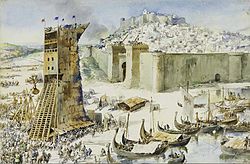
Depiction of the 1147 siege of Lisbon, painting by Alfredo Roque Gameiro (1917)

A siege (from Latin sedere 'to sit')[1] is a military blockade of a city, or fortress, with the intent of conquering by attrition, or by well-prepared assault. Siege warfare (also called siegecraft or poliorcetics) is a form of constant, low-intensity conflict characterized by one party holding a strong, static, defensive position. The attacking party is said to be laying siege. Consequently, an opportunity for negotiation between combatants is common, as proximity and fluctuating advantage can encourage diplomacy.

A siege occurs when an attacker encounters a city or fortress that cannot be easily taken by a quick assault, and which refuses to surrender. Sieges involve surrounding the target to block provision of supplies and reinforcement or escape of troops (a tactic known as "investment").[2] This is typically coupled with attempts to reduce the fortifications by means of siege engines, artillery bombardment, or mining (also known as sapping), or the use of deception or treachery to bypass defenses.

Failing a military outcome, sieges can often be decided by starvation, thirst, or disease, which can afflict either the attacker or defender. This form of siege, though, can take many months or even years, depending upon the size of the stores of food the fortified position holds. The attacking force can circumvallate the besieged place, which is to build a line of earth-works, consisting of a rampart and trench, surrounding it. During the process of circumvallation, the attacking force can be set upon by another force, an ally of the besieged place, due to the lengthy amount of time required to force it to capitulate. A defensive ring of forts outside the ring of circumvallated forts, called contravallation, is also sometimes used to defend the attackers from outside.

The siege of Rancagua during the Chilean War of Independence, painting by Pedro Subercaseaux

Ancient cities in the Middle East show archaeological evidence of fortified city walls. During the Warring States period of ancient China, there is both textual and archaeological evidence of prolonged sieges and siege machinery used against the defenders of city walls. Siege machinery was also a tradition of the ancient Greco-Roman world. During the Renaissance and the early modern period, siege warfare dominated the conduct of war in Europe. Leonardo da Vinci gained some of his renown from design of fortifications. Medieval campaigns were generally designed around a succession of sieges. In the Napoleonic era, increasing use of ever more powerful cannons reduced the value of fortifications. In the 20th century, the significance of the classical siege declined. With the advent of mobile warfare, a single fortified stronghold is no longer as decisive as it once was. While traditional sieges do still occur, they are not as common as they once were due to changes in modes of battle, principally the ease by which huge volumes of destructive power can be directed onto a static target. Modern sieges are more commonly the result of smaller hostage, militant, or extreme resisting arrest situations.

Ancient period

[edit]

The necessity of city walls

[edit]
Assyrians using siege ladders in a relief of attack on an enemy town during the reign of Tiglath-Pileser III 720–738 BCE from his palace at Kalhu (Nimrud)

The Assyrians deployed large labour forces to build new palaces, temples, and defensive walls.[3] Some settlements in the Indus Valley civilization were also fortified. By about 3500 BC, hundreds of small farming villages dotted the Indus River floodplain. Many of these settlements had fortifications and planned streets.

The stone and mud brick houses of Kot Diji were clustered behind massive stone flood dikes and defensive walls, for neighbouring communities quarrelled constantly about the control of prime agricultural land.[4] Mundigak (c. 2500 BC) in present-day south-east Afghanistan has defensive walls and square bastions of sun-dried bricks.[3]

City walls and fortifications were essential for the defence of the first cities in the ancient Near East. The walls were built of mudbricks, stone, wood, or a combination of these materials, depending on local availability. They may also have served the dual purpose of showing potential enemies the might of the kingdom. The great walls surrounding the Sumerian city of Uruk gained a widespread reputation. The walls were 9.5 km (5.9 mi) in length, and up to 12 m (39 ft) in height.

Later, the walls of Babylon, reinforced by towers, moats, and ditches, gained a similar reputation. In Anatolia, the Hittites built massive stone walls around their cities atop hillsides, taking advantage of the terrain. In Shang dynasty China, at the site of Ao, large walls were erected in the 15th century BC that had dimensions of 20 m (66 ft) in width at the base and enclosed an area of some 1,900 m (2,100 yd) squared.[5] The ancient Chinese capital for the State of Zhao, Handan, founded in 386 BC, also had walls that were 20 m (66 ft) wide at the base; they were 15 m (49 ft) tall, with two separate sides of its rectangular enclosure at a length of 1,400 m (1,530 yd).[5]

The cities of the Indus Valley Civilization showed less effort in constructing defences, as did the Minoan civilization on Crete. These civilizations probably relied more on the defence of their outer borders or sea shores. Unlike the ancient Minoan civilization, the Mycenaean Greeks emphasized the need for fortifications alongside natural defences of mountainous terrain, such as the massive Cyclopean walls built at Mycenae and other adjacent Late Bronze Age (c. 1600–1100 BC) centers of central and southern Greece.[6]

Archaeological evidence

[edit]
The Egyptian siege of Dapur in the 13th century BC, from Ramesseum, Thebes

Although there are depictions of sieges from the ancient Near East in historical sources and in art, there are very few examples of siege systems that have been found archaeologically. Of the few examples, several are noteworthy:

  • The late 9th-century BC siege system surrounding Tell es-Safi/Gath, Israel, consists of a 2.5 km (1.6 mi) long siege trench, towers, and other elements, and is the earliest evidence of a circumvallation system known in the world. It was apparently built by Hazael of Aram Damascus, as part of his siege and conquest of Philistine Gath in the late 9th century BC (mentioned in II Kings 12:18).
  • The late 8th-century BC siege system surrounding the site of Lachish (Tell el-Duweir) in Israel, built by Sennacherib of Assyria in 701 BC, is not only evident in the archaeological remains, but is described in Assyrian and biblical sources and in the reliefs of Sennacherib's palace in Nineveh.
  • The siege of Alt-Paphos, Cyprus by the Persian army in the 4th century BC.

Depictions

[edit]

The earliest representations of siege warfare have been dated to the Protodynastic Period of Egypt, c. 3000 BC. These show the symbolic destruction of city walls by divine animals using hoes.

The first siege equipment is known from Egyptian tomb reliefs of the 24th century BC, showing Egyptian soldiers storming Canaanite town walls on wheeled siege ladders. Later Egyptian temple reliefs of the 13th century BC portray the violent siege of Dapur, a Syrian city, with soldiers climbing scale ladders supported by archers.

Assyrian palace reliefs of the 9th to 7th centuries BC display sieges of several Near Eastern cities. Though a simple battering ram had come into use in the previous millennium, the Assyrians improved siege warfare and used huge wooden tower-shaped battering rams with archers positioned on top.

In ancient China, sieges of city walls (along with naval battles) were portrayed on bronze 'hu' vessels, like those found in Chengdu, Sichuan in 1965, which have been dated to the Warring States period (5th to 3rd centuries BC).[7]

Tactics

[edit]

Offensive

[edit]
Depiction of various siege machines in the mid-16th century

An attacker's first act in a siege might be a surprise attack, attempting to overwhelm the defenders before they were ready or were even aware there was a threat. This was how William de Forz captured Fotheringhay Castle in 1221.[8]

The most common practice of siege warfare was to lay siege and just wait for the surrender of the enemies inside or, quite commonly, to coerce someone inside to betray the fortification. During the medieval period, negotiations would frequently take place during the early part of the siege. An attacker – aware of a prolonged siege's great cost in time, money, and lives – might offer generous terms to a defender who surrendered quickly. The defending troops would be allowed to march away unharmed, often retaining their weapons. However, a garrison commander who was thought to have surrendered too quickly might face execution by his own side for treason.[8]

As a siege progressed, the surrounding army would build earthworks (a line of circumvallation) to completely encircle their target, preventing food, water, and other supplies from reaching the besieged city. If sufficiently desperate as the siege progressed, defenders and civilians might have been reduced to eating anything vaguely edible – horses, family pets, the leather from shoes, and even each other.

The Hittite siege of a rebellious Anatolian vassal in the 14th century BC ended when the queen mother came out of the city and begged for mercy on behalf of her people. The Hittite campaign against the kingdom of Mitanni in the 14th century BC bypassed the fortified city of Carchemish. If the main objective of a campaign was not the conquest of a particular city, it could simply be passed by. When the main objective of the campaign had been fulfilled, the Hittite army returned to Carchemish and the city fell after an eight-day siege.

Disease was another effective siege weapon, although the attackers were often as vulnerable as the defenders. In some instances, catapults or similar weapons were used to fling diseased animals over city walls in an early example of biological warfare. If all else failed, a besieger could claim the booty of his conquest undamaged, and retain his men and equipment intact, for the price of a well-placed bribe to a disgruntled gatekeeper. The Assyrian siege of Jerusalem in the 8th century BC came to an end when the Israelites bought them off with gifts and tribute, according to the Assyrian account, or when the Assyrian camp was struck by mass death, according to the Biblical account. Due to logistics, long-lasting sieges involving a minor force could seldom be maintained. A besieging army, encamped in possibly squalid field conditions and dependent on the countryside and its own supply lines for food, could very well be threatened with the disease and starvation intended for the besieged.

Medieval trebuchets could sling about two projectiles per hour at enemy positions.

To end a siege more rapidly, various methods were developed in ancient and medieval times to counter fortifications, and a large variety of siege engines was developed for use by besieging armies. Ladders could be used to escalade over the defenses. Battering rams and siege hooks could also be used to force through gates or walls, while catapults, ballistae, trebuchets, mangonels, and onagers could be used to launch projectiles to break down a city's fortifications and kill its defenders. A siege tower, a substantial structure built to equal or greater height than the fortification's walls, could allow the attackers to fire down upon the defenders and also advance troops to the wall with less danger than using ladders.

In addition to launching projectiles at the fortifications or defenders, it was also quite common to attempt to undermine the fortifications, causing them to collapse. This could be accomplished by digging a tunnel beneath the foundations of the walls, and then deliberately collapsing or exploding the tunnel. This process is known as mining. The defenders could dig counter-tunnels to cut into the attackers' works and collapse them prematurely.

Fire was often used as a weapon when dealing with wooden fortifications. The Roman Empire used Greek fire, which contained additives that made it hard to extinguish. Combined with a primitive flamethrower, it proved an effective offensive and defensive weapon.[9] A sallying out might also occur with such weapons, or if the siege was of a location on a coastline, from ships launched from the harbor of the location.

Defensive

[edit]

The universal method for defending against siege is the use of fortifications, principally walls and ditches, to supplement natural features. A sufficient supply of food and water was also important to defeat the simplest method of siege warfare: starvation. On occasion, the defenders would drive 'surplus' civilians out to reduce the demands on stored food and water.[10]

During the Warring States period in China (481–221 BC), warfare lost its honorable, gentlemen's duty that was found in the previous era of the Spring and Autumn period, and became more practical, competitive, cut-throat, and efficient for gaining victory.[11] The Chinese invention of the hand-held, trigger-mechanism crossbow during this period revolutionized warfare, giving greater emphasis to infantry and cavalry and less to traditional chariot warfare.

The philosophically pacifist Mohists (followers of the philosopher Mozi) of the 5th century BC believed in aiding the defensive warfare of smaller Chinese states against the hostile offensive warfare of larger domineering states. The Mohists were renowned in the smaller states (and the enemies of the larger states) for the inventions of siege machinery to scale or destroy walls. These included traction trebuchet catapults, 8-foot (2.4 m) high ballistas, a wheeled siege ramp with grappling hooks known as the Cloud Bridge (the protractible, folded ramp slinging forward by means of a counterweight with rope and pulley), and wheeled 'hook-carts' used to latch large iron hooks onto the tops of walls to pull them down.[12]

Cahir Castle in Ireland was besieged and captured three times: in 1599 by the Earl of Essex, in 1647 by Lord Inchiquin, and in 1650 by Oliver Cromwell.

When enemies attempted to dig tunnels under walls for mining or entry into the city, the defenders used large bellows (the type the Chinese commonly used in heating up a blast furnace for smelting cast iron) to pump smoke into the tunnels in order to suffocate the intruders.[11]

Advances in the prosecution of sieges in ancient and medieval times naturally encouraged the development of a variety of defensive countermeasures. In particular, medieval fortifications became progressively stronger—for example, the advent of the concentric castle from the period of the Crusades—and more dangerous to attackers—witness the increasing use of machicolations and murder-holes, as well the preparation of hot or incendiary substances.[13] Arrowslits (also called arrow loops or loopholes), sally ports (airlock-like doors) for sallies and deep water wells were also integral means of resisting siege at this time. Particular attention would be paid to defending entrances, with gates protected by drawbridges, portcullises, and barbicans. Moats and other water defenses, whether natural or augmented, were also vital to defenders.[14]

In the European Middle Ages, virtually all large cities had city walls—Dubrovnik in Dalmatia is a well-preserved example—and more important cities had citadels, forts, or castles. Great effort was expended to ensure a good water supply inside the city in case of siege. In some cases, long tunnels were constructed to carry water into the city. Complex systems of tunnels were used for storage and communications in medieval cities like Tábor in Bohemia, similar to those used much later in Vietnam during the Vietnam War.[citation needed]

Until the invention of gunpowder-based weapons (and the resulting higher-velocity projectiles), the balance of power and logistics definitely favored the defender. With the invention of gunpowder, cannon and mortars and howitzers (in modern times), the traditional methods of defense became less effective against a determined siege.[15]

Siege accounts

[edit]

Although there are numerous ancient accounts of cities being sacked, few contain any clues to how this was achieved. Some popular tales existed on how the cunning heroes succeeded in their sieges. The best-known is the Trojan Horse of the Trojan War, and a similar story tells how the Canaanite city of Joppa was conquered by the Egyptians in the 15th century BC. The Biblical Book of Joshua contains the story of the miraculous Battle of Jericho.

A more detailed historical account from the 8th century BC, called the Piankhi stela, records how the Nubians laid siege to and conquered several Egyptian cities by using battering rams, archers, and slingers and building causeways across moats.

Classical antiquity

[edit]

During the Peloponnesian War, one hundred sieges were attempted and fifty-eight ended with the surrender of the besieged area.[16]

Alexander the Great's army successfully besieged many powerful cities during his conquests. Two of his most impressive achievements in siegecraft took place in the siege of Tyre and the siege of the Sogdian Rock. His engineers built a causeway that was originally 60 m (200 ft) wide and reached the range of his torsion-powered artillery, while his soldiers pushed siege towers housing stone throwers and light catapults to bombard the city walls.

Most conquerors before him had found Tyre, a Phoenician island-city about 1 km (1,100 yd) from the mainland, impregnable. The Macedonians built a mole, a raised spit of earth across the water, by piling stones up on a natural land bridge that extended underwater to the island, and although the Tyrians rallied by sending a fire ship to destroy the towers, and captured the mole in a swarming frenzy, the city eventually fell to the Macedonians after a seven-month siege. In complete contrast to Tyre, Sogdian Rock was captured by stealthy attack. Alexander used commando-like tactics to scale the cliffs and capture the high ground, and the demoralized defenders surrendered.

Roman siege machines

The importance of siege warfare in the ancient period should not be underestimated. One of the contributing causes of Hannibal's inability to defeat Rome was his lack of siege engines, thus, while he was able to defeat Roman armies in the field, he was unable to capture Rome itself. The legionary armies of the Roman Republic and Empire are noted as being particularly skilled and determined in siege warfare. An astonishing number and variety of sieges, for example, formed the core of Julius Caesar's mid-1st-century BC conquest of Gaul (modern France).

In his Commentarii de Bello Gallico (Commentaries on the Gallic War), Caesar describes how, at the Battle of Alesia, the Roman legions created two huge fortified walls around the city. The inner circumvallation, 16 km (10 mi), held in Vercingetorix's forces, while the outer contravallation kept relief from reaching them. The Romans held the ground in between the two walls. The besieged Gauls, facing starvation, eventually surrendered after their relief force met defeat against Caesar's auxiliary cavalry.

The Sicarii Zealots who defended Masada in AD 73 were defeated by the Roman legions, who built a ramp 100 metres (330 ft) high up to the fortress's west wall.

During the Roman–Persian Wars, siege warfare was extensively used by both sides.

Medieval period

[edit]

Mongols and Chinese

[edit]

In the Middle Ages, the Mongol Empire's campaign against China (then comprising the Western Xia dynasty, Jin dynasty, and Southern Song dynasty) by Genghis Khan until Kublai Khan, who eventually established the Yuan dynasty in 1271, was very effective, allowing the Mongols to sweep through large areas. Even if they could not enter some of the more well-fortified cities, they used innovative battle tactics to grab hold of the land and the people:

By concentrating on the field armies, the strongholds had to wait. Of course, smaller fortresses, or ones easily surprised, were taken as they came along. This had two effects. First, it cut off the principal city from communicating with other cities where they might expect aid. Secondly, refugees from these smaller cities would flee to the last stronghold. The reports from these cities and the streaming hordes of refugees not only reduced the morale of the inhabitants and garrison of the principal city, it also strained their resources. Food and water reserves were taxed by the sudden influx of refugees. Soon, what was once a formidable undertaking became easy. The Mongols were then free to lay siege without interference of the field army, as it had been destroyed. At the siege of Aleppo, Hulagu used twenty catapults against the Bab al-Iraq (Gate of Iraq) alone.[17]

In Jûzjânî, there are several episodes in which the Mongols constructed hundreds of siege machines in order to surpass the number which the defending city possessed. While Jûzjânî surely exaggerated, the improbably high numbers which he used for both the Mongols and the defenders do give one a sense of the large numbers of machines used at a single siege.[citation needed]

Another Mongol tactic was to use catapults to launch corpses of plague victims into besieged cities. The disease-carrying fleas from the bodies would then infest the city, and the plague would spread, allowing the city to be easily captured, although this transmission mechanism was not known at the time. In 1346, the bodies of Mongol warriors of the Golden Horde who had died of plague were thrown over the walls of the Crimean city of Kaffa (now Feodosiya) during the siege of Caffa. It has been speculated that this operation may have been responsible for the advent of the Black Death in Europe.[18] The Black Death is estimated to have killed 30%–60% of Europe's population.[19]

On the first night while laying siege to a city, the leader of the Mongol forces would lead from a white tent: if the city surrendered, all would be spared. On the second day, he would use a red tent: if the city surrendered, the men would all be killed, but the rest would be spared. On the third day, he would use a black tent: no quarter would be given.[20]

Chinese and Korean troops assault the Japanese forces of Hideyoshi in the siege of Ulsan during the Imjin War (1592–1598).

However, the Chinese were not completely defenseless, and from AD 1234 until 1279, the Southern Song Chinese held out against the enormous barrage of Mongol attacks. Much of this success in defense lay in the world's first use of gunpowder (i.e. with early flamethrowers, grenades, firearms, cannons, and land mines) to fight back against the Khitans, the Tanguts, the Jurchens, and then the Mongols.

The Chinese of the Song period also discovered the explosive potential of packing hollowed cannonball shells with gunpowder. Written later c. 1350 in the Huo Long Jing, this manuscript of Jiao Yu recorded an earlier Song-era cast-iron cannon known as the 'flying-cloud thunderclap eruptor' (fei yun pi-li pao). The manuscript stated that (Wade–Giles spelling):

The shells (phao) are made of cast iron, as large as a bowl and shaped like a ball. Inside they contain half a pound of 'magic' gunpowder (shen huo). They are sent flying towards the enemy camp from an eruptor (mu phao); and when they get there a sound like a thunder-clap is heard, and flashes of light appear. If ten of these shells are fired successfully into the enemy camp, the whole place will be set ablaze...[21]

During the Ming dynasty (AD 1368–1644), the Chinese were very concerned with city planning in regards to gunpowder warfare. The site for constructing the walls and the thickness of the walls in Beijing's Forbidden City were favoured by the Chinese Yongle Emperor (r. 1402–1424) because they were in pristine position to resist cannon volley and were built thick enough to withstand attacks from cannon fire.[22]

For more, see Technology of the Song dynasty.

Age of gunpowder

[edit]

The introduction of gunpowder and the use of cannons brought about a new age in siege warfare. Cannons were first used in Song dynasty China during the early 13th century, but did not become significant weapons for another 150 years or so. In early decades, cannons could do little against strong castles and fortresses, providing little more than smoke and fire. By the 16th century, however, they were an essential and regularized part of any campaigning army, or castle's defences.

The greatest advantage of cannons over other siege weapons was the ability to fire a heavier projectile, farther, faster, and more often than previous weapons. They could also fire projectiles in a straight line, so that they could destroy the bases of high walls. Thus, 'old fashioned' walls – that is, high and, relatively, thin – were excellent targets, and, over time, easily demolished. In 1453, the Theodosian Walls of Constantinople, the capital of the Roman Empire, were broken through in just six weeks by the 62 cannons of Mehmed II's army, although in the end the conquest was a long and extremely difficult siege with heavy Ottoman casualties due to the repeated attempts at taking the city by assault.

Late 16th-century illustration of cannon with gabions

However, new fortifications, designed to withstand gunpowder weapons, were soon constructed throughout Europe. During the Renaissance and the early modern period, siege warfare continued to dominate the conduct of the European wars.

Once siege guns were developed, the techniques for assaulting a town or fortress became well known and ritualized. The attacking army would surround a town. Then the town would be asked to surrender. If they did not comply, the besieging army would surround the town with temporary fortifications to stop sallies from the stronghold or relief getting in. The attackers would next build a length of trenches parallel to the defenses (these are known as the "first parallel") and just out of range of the defending artillery. They would dig a trench (known as a forward) towards the town in a zigzag pattern so that it could not be enfiladed by defending fire. Once they were within artillery range, they would dig another parallel (the "second parallel") trench and fortify it with gun emplacements. This technique is commonly called entrenchment.

If necessary, using the first artillery fire for cover, the forces conducting the siege would repeat the process until they placed their guns close enough to be laid (aimed) accurately to make a breach in the fortifications. In order to allow the forlorn hope and support troops to get close enough to exploit the breach, more zigzag trenches could be dug even closer to the walls, with more parallel trenches to protect and conceal the attacking troops. After each step in the process, the besiegers would ask the besieged to surrender. If the forlorn hope stormed the breach successfully, the defenders could expect no mercy.

Emerging theories

[edit]

The castles that in earlier years had been formidable obstacles were easily breached by the new weapons. For example, in Spain, the newly equipped army of Ferdinand and Isabella was able to conquer Moorish strongholds in Granada in 1482–1492 that had held out for centuries before the invention of cannons.

In the early 15th century, Italian architect Leon Battista Alberti wrote a treatise entitled De Re aedificatoria, which theorized methods of building fortifications capable of withstanding the new guns. He proposed that walls be "built in uneven lines, like the teeth of a saw". He proposed star-shaped fortresses with low, thick walls.

However, few rulers paid any attention to his theories. A few towns in Italy began building in the new style late in the 1480s, but it was only with the French invasion of the Italian peninsula in 1494–1495 that the new fortifications were built on a large scale. Charles VIII invaded Italy with an army of 18,000 men and a horse-drawn siege-train. As a result, he could defeat virtually any city or state, no matter how well defended. In a panic, military strategy was completely rethought throughout the Italian states of the time, with a strong emphasis on the new fortifications that could withstand a modern siege.

New fortresses

[edit]
The siege of Candia, regarded as one of the longest sieges in history (1648–1669)

The most effective way to protect walls against cannon fire proved to be depth (increasing the width of the defenses) and angles (ensuring that attackers could only fire on walls at an oblique angle, not square on). Initially, walls were lowered and backed, in front and behind, with earth. Towers were reformed into triangular bastions.[23] This design matured into the trace italienne. Star-shaped fortresses surrounding towns and even cities with outlying defenses proved very difficult to capture, even for a well-equipped army.[24] Fortresses built in this style throughout the 16th century did not become fully obsolete until the 19th century, and were still in use throughout World War I (though modified for 20th-century warfare). During World War II, trace italienne fortresses could still present a formidable challenge, for example, in the last days of World War II, during the Battle in Berlin, that saw some of the heaviest urban fighting of the war, the Soviets did not attempt to storm the Spandau Citadel (built between 1559 and 1594), but chose to invest it and negotiate its surrender.[25]

However, the cost of building such vast modern fortifications was incredibly high, and was often too much for individual cities to undertake. Many were bankrupted in the process of building them; others, such as Siena, spent so much money on fortifications that they were unable to maintain their armies properly, and so lost their wars anyway. Nonetheless, innumerable large and impressive fortresses were built throughout northern Italy in the first decades of the 16th century to resist repeated French invasions that became known as the Italian Wars. Many stand to this day.

The Siege of Ostend during the Eighty Years' War, 1601–1604

In the 1530s and 1540s, the new style of fortification began to spread out of Italy into the rest of Europe, particularly to France, the Netherlands, and Spain. Italian engineers were in enormous demand throughout Europe, especially in war-torn areas such as the Netherlands, which became dotted by towns encircled in modern fortifications. The densely populated areas of Northern Italy and the United Provinces (the Netherlands) were infamous for their high degree of fortification of cities. It made campaigns in these areas very hard to successfully conduct, considering even minor cities had to be captured by siege within the span of the campaigning season. In the Dutch case, the possibility of flooding large parts of the land provided an additional obstacle to besiegers, for example at the siege of Leiden. For many years, defensive and offensive tactics were well balanced, leading to protracted and costly wars such as Europe had never known, involving more and more planning and government involvement. The new fortresses ensured that war rarely extended beyond a series of sieges. Because the new fortresses could easily hold 10,000 men, an attacking army could not ignore a powerfully fortified position without serious risk of counterattack. As a result, virtually all towns had to be taken, and that was usually a long, drawn-out affair, potentially lasting from several months to years, while the members of the town were starved to death. Most battles in this period were between besieging armies and relief columns sent to rescue the besieged.

Marshal Vauban and Van Coehoorn

[edit]
Vauban's star-shaped fortified city of Neuf-Brisach

At the end of the 17th century, two influential military engineers, the French Marshal Vauban and the Dutch military engineer Menno van Coehoorn, developed modern fortification to its pinnacle, refining siege warfare without fundamentally altering it: ditches would be dug; walls would be protected by glacis; and bastions would enfilade an attacker. Both engineers developed their ideas independently, but came to similar general rules regarding defensive construction and offensive action against fortifications. Both were skilled in conducting sieges and defenses themselves. Before Vauban and Van Coehoorn, sieges had been somewhat slapdash operations. Vauban and Van Coehoorn refined besieging to a science with a methodical process that, if uninterrupted, would break even the strongest fortifications. Examples of their styles of fortifications are Arras (Vauban) and the no-longer-existent fortress of Bergen op Zoom (Van Coehoorn). The main differences between the two lay in the difference in terrain on which Vauban and Van Coehoorn constructed their defenses: Vauban in the sometimes more hilly and mountainous terrain of France, Van Coehoorn in the flat and floodable lowlands of the Netherlands.

Planning and maintaining a siege is just as difficult as fending one off. A besieging army must be prepared to repel both sorties from the besieged area and also any attack that may try to relieve the defenders. It was thus usual to construct lines of trenches and defenses facing in both directions. The outermost lines, known as the lines of contravallation, would surround the entire besieging army and protect it from attackers.

The Siege of Philippsburg during the Franco-Dutch War, 1676

This would be the first construction effort of a besieging army, built soon after a fortress or city had been invested. A line of circumvallation would also be constructed, facing in towards the besieged area, to protect against sorties by the defenders and to prevent the besieged from escaping. The next line, which Vauban usually placed at about 600 metres (2,000 ft) from the target, would contain the main batteries of heavy cannons so that they could hit the target without being vulnerable themselves. Once this line was established, work crews would move forward, creating another line at 250 metres (1,000 ft). This line contained smaller guns. The final line would be constructed only 30 to 60 metres (100 to 200 ft) from the fortress. This line would contain the mortars and would act as a staging area for attack parties once the walls were breached. Van Coehoorn developed a small and easily movable mortar named the coehorn, variations of which were used in sieges until the 19th century. It would also be from this line that miners working to undermine the fortress would operate.

The trenches connecting the various lines of the besiegers could not be built perpendicular to the walls of the fortress, as the defenders would have a clear line of fire along the whole trench. Thus, these lines (known as saps) needed to be sharply jagged.

The Battle of Vienna took place in 1683 after Vienna had been besieged by the Ottoman Empire for two months.

Another element of a fortress was the citadel. Usually, a citadel was a "mini fortress" within the larger fortress, sometimes designed as a reduit, but more often as a means of protecting the garrison from potential revolt in the city. The citadel was used in wartime and peacetime to keep the residents of the city in line.

As in ages past, most sieges were decided with very little fighting between the opposing armies. An attacker's army was poorly served, incurring the high casualties that a direct assault on a fortress would entail. Usually, they would wait until supplies inside the fortifications were exhausted or disease had weakened the defenders to the point that they were willing to surrender. At the same time, diseases, especially typhus, were a constant danger to the encamped armies outside the fortress, and often forced a premature retreat. Sieges were often won by the army that lasted the longest.

An important element of strategy for the besieging army was whether or not to allow the encamped city to surrender. Usually, it was preferable to graciously allow a surrender, both to save on casualties, and to set an example for future defending cities. A city that was allowed to surrender with minimal loss of life was much better off than a city that held out for a long time and was brutally butchered at the end. Moreover, if an attacking army had a reputation of killing and pillaging regardless of a surrender, then other cities' defensive efforts would be redoubled. Usually, a city would surrender (with no honour lost) when its inner lines of defense were reached by the attacker. In case of refusal, however, the inner lines would have to be stormed by the attacker and the attacking troops would be seen to be justified in sacking the city.

Siege warfare

[edit]

Siege warfare dominated in Western Europe for most of the 17th and 18th centuries. An entire campaign, or longer, could be used in a single siege (for example, Ostend in 1601–1604; La Rochelle in 1627–1628). This resulted in extremely prolonged conflicts. The balance was that, while siege warfare was extremely expensive and very slow, it was very successful—or, at least, more so than encounters in the field. Battles arose through clashes between besiegers and relieving armies, but the principle was a slow, grinding victory by the greater economic power. The relatively rare attempts at forcing pitched battles (Gustavus Adolphus in 1630; the French against the Dutch in 1672 or 1688) were almost always expensive failures.

Storming of redoubt #10 during the siege of Yorktown

The exception to this rule were the English.[26] During the English Civil War, anything which tended to prolong the struggle, or seemed like want of energy and avoidance of a decision, was bitterly resented by the men of both sides. In France and Germany, the prolongation of a war meant continued employment for the soldiers, but in England, both sides were looking to end the war quickly. Even when in the end the New Model Army—a regular professional army—developed the original decision-compelling spirit permeated the whole organisation, as was seen when pitched against regular professional continental troops the Battle of the Dunes during the Interregnum.[27]

British infantry attempt to scale the walls of Badajoz, Peninsular War, 1812

Experienced commanders on both sides in the English Civil War recommended the abandonment of garrisoned fortifications for two primary reasons. The first, as for example proposed by the Royalist Sir Richard Willis to King Charles, was that by abandoning the garrisoning of all but the most strategic locations in one's own territory, far more troops would be available for the field armies, and it was the field armies which would decide the conflict. The other argument was that by slighting potential strong points in one's own territory, an enemy expeditionary force, or local enemy rising, would find it more difficult to consolidate territorial gains against an inevitable counterattack. Sir John Meldrum put forward just such an argument to the Parliamentary Committee of Both Kingdoms, to justify his slighting of Gainsborough in Lincolnshire.[28][29]

Sixty years later, during the War of the Spanish Succession, the Duke of Marlborough preferred to engage the enemy in pitched battles, rather than engage in siege warfare, although he was very proficient in both types of warfare.

On 15 April 1746, the day before the Battle of Culloden, at Dunrobin Castle, a party of William Sutherland's militia conducted the last siege fought on the mainland of Great Britain against Jacobite members of Clan MacLeod.

Strategic concepts

[edit]

In the French Revolutionary and Napoleonic Wars, new techniques stressed the division of armies into all-arms corps that would march separately and only come together on the battlefield. The less-concentrated army could now live off the country and move more rapidly over a larger number of roads.

Fortresses commanding lines of communication could be bypassed and would no longer stop an invasion. Since armies could not live off the land indefinitely, Napoleon Bonaparte always sought a quick end to any conflict by pitched battle. This military revolution was described and codified by Clausewitz.

Industrial advances

[edit]
French Engineer Corps during the siege of Antwerp, 1832

Advances in artillery made previously impregnable defenses useless. For example, the walls of Vienna that had held off the Turks in the mid-17th century were no obstacle to Napoleon in the early 19th.

Where sieges occurred (such as the siege of Delhi and the siege of Cawnpore during the Indian Rebellion of 1857), the attackers were usually able to defeat the defenses within a matter of days or weeks, rather than weeks or months as previously. The great Swedish white-elephant fortress of Karlsborg was built in the tradition of Vauban and intended as a reserve capital for Sweden, but it was obsolete before it was completed in 1869.

Railways, when they were introduced, made possible the movement and supply of larger armies than those that fought in the Napoleonic Wars. It also reintroduced siege warfare, as armies seeking to use railway lines in enemy territory were forced to capture fortresses which blocked these lines.

During the Franco-Prussian War, the battlefield front lines moved rapidly through France. However, the Prussian and other German armies were delayed for months at the siege of Metz and the siege of Paris, due to the greatly increased firepower of the defending infantry, and the principle of detached or semi-detached forts with heavy-caliber artillery. This resulted in the later construction of fortress works across Europe, such as the massive fortifications at Verdun. It also led to the introduction of tactics which sought to induce surrender by bombarding the civilian population within a fortress, rather than the defending works themselves.

The siege of Sevastopol during the Crimean War and the siege of Petersburg (1864–1865) during the American Civil War showed that modern citadels, when improved by improvised defences, could still resist an enemy for many months. The siege of Plevna during the Russo-Turkish War (1877–1878) proved that hastily constructed field defenses could resist attacks prepared without proper resources, and were a portent of the trench warfare of World War I.

Advances in firearms technology without the necessary advances in battlefield communications gradually led to the defense again gaining the ascendancy. An example of siege during this time, prolonged during 337 days due to the isolation of the surrounded troops, was the siege of Baler, in which a reduced group of Spanish soldiers was besieged in a small church by the Philippine rebels in the course of the Philippine Revolution and the Spanish–American War, until months after the Treaty of Paris, the end of the conflict.

Furthermore, the development of steamships availed greater speed to blockade runners, ships with the purpose of bringing cargo, e.g. food, to cities under blockade, as with Charleston, South Carolina, during the American Civil War.

Modern warfare

[edit]

World War I

[edit]
This sepoy PoW shows the conditions of the garrison at Kut at the end of the siege in World War I.

Mainly as a result of the increasing firepower (such as machine guns) available to defensive forces, First World War trench warfare briefly revived a form of siege warfare. Although siege warfare had moved out from an urban setting because city walls had become ineffective against modern weapons, trench warfare was nonetheless able to use many of the techniques of siege warfare in its prosecution (sapping, mining, barrage and, of course, attrition), but on a much larger scale and on a greatly extended front.

More traditional sieges of fortifications took place in addition to trench sieges. The siege of Tsingtao was one of the first major sieges of the war, but the inability for significant resupply of the German garrison made it a relatively one-sided battle. The Germans and the crew of an Austro-Hungarian protected cruiser put up a hopeless defense and, after holding out for more than a week, surrendered to the Japanese, forcing the German East Asia Squadron to steam towards South America for a new coal source.[dubiousdiscuss]

The other major siege outside Europe during the First World War was in Mesopotamia, at the siege of Kut. After a failed attempt to move on Baghdad, stopped by the Ottomans at the bloody Battle of Ctesiphon, the British and their large contingent of Indian sepoy soldiers were forced to retreat to Kut, where the Ottomans under German General Baron Colmar von der Goltz laid siege. The British attempts to resupply the force via the Tigris river failed, and rationing was complicated by the refusal of many Indian troops to eat cattle products. By the time the garrison fell on 29 April 1916, starvation was rampant. Conditions did not improve greatly under Turkish imprisonment. Along with the battles of Tanga, Sandfontein, Gallipoli, and Namacurra, it would be one of Britain's numerous embarrassing colonial defeats of the war.

The Skoda 305 mm Model 1911

The largest sieges of the war, however, took place in Europe. The initial German advance into Belgium produced four major sieges: the Battle of Liège, the siege of Namur, the siege of Maubeuge, and the siege of Antwerp. All four would prove crushing German victories, at Liège and Namur against the Belgians, at Maubeuge against the French and at Antwerp against a combined Anglo-Belgian force. The weapon that made these victories possible were the German Big Berthas and the Skoda 305 mm Model 1911 siege mortars, one of the best siege mortars of the war,[30] on loan from Austria-Hungary. These huge guns were the decisive weapon of siege warfare in the 20th century, taking part at Przemyśl, the Belgian sieges, on the Italian Front and Serbian Front, and even being reused in World War II.

Siege of Przemyśl

At the siege of Przemyśl, during World War I, the Austro-Hungarian garrison showed excellent knowledge of siege warfare, not only waiting for relief, but sending sorties into Russian lines and employing an active defense that resulted in the capture of the Russian General Lavr Kornilov. Despite its excellent performance, the garrison's food supply had been requisitioned for earlier offensives, a relief expedition was stalled by the weather, ethnic rivalries flared up between the defending soldiers, and a breakout attempt failed. When the commander of the garrison Hermann Kusmanek finally surrendered, his troops were eating their horses and the first attempt of large-scale air supply had failed. It was one of the few great victories obtained by either side during the war; 110,000 Austro-Hungarian prisoners were marched back to Russia. Use of aircraft for siege running, bringing supplies to areas under siege, would nevertheless prove useful in many sieges to come.

The largest siege of the war, and arguably the roughest, most gruesome battle in history, was the Battle of Verdun. Whether the battle can be considered true siege warfare is debatable. Under the theories of Erich von Falkenhayn, it is more distinguishable as purely attrition with a coincidental presence of fortifications on the battlefield. When considering the plans of Crown Prince Wilhelm, purely concerned with taking the citadel and not with French casualty figures, it can be considered a true siege. The main fortifications were Fort Douaumont, Fort Vaux, and the fortified city of Verdun itself. The Germans, through the use of huge artillery bombardments, flamethrowers, and infiltration tactics, were able to capture both Vaux and Douaumont, but were never able to take the city, and eventually lost most of their gains. It was a battle that, despite the French ability to fend off the Germans, neither side won. The German losses were not worth the potential capture of the city, and the French casualties were not worth holding the symbol of her defense.

The development of the armored tank and improved infantry tactics at the end of World War I swung the pendulum back in favor of maneuver, and with the advent of Blitzkrieg in 1939, the end of traditional siege warfare was at hand. The Maginot Line would be the prime example of the failure of immobile, post–World War I fortifications. Although sieges would continue, it would be in a totally different style and on a reduced scale.

World War II

[edit]

The Blitzkrieg of the Second World War truly showed that fixed fortifications are easily defeated by manoeuvre instead of frontal assault or long sieges. The great Maginot Line was bypassed, and battles that would have taken weeks of siege could now be avoided with the careful application of air power (such as the German paratrooper capture of Fort Eben-Emael, Belgium, early in World War II).

Map showing Axis encirclement during the siege of Leningrad (1942–1943)

The most important siege was the siege of Leningrad, which lasted over 29 months, about half of the duration of the entire Second World War. The siege of Leningrad resulted in the deaths of some one million of the city's inhabitants.[31] Along with the Battle of Stalingrad, the siege of Leningrad on the Eastern Front was the deadliest siege of a city in history. In the west, apart from the Battle of the Atlantic, the sieges were not on the same scale as those on the European Eastern front; however, there were several notable or critical sieges: the island of Malta, for which the population won the George Cross and Tobruk. In the South-East Asian theatre, there was the siege of Singapore, and in the Burma campaign, sieges of Myitkyina, the Admin Box, Imphal, and Kohima, which was the high-water mark for the Japanese advance into India.

The siege of Sevastopol saw the use of the heaviest and most powerful individual siege engines ever to be used: the German 800 mm railway gun and the 600 mm siege mortar. Though a single shell could have disastrous local effect, the guns were susceptible to air attack in addition to being slow to move.

Airbridge

[edit]

Throughout the war both the Western Allies and the Germans tried to supply forces besieged behind enemy lines with ad-hoc airbridges. Sometimes these attempts failed, as happened to the besieged German Sixth Army the Battle of Stalingrad, and sometimes they succeeded as happened during the Battle of the Admin Box (5 – 23 February 1944) and the short Siege of Bastogne (December 1944).

The logistics of strategic airbridge operations were developed by the Americans flying military transport aircraft from India to China over the Hump (1942–1945), to resupply the Chinese war effort of Chiang Kai-shek, and to the USAAF XX Bomber Command (during Operation Matterhorn).[citation needed]

Tactical airbridge methods were developed and, as planned, used extensively for supplying the Chindits during Operation Thursday (February – May 1944). The Chindits, a specially trained division of the British and Indian armies, were flown deep behind Japanese front lines in the South-East Asian theatre to jungle clearings in Burma where they set up fortified airheads from which they sailed out to attack Japanese lines of communications, while defending the bases from Japanese counterattacks. The bases were re-supplied by air with casualties flown out by returning aircraft. When the Japanese attacked in strength the Chindits abandoned the bases and either moved to new bases, or back to Allied lines.[32]

Post-World War II

[edit]
French troops seeking cover in trenches, Dien Bien Phu, 1954
Sarajevo residents collecting firewood, winter of 1992–1993
Map of destroyed infrastructure following the siege of Marawi, 2017

Several times during the Cold War the western powers had to use their airbridge expertise.

In both Vietnamese cases, the Viet Minh and NLF were able to cut off the opposing army by capturing the surrounding rugged terrain.[33] At Dien Bien Phu, the French were unable to use air power to overcome the siege and were defeated.[34] However, at Khe Sanh, a mere 14 years later, advances in air power—and a reduction in Vietnamese anti-aircraft capability—allowed the United States to withstand the siege. The resistance of US forces was assisted by the PAVN and PLAF forces' decision to use the Khe Sanh siege as a strategic distraction to allow their mobile warfare offensive, the first Tet Offensive, to unfold securely.

The Battle of Khe Sanh displays typical features of modern sieges, as the defender has greater capacity to withstand the siege, the attacker's main aim is to bottle operational forces or create a strategic distraction, rather than take the siege to a conclusion.

In neighboring Cambodia, at that time known as the Khmer Republic, the Khmer Rouge used siege tactics to cut off supplies from Phnom Penh to other government-held enclaves in an attempt to break the will of the government to continue fighting.

In 1972, during the Easter offensive, the siege of An Lộc Vietnam occurred. ARVN troops and U.S. advisers and air power successfully defeated communist forces. The Battle of An Lộc pitted some 6,350 ARVN men against a force three times that size. During the peak of the battle, ARVN had access to only one 105 mm howitzer to provide close support, while the enemy attack was backed by an entire artillery division. ARVN had no tanks, the NVA communist forces had two armoured regiments. ARVN prevailed after over two months of continuous fighting. As General Paul Vanuxem, a French veteran of the Indochina War, wrote in 1972 after visiting the liberated city of An Lộc: "An Lộc was the Verdun of Vietnam, where Vietnam received as in baptism the supreme consecration of her will."

During the 1982 Lebanon War, the Israel Defence Forces besieged Beirut, the capital of Lebanon, to quickly realize their goals including the eviction of the Palestine Liberation Organization from the country.

During the Yugoslav Wars in the 1990s, Republika Srpska forces besieged Sarajevo, the capital of Bosnia-Herzegovina. The siege lasted from April 1992 until February 1996.

Numerous sieges haven taken place during the Syrian civil war, such as the siege of Homs, siege of Kobanî, siege of Deir ez-Zor (2014–2017), siege of Nubl and al-Zahraa, and siege of al-Fu'ah and Kafriya.

During various points in the Nagorno-Karabakh Conflict, Azerbaijan besieged the capital of Stepanakert (1991-1992), as well as the entire de facto Armenian-controlled republic during the Blockade of Nagorno-Karabakh (2022-2023).[35][36]

Multiple sieges took place in the Russo-Ukrainian war, notably the siege of Mariupol.[37] Other sieges in the war include the Siege of Chernihiv and Siege of Sloviansk.

The Gaza war contained multiple sieges, including the siege of Gaza City and the siege of Khan Yunis.

Police sieges

[edit]
A Los Angeles Police Department Metropolitan Division truck at the scene of a standoff in 2009

Siege tactics continue to be employed in police contexts; such a siege is typically called a standoff or, in law enforcement jargon, a barricade situation. Standoffs may result from crimes and incidents such as robberies, raids, search and arrest warrants, prison riots, or terrorist attacks. Standoffs occur due to a variety of factors, most prominently the safety of police (against whom the besieged may have the upper hand), the besieged suspects (who police generally intend to arrest), bystanders (who may be in the crossfire), and hostages (who may be injured or killed by the suspects).

The optimal result of most standoffs is a peaceful resolution: the safe extraction of hostages and bystanders, and the peaceful surrender and arrest of the hostage-takers. To ensure this, police make use of trained negotiators and psychologists to learn the hostage-takers' demands (and meet said demands if feasible or permissible), gain the hostage-takers' trust, clarify that police do not intend to kill them or will even let them go (regardless of whether such claims are true), and coax the hostage-takers into surrendering or at least releasing hostages. In the event a peaceful resolution is impossible—negotiations fail or do not proceed, hostages are released but the hostage-takers refuse to surrender, the hostage-takers resist violently, or hostages are killed—police may respond in force, generally being able to rely on police tactical units or even military support if possible and required.

Washington State Patrol SWAT attempting to arrest a suspect during a simulated standoff in 2011

Most standoffs are much shorter than military sieges, often lasting hours or days at most. Lengthy sieges may still occur, albeit rarely, such as the 51-day-long 1993 Waco siege. Most standoffs end in a peaceful resolution (i.e. 1973 Brooklyn hostage crisis, 1997 Roby standoff), though some may end in a police or military assault (i.e. 1994 Air France Flight 8969 hijacking, 1980 Iranian Embassy siege) or, in the worst-case scenarios, the deaths of authorities, hostage-takers, or hostages (i.e. 1985 MOVE bombing, 1985 EgyptAir Flight 648 hijacking, 2004 Beslan school siege, 2022 Robb Elementary School shooting). The aforementioned worst-case scenarios often result from poor planning, tactics, or negotiations on the part of the authorities (e.g. accidental killings of hostages by Unit 777 during the EgyptAir Flight 648 hijacking), or from violent acts committed by the hostage-takers (e.g. suicide bombings and executions during the Beslan school siege).

In some jurisdictions, depending on certain circumstances, standoffs that would usually be handled by police may be transferred to the military. For example, in the United Kingdom, standoffs with terrorists may be transferred to military responsibility for a military assault on the besieged. The threat of such an action ended the 1975 Balcombe Street siege, but the 1980 Iranian Embassy siege ended in a military assault and the deaths of all but one of the hostage-takers.

See also

[edit]
Lists

Notes

[edit]

References

[edit]

Further reading

[edit]
[edit]
Revisions and contributorsEdit on WikipediaRead on Wikipedia
from Grokipedia
A siege is a in which an attacking force encircles a fortified position, such as a or fortress, to isolate it from external support and compel surrender through blockade-induced attrition, , or storming the defenses. This tactic exploits the defender's dependence on supplies and reinforcements by severing lines of communication, often requiring extensive and efforts from the besiegers to maintain the against potential relief forces. Sieges have been a dominant form of warfare since antiquity, with records of organized blockades appearing in Mesopotamian and Egyptian campaigns, where attackers used ramps, battering , and to breach walls. Historically, sieges outnumbered pitched battles in pre-modern eras, particularly in medieval where they constituted the primary means of territorial , demanding mastery of siege engines like trebuchets and counter-defensive measures such as and boiling oil from the besieged. The advent of in the shifted tactics toward artillery-dominated bombardments and trace italienne fortifications, prolonging contests but increasing destructive potential against both and targets. Defining characteristics include the asymmetry between attacker and defender, with success often hinging on the besieger's ability to outlast the garrison's provisions—typically measured in weeks or months—while mitigating , desertion, and counterattacks. Notable sieges, such as those at in 1683 or Leningrad during , highlight the tactic's role in decisive campaigns, though they also underscore causal realities like mass and psychological strain as instruments of rather than incidental effects. In contemporary contexts, sieges persist in , adapted to asymmetric conflicts where mobility challenges traditional , yet the core principle of isolation remains empirically effective for forcing capitulation. Controversies arise from the indiscriminate hardship imposed on non-combatants, but first-principles reveals sieges as rational responses to fortified resistance, prioritizing operational efficacy over humanitarian concerns that emerged later in normative frameworks.

Fundamentals of Siege Warfare

Definition and Core Principles

A siege is a prolonged military operation in which an attacking force surrounds and isolates a fortified position, such as a city, castle, or fortress, to compel surrender by cutting off external supplies, reinforcements, and communication lines, often combining blockade with the threat or execution of assault. This method contrasts with open-field battles by emphasizing attrition over decisive engagement, exploiting the defender's dependence on finite resources within enclosed defenses. Historically, sieges have predominated in warfare when capturing strongholds proved necessary for territorial control, as attackers could not reliably breach fortifications through rapid maneuvers alone. The core principles of siege warfare center on logistical dominance and temporal pressure. Besiegers must achieve complete —known as —to deny ingress and egress, thereby inducing , , or demoralization among defenders, while positioning forces to repel relief armies through entrenched lines or counter-sieges. This requires superior manpower, to construct camps and siege works, and sustained supply chains, as prolonged operations amplify risks of , weather exposure, and counterattacks. Attrition operates on causal logic: enclosed populations deplete stored foodstuffs at predictable rates, with historical analyses estimating defender at weeks to months based on reserves and access, forcing capitulation without full-scale in many cases. Defensive principles emphasize and , prioritizing the fortification's inherent advantages—high walls, moats, and elevated positions—to multiply defender against numerical inferiority. provisions, maintaining through , and conducting sorties to disrupt besieger form the of resistance, with success often depending on awaiting or exploiting attacker overextension. Empirical patterns from pre-modern conflicts reveal that sieges favored defenders when provisions exceeded 30-60 days' supply , underscoring the asymmetry where time erodes the aggressor's initiative if not balanced by breaches or psychological inducements like offers of quarter. These principles reflect causal realism in warfare: fortified isolation amplifies scarcity's compounding effects, rendering sieges a calculated gamble on resource asymmetry rather than brute force.

Strategic Advantages and Costs

Sieges offered attackers the strategic advantage of bypassing the inherent defensive superiority of fortified positions, where direct assaults historically incurred disproportionate due to elevated , prepared defenses, and concentrated . By establishing a , besiegers could sever supply lines and external reinforcements, compelling defenders to expend resources over time through , , or internal discord, often yielding capitulation without a decisive battle. This method preserved the attacker's combat strength by minimizing exposure to or ranged engagements, allowing control of the operational tempo and surrounding territory while psychologically pressuring the enemy to negotiate terms favorable to the aggressor. In resource terms, sieges enabled efficient allocation of forces against immobilized targets, reducing the need for constant vigilance across fluid fronts and permitting the besieger to feign offensive pressure while conserving manpower for potential escalations elsewhere. Historical analyses indicate that this isolation tactic was particularly effective against urban centers reliant on , as prolonged amplified logistical vulnerabilities within the walls, often leading to surrender rates exceeding those of stormed breaches in pre-gunpowder eras. Despite these benefits, sieges exacted heavy costs on the attacking force, primarily through extended timelines that immobilized large armies—sometimes numbering tens of thousands—for months or years, diverting them from decisive maneuvers against enemy field armies. Logistical sustainment posed acute challenges, as besiegers required vast quantities of food, , and to maintain , often straining imperial or feudal supply chains and exposing camps to epidemics that claimed more lives than . Financial burdens were immense, with medieval records showing expenditures on wages, equipment, and entrenchments that could bankrupt lesser powers, while vulnerability to relieving forces frequently turned the siege into a race against external intervention. Attrition from boredom, , and weather further eroded , rendering many sieges pyrrhic even in victory, as the opportunity costs of tied-down resources allowed adversaries to regroup or strike elsewhere.

Basic Offensive and Defensive Tactics

In siege warfare, offensive tactics fundamentally revolve around two strategies: attrition through to induce surrender via or , and direct to breach fortifications. entails encircling the target to sever supply lines and prevent forces, often supplemented by constructing circumvallation lines of forts and ditches for against counterattacks. Direct assaults seek immediate entry via , using ladders under covering fire from archers or , though this incurred high casualties from defender . Breaching methods include battering rams, typically heavy logs with metal heads swung against under protective sheds, and siege such as mangonels or counterpoise trebuchets capable of hurling stones weighing up to a metric to batter walls. involves digging tunnels beneath walls, packing them with combustibles like to sections, as demonstrated at in 1215. Siege towers, wheeled multi-story structures, enabled attackers to reach height shielded from missiles, facilitating close combat on battlements. Defensive tactics emphasize preparation and active repulsion to prolong resistance until relief arrives or attackers withdraw due to strain. Defenders stockpiled food, , arrows, stones, and flammables like or for extended endurance, while high walls, moats, and gates deterred easy access. Against escalades, they employed poles or cranes to topple ladders, brattices for overhead , and hurled boiling substances, arrows, or stones to repel climbers. To counter , defenders dug countermine shafts to intercept tunnels, and sorties—sudden armed sallies—disrupted enemy engineers or supply lines. Psychological elements, such as displaying captured attackers, aimed to demoralize besiegers, mirroring offensive intimidation tactics.

Ancient Sieges

Role of City Walls and Fortifications

City walls and fortifications constituted the primary defensive mechanism in ancient sieges, transforming urban centers into resilient strongholds that compelled attackers to shift from rapid assaults to resource-intensive encirclement and engineering efforts. Emerging as early as the Neolithic period, these structures, exemplified by Jericho's circa 8000 BCE walls—3.6 meters high, 1.5–2 meters thick, augmented by an 8.5-meter tower and 2.7-meter-deep ditch—deterred scaling and direct breaches, forcing besiegers to contend with elevated positions and prepared defenders. In the Bronze Age Near East, walls of mudbrick on stone foundations, often incorporating glacis slopes and fosses, resisted undermining and rams, as seen in Levantine Middle Bronze Age (circa 1900–1500 BCE) examples where preserved sections reached 4.4 meters in height and 2 meters in thickness. These fortifications influenced siege dynamics by enabling stockpiling of supplies, thereby prolonging resistance and exploiting attackers' logistical vulnerabilities, such as extended supply lines prone to disruption. Mesopotamian cities like , with baked-brick s enclosing over three square miles by 2900–2700 BCE, underscored this role, serving both as physical barriers and symbols of that psychologically deterred opportunistic raids. In the Iron Age , innovations like casemate walls (parallel walls with interconnecting rooms, circa 1000–920 BCE) and offset-inset designs at sites such as Hazor, Megiddo, and Dan provided enfilading fire positions for archers, countering ladders and rams while minimizing material use. The effectiveness of walls lay in their capacity to impose high costs on besiegers, often leading to attrition through , , or abandonment rather than decisive breaches; Assyrian reliefs from Tiglath-Pileser III's reign (745–727 BCE) depict ramps and towers necessitated by such defenses during campaigns like the siege of Lachish (701 BCE). However, mudbrick's vulnerability to erosion required periodic rebuilding, and breaches via betrayal or superior engineering, as in Neo-Assyrian tactics, highlighted limits when defenders could not sustain isolation. Overall, walls elevated sieges to tests of endurance and ingenuity, distinguishing from field battles and preserving city autonomy amid conquest-driven eras.

Archaeological and Depictive Evidence

Archaeological investigations in the ancient Near East have uncovered tangible remnants of siege warfare, particularly from Assyrian campaigns. At Tel Lachish in southern Israel, excavations revealed a massive siege ramp constructed by Assyrian forces under King Sennacherib during the 701 BCE assault on the Judean city. Composed primarily of small boulders averaging 6.5 kilograms each, the ramp facilitated the movement of battering rams and infantry to breach the fortified walls, with physical evidence of wall breaches and scattered Assyrian arrowheads confirming the intensity of the engagement. This structure represents the sole preserved example of an Assyrian siege ramp in the region, underscoring the engineering scale required to overcome elevated defenses. Further findings include Assyrian military encampments linked to Sennacherib's Levantine campaigns, identified through surface surveys and geophysical analysis. Sites near exhibit elliptical enclosures divided into internal sectors, consistent with descriptions in Assyrian reliefs and , housing troops and siege equipment during prolonged operations. These camps, often positioned on hilltops for strategic oversight, reflect the logistical demands of ancient sieges, including provisions for large armies sustained over months. Depictive evidence from provides complementary insights into siege tactics and technologies. Neo-Assyrian palace reliefs, such as those from Sennacherib's Southwest Palace at (ca. 700 BCE), illustrate the siege of Lachish with spearmen scaling ladders, archers providing covering fire, and battering rams undermining gates amid defensive counterattacks. These carvings, recovered from the site, depict organized assault formations and the psychological impact of massed , aligning with archaeological traces of the event. Earlier Mesopotamian glyptic art from the Early features cylinder seals showing battering rams and rudimentary siege towers assaulting walled settlements, evidencing the conceptual origins of such machinery by the third millennium BCE. In Egyptian contexts, reliefs at the mortuary temple of (ca. 1274 BCE) portray the siege of Dapur, with scenes of troops constructing earthen ramps to elevate battering rams against double-walled fortifications on a rocky outcrop. These carvings emphasize pharaonic oversight from chariots and the deployment of scaling equipment, mirroring Hittite-influenced defensive designs prevalent in the Late Bronze Age . Such artistic records, while propagandistic, corroborate the of sieges through consistent portrayal of ramps, rams, and fortified responses observed across contemporaneous sites.

Key Tactics and Technologies

In ancient Near Eastern sieges, particularly during the Bronze and Iron Ages, attackers primarily employed encirclement to isolate defenders, cutting off food supplies and reinforcements to induce surrender through starvation, a tactic evident in Assyrian campaigns where prolonged blockades forced capitulation without assault. Direct assaults involved scaling walls using ladders or constructed earthen ramps, allowing infantry to overrun parapets while archers and slingers suppressed defenders from below. Breaching fortifications through engineering methods, such as undermining walls or deploying battering rams against gates, represented advanced offensive strategies, with the Assyrians integrating these in coordinated operations post the military reforms of Tiglath-Pileser III around 745–727 BCE. Key technologies included wooden , often capped with metal heads and maneuvered by teams under protective roofing or shields to dismantle gates and weaker wall sections, as depicted in Assyrian palace reliefs from dating to 745–727 BCE. Sappers utilized iron tools—enabled by metallurgy—to dig tunnels beneath walls, collapsing them via props removal or fire-setting, a method refined by Neo-Assyrian engineers for efficiency against mud-brick and stone defenses. Earthen ramps, piled with , , and timber, facilitated access for rams or troops, as seen in Egyptian reliefs of Ramesses II's circa 1274 BCE, where such inclines bypassed height advantages. Defensive countermeasures shaped offensive adaptations; for instance, Hittite and Egyptian fortifications featured sloped bases to deter , prompting attackers to combine with volleys for cover, achieving breaches in campaigns like the Assyrian conquests of the BCE. While early sieges relied on bronze-tipped spears and basic ladders, the transition introduced durable iron implements for faster ramp construction and tunneling, reducing siege durations from months to weeks in successful cases. Archaeological evidence, including tool fragments and ramp remnants at sites like Lachish (sieged by in 701 BCE), corroborates these methods' prevalence and effectiveness.

Notable Ancient Sieges

The Battle and Siege of Megiddo in 1457 BC marked the first detailed recorded military engagement involving siege tactics, conducted by against a coalition of Canaanite rulers led by the king of Kadesh. Egyptian forces, numbering around 20,000 infantry and 2,000 chariots, executed a risky flanking march through the Aruna Pass to surprise the enemy positioned north of Megiddo, achieving a decisive victory that trapped the coalition's remnants within the city's walls. The subsequent siege lasted seven months, with the defenders capitulating due to famine, allowing Egyptians to plunder 340 living prisoners, 83 ships, 924 chariots, and extensive livestock and grain stores, thereby establishing Egyptian hegemony in the for centuries. The Siege of Dapur circa 1269 BC, part of Ramesses II's sixth Syrian campaign against Hittite vassals, targeted the fortified city in the Orontes Valley allied with the Amurru kingdom. Egyptian troops deployed assault ladders, battering rams, and infantry to scale and breach the defenses, as illustrated in temple reliefs showing the pharaoh personally leading the attack. The city's swift capture enabled Ramesses to install an Egyptian garrison and advance further into Hittite territory, though it did not prevent later concessions in the peace treaty with the Hittites, highlighting the limits of Egyptian projection in Syria. In 701 BC, King of laid siege to Lachish, a major Judean fortress city, employing massive earthen ramps—up to 25 meters high—to position battering rams and archers against the walls, corroborated by palace reliefs at and excavated ramp remnants at the site. Assyrian forces overwhelmed the defenders after prolonged assault, deporting an estimated 200,150 captives from Judah overall, with graphic depictions of impalements and flayings underscoring the terror tactics used to subdue resistance. This secured Assyrian control over key trade routes, though Sennacherib's subsequent failed encirclement of demonstrated vulnerabilities in overextended campaigns.

Classical Antiquity Sieges

Greek Innovations in Siegecraft

Greek military engineers, particularly under , pioneered the around 399 BCE as a response to Carthaginian threats, marking a shift from manual projection devices to mechanically powered . This involved gathering skilled craftsmen to develop tension-based launchers using sinew or hair bundles, enabling more accurate and forceful of fortifications from a distance. Initial designs were non-torsion catapults, but they laid the groundwork for subsequent advancements in warfare, allowing besiegers to weaken walls and defenders without direct exposure to . Macedonian kings Philip II and his son further revolutionized siegecraft by integrating torsion technology into catapults and organizing dedicated engineering corps around 350 BCE. Philip's mobile siege train, including torsion artillery and battering rams, facilitated rapid assaults, as demonstrated at the siege of in 357 BCE and Byzantion in 340 BCE, where catapults hurled stones to breach defenses. These machines exploited twisted skeins of sinew for , achieving greater range and power than earlier tension systems, and were transported with field armies to exploit weaknesses in Greek city walls. Engineers like Polyidus refined these into and lithoboloi, combining them with protective sheds and rams for coordinated assaults. In the Hellenistic era, Demetrius I Poliorcetes epitomized Greek engineering prowess with the helepolis, a massive wheeled constructed by Epimachus of for of Rhodes in 305–304 BCE. Standing approximately 40 meters tall with multiple levels armed with catapults and protected by iron plating and hides against incendiaries, it allowed troops to approach and scale walls under cover while below targeted gates. Though ultimately countered by Rhodian ingenuity—such as undermining and fire attacks—this innovation underscored the Greeks' emphasis on scale and integration of , , and , influencing later siege doctrines despite the era's preference for maneuver over prolonged blockades. Battering , often bronze-tipped logs suspended from frames, complemented these by focusing kinetic force on specific wall vulnerabilities, with evidence of their use dating to the BCE.

Roman Engineering and Discipline

Roman legions excelled in siege warfare through systematic engineering, leveraging soldiers trained as skilled laborers to construct fortifications and machinery under combat conditions. Each carried tools for rapid earthworks, enabling the erection of fortified camps nightly during campaigns, which evolved into elaborate siege lines during prolonged engagements. This capability stemmed from institutional emphasis on polyvalent training, where troops mastered both combat and , allowing for feats like the dual circumvallation and contravallation at the Siege of Alesia in 52 BCE. At Alesia, Julius Caesar's approximately 60,000 troops completed over 18 kilometers of fortifications in three weeks, featuring 4-meter-high walls, multiple ditches up to 6 yards wide and 5 yards deep, palisades, watchtowers at 80-yard intervals, and anti-personnel traps including lilia (pits with sharpened stakes). The inner circumvallation, spanning about 11 miles, sealed Vercingetorix's 80,000 Gallic defenders, while the outer line, an additional 13 miles, repelled a of 250,000, demonstrating engineering's role in neutralizing numerical inferiority through layered defenses. Such works required precise labor division, with soldiers excavating, timbering, and arming barriers amid harassment, underscoring the army's logistical prowess in supplying materials via foraging and pre-positioned stores. Siege engines further amplified Roman offensive capabilities, including torsion-powered ballistae for bolt projection, onagers for stone-throwing, and mobile towers up to four stories high for scaling walls. , a Roman , detailed these in , describing ballistae with sinew-wound arms achieving ranges exceeding 400 meters, while battering rams with iron-clad heads breached gates under testudo formations for protection. Innovations like covered galleries for mining under walls minimized exposure, as employed at in 73 CE, where ramps ascended 130 meters to overcome natural cliffs. Military discipline was pivotal, enforced through hierarchical command, daily drills, and severe penalties to sustain and cohesion during sieges' attrition. Legionaries marched 20 Roman miles (about 30 km) in five hours under 45-pound loads, fostering endurance for engineering tasks, while infractions like desertion incurred flogging, decimation—executing every tenth man in delinquent units—or . Rewards such as corona civica for saving comrades incentivized valor, ensuring troops maintained order even when starved or outnumbered, as at Alesia where relief failure stemmed from disciplined Roman resistance. This regimen, rooted in Republican traditions, allowed Romans to outlast foes psychologically, converting sieges into attritional victories via sustained operational tempo.

Eastern Influences and Examples

The Assyrian Empire, spanning the 9th to 7th centuries BCE, pioneered systematic siege warfare in the ancient Near East, employing combined tactics of battering rams, earthen ramps, and escalade to overcome fortified cities. Assyrian engineers constructed massive siege ramps to elevate battering rams and troops to wall heights, while protected rams with iron-clad heads and wheeled bases breached gates and walls. Siege towers shielded archers and ladders, allowing infantry to scale defenses under cover. These innovations, refined under kings like Tiglath-Pileser III (r. 745–727 BCE), enabled the conquest of over 100 cities through relentless engineering and logistics, including tunnel mining and supply lines. Assyrian reliefs from palaces at and depict these operations in detail, showing soldiers pushing into breaches amid arrow fire, with defenders countering from towers. The siege of Lachish in 701 BCE by Sennacherib's forces exemplifies this approach: ramps facilitated direct assaults, leading to the city's fall after two years, followed by mass deportations of 200,000 inhabitants as a terror tactic. Such methods emphasized overwhelming force over starvation, contrasting with later Greek preferences for . These Eastern techniques influenced early Greek siegecraft, particularly after contacts via trade and conflict in the Aegean and during the 8th–6th centuries BCE. Walled poleis reemerged in eastern and islands, likely spurred by Assyrian and Babylonian demonstrations of siege efficacy, prompting adoption of and basic engines by tyrants like (r. 405–367 BCE), who drew from Phoenician (Carthaginian-Eastern) models. Greek engineers, facing Persian threats, integrated ramp-building and protected assaults, as seen in the development of helepolis towers. The Achaemenid Persians (550–330 BCE) adapted Assyrian-Babylonian siegecraft into their vast empire's arsenal, though prioritizing mobility and submission over prolonged assaults. Persian forces under (r. 559–530 BCE) captured in 539 BCE by diverting the to lower water levels, enabling entry through river gates—a feat combining intelligence and minimal direct combat. Later, Darius I (r. 522–486 BCE) employed Greek and Phoenician mercenaries for specialized engines during Ionian campaigns, but Persian sieges often succeeded through and rather than innovation, reflecting logistical strengths over technological leaps. This pragmatic approach influenced Hellenistic successors, blending Eastern engineering with Western discipline.

Medieval Sieges

Evolution of Castles and Defenses

The earliest medieval castles in Europe, particularly following the Norman Conquest of England in 1066, were motte-and-bailey designs constructed primarily from earth and timber. These featured an artificial mound (motte) topped with a wooden keep for the lord's residence and oversight, adjacent to a defended enclosure (bailey) surrounded by a ditch and palisade, exploiting natural elevations for strategic advantage. This form allowed rapid construction—often in days—to secure conquered territories against rebellion and siege, though vulnerable to fire and undermining. By the late 11th to 12th centuries, vulnerabilities exposed during sieges prompted a shift to stone construction, beginning with shell keeps—circular stone walls encircling the motte's summit—and evolving into freestanding square keeps like the White Tower at the , completed around 1100. Stone keeps boasted walls up to 6 meters thick, as at , providing resistance to battering rams, catapults, and incendiary attacks that readily destroyed wood. Curtain walls with integrated towers enabled (enfilade) on attackers, while arrow slits optimized defensive archery without exposing defenders. The 13th century saw the pinnacle of pre-gunpowder defenses in concentric castles, featuring multiple overlapping rings of towered walls rather than a dominant central keep, allowing successive fallback positions during assaults. Originating in around 1168 (e.g., ) and adopted in , exemplified by Edward I's Welsh fortresses like (1295) and (1268), these designs incorporated vast moats, barbicans with layered gates, and round towers to deflect and . Such fortifications demanded massive resources but proved highly effective against prolonged sieges, as layered defenses forced attackers to breach multiple barriers under constant fire. Defensive innovations continually adapted to siege tactics: machicolations—overhanging projections with floor openings—emerged in the for dropping stones or boiling substances on assailants below walls or at gates; gatehouses evolved into fortified complexes with portcullises, drawbridges, and murder holes to counter and rushes; while moats, often less than 1 meter deep but staked, impeded approaches and . Round towers, replacing vulnerable square corners by the late medieval period, distributed impact from siege engines more evenly, reflecting empirical responses to observed failures in earlier designs.

Siege Engines, Mining, and Countermeasures

Siege engines in medieval primarily included stone-throwing machines such as mangonels and , which evolved from earlier traction-powered designs to more efficient mechanisms by the . Traction trebuchets, reliant on teams of pullers to launch projectiles up to 90-180 kg, were common in early medieval sieges but limited by manpower. The trebuchet, featuring a pivoting with a heavy counterbalance—often a box of earth or stone—weighed up to several tons and could propel stones of 50-200 kg over 200-300 meters, enabling bombardment of walls and defenders from afar. These engines, constructed from timber and requiring skilled engineers, were deployed en masse during major campaigns, as seen in the where multiple trebuchets assaulted fortified cities. Battering rams, often protected by wheeled sheds or "sows," targeted gates and weaker wall sections by repeated impacts, sometimes augmented with metal heads or internal fires to weaken stone. Siege towers, multi-story wooden structures on wheels exceeding 20 meters in height, facilitated protected assaults by aligning drawbridges with battlements for infantry advances, though vulnerable to fire and enemy artillery. Ballistae and springalds provided precision bolt fire against machinery and personnel, bridging the gap between hand-held weapons and heavy artillery. Mining, or sapping, involved attackers excavating tunnels beneath fortress walls to remove supports and induce collapse, a tactic refined from Roman precedents and widely used in 11th-13th century conflicts. Sappers, working in shifts under cover of siege works, shored tunnels with timber props soaked in pitch, then ignited them to burn out supports, causing ; successful mines could fell wall sections 10-20 meters wide. Notable applications include the 1216 siege of , where French forces undermined the outer bailey, though English defenders detected and countered the effort. Countermeasures against engines emphasized both passive and active defenses: walls were buttressed with earthen ramps or "" to absorb impacts, while wet hides, screens, or iron plates shielded vulnerable points from incendiaries. Defenders deployed their own for , using mangonels or large crossbows to dismantle enemy machines from afar, and sallied forth to burn or dismantle them under cover of sorties. Against , countermines allowed defenders to intercept tunnels, leading to underground skirmishes with swords and fire; auditory vigilance, smoke detection, or flooding with water pinpointed enemy diggers. Castle designs incorporated deep foundations and rounded bastions to complicate undermining, reducing the efficacy of both tactics as fortifications advanced.

Mongol, Chinese, and Islamic Contributions

The (960–1279) advanced siege warfare through the integration of into offensive weaponry, developing explosive devices such as the huo pao (thunder crash bombs) that combined with shrapnel for hurling from trebuchets or hand-throwing during assaults. These iron-cased bombs, documented in Song military texts like the (1044), produced shattering blasts capable of breaching walls or demoralizing defenders, marking an early shift from incendiary to high-explosive effects in sieges. Chinese engineers also refined traction trebuchets, powered by human crews pulling ropes to launch stones up to 100–200 meters, which were deployed en masse during defenses against Jurchen Jin invaders in the , though these proved insufficient against later Mongol adaptations. Mongol forces, traditionally reliant on open-field mobility, transformed siege capabilities by systematically incorporating engineers and technologies from conquered Chinese and Persian specialists, enabling the reduction of fortified cities across from 1211 onward. Under and his successors, they deployed wagon- or animal-mounted catapults for rapid assembly and used conscripted labor to construct massive counterweight , as seen in the six-year siege of (1268–1273), where Persian-designed engines hurled 100-kg projectiles to breach Song defenses and pave the way for the Yuan conquest of southern . This synthesis emphasized logistical encirclement, starvation tactics, and psychological terror—such as catapulting plague-ridden corpses over walls—allowing nomadic armies to overcome static fortifications, with over 100 cities captured in the 13th century through such methods. Islamic military engineers during the Abbasid (750–1258) and Ayyubid (1171–1260) eras contributed refinements to counterweight trebuchets (manjaniq), enhancing range and payload for sieges against Byzantine and Crusader strongholds, with devices capable of launching 90-kg stones over 300 meters by the . Under , Ayyubid forces employed , , and coordinated in operations like the 1187 siege of Jerusalem, where earthworks and rams facilitated breaches after initial softened defenses, recapturing the city with minimal direct assault. These innovations, drawing from Hellenistic traditions preserved in Islamic scholarship, influenced cross-cultural exchanges, as Abbasid technicians later aided Mongol sieges, underscoring a focus on modular, high-precision engines that prioritized structural vulnerability over brute force.

Famous Medieval Sieges

The Siege of Antioch from October 20, 1097, to June 28, 1098, during the involved approximately 40,000 Crusader troops besieging a city defended by Seljuk forces under Yaghi-Siyan, who commanded around 6,000 men. The attackers endured severe starvation and disease, with many knights dying, yet persisted by constructing makeshift fortifications and foraging parties. A turning point occurred when a traitor, Firouz, allowed Bohemond of Taranto's forces entry through a tower on June 2, 1098, leading to the city's capture and the slaughter of much of the Muslim and Armenian population. Subsequently, the Crusaders repelled a massive relief army of 35,000–75,000 led by on June 28, 1098, through a desperate sally inspired by the discovery of the , securing their hold on the city. The Siege of Jerusalem, commencing on June 7, 1099, pitted about 12,000–15,000 fatigued Crusaders against Fatimid defenders numbering 1,000–20,000 within the city's formidable walls. Lacking sufficient siege equipment initially, the attackers built two large siege towers and rams over five weeks, enduring thirst and dysentery that halved their effective strength. On July 15, 1099, coordinated assaults from north and south breached the walls, resulting in the city's capture and the massacre of nearly all Muslim and Jewish inhabitants, estimated at 10,000–70,000 killed, with streets running with blood. This victory established the Kingdom of Jerusalem, fulfilling the Crusade's primary objective. In the , the lasted from October 12, 1428, to May 8, 1429, with English forces under the and Thomas Montagu besieging the city held by 2,400 French troops and civilians. The English constructed bastilles around the perimeter, controlling river access and bombarding with , reducing the city to near starvation by early 1429. Joan of Arc's arrival on April 29, 1429, with reinforcements and supplies boosted morale; she led assaults that captured key English forts, culminating in the abandonment of the siege on May 8 after the fall of the Tourelles bastion. This reversal marked a turning point, enabling French reconquest of northern territories. The Fall of Constantinople on May 29, 1453, concluded a 53-day siege starting April 6, where Sultan II's Ottoman army of 50,000–80,000, supported by massive bombards casting 500–600 kg stone balls, overwhelmed 7,000 defenders led by Emperor Constantine XI. Innovations like ship portage over land to blockade the and mining under walls, countered by and chains, preceded the final breach via ladders and cannon fire at the Lycus Valley gate. The city's capture ended the , with widespread looting and enslavement, though exaggerated claims of total population massacre lack substantiation; repurposed the as a , integrating the city into the Ottoman realm.

Early Modern Sieges

Gunpowder and Artillery Revolution

The advent of fundamentally altered siege warfare in the early , shifting the balance from defenders' high walls and mechanical countermeasures to attackers' ability to deliver devastating explosive impacts over distance. Introduced to via Mongol invasions and Islamic intermediaries in the 13th century, gunpowder's application evolved from primitive pot-de-fer bombs to sophisticated s by the mid-14th century. Early siege uses, such as Castilian bombards at the 1344 Siege of , demonstrated limited breaching power due to wrought-iron construction, inaccurate stone projectiles, and slow reloading times exceeding 30 minutes per shot. By the , advancements in corned —granulated for consistent burn rates—and cast-bronze barrels enabled larger, more reliable pieces capable of firing iron or stone balls weighing 100 to 1,500 pounds. These bombards, often 20 feet long and weighing up to 20 tons, rendered traditional perpendicular curtain walls vulnerable to , as from high-velocity impacts could fracture masonry and create rubble-strewn breaches for assaults. The 1453 Ottoman Siege of exemplified this revolution: deployed over 70 cannons, including a 27-foot supergun designed by Hungarian engineer that fired 1,200-pound projectiles at velocities sufficient to penetrate the 2,000-year-old Theodosian Walls after sustained barrages, culminating in the city's fall on May 29 following a 53-day investment. In , artillery's siege dominance accelerated during the late and (1494–1559), where batteries of 20–50 guns reduced fortresses like those at the 1495 through parallel trenches and enfilading fire, minimizing exposure to sorties. English forces at the 1429 employed early bombards alongside traditional engines, but by the 1460s , specialized siege trains with demi-cannons and culverins shortened assaults by creating practicable breaches within days rather than months. This offensive edge demanded logistical innovations, including oxen-drawn caissons for powder and shot, as a single large bombard required 500 pounds of powder per volley, straining supply lines but enabling rapid dominance over static defenses. The revolution's causal impact stemmed from 's physics: unlike trebuchets limited to 300-pound counterweight-launched stones at subsonic speeds, propulsion achieved muzzle velocities over 300 meters per second, concentrating force to shatter rather than merely dent fortifications. However, limitations persisted— guns overheated after 3–5 shots, necessitating cooling periods, and immobility confined major impacts to prepared sieges—yet these spurred tactical evolutions like and approaches. By 1500, accounted for over 60% of siege outcomes in major European campaigns, obsoleting unadapted medieval castles and compelling a defensive redesign, though empirical records show hybrid tactics persisted until widespread adoption of mobile field pieces in the .

Development of Trace Italienne Fortresses

The trace italienne, also known as the or Italian school of , developed in during the mid-15th century as a direct response to the destructive capabilities of , which rendered high medieval walls and towers highly vulnerable to breaching. Engineers shifted from vertical stone defenses to low, thick earthen ramparts revetted with stone, designed to deflect or absorb cannonballs through sloped profiles and wide moats, while incorporating projecting bastions to enable overlapping fields of defensive fire and eliminate dead angles for attackers. This geometric approach emphasized precise angles and lines of sight, transforming into a mathematical rather than . Francesco di Giorgio Martini (1439–1501), often regarded as the father of the angled , pioneered key elements through commissions for , Duke of , constructing or redesigning nearly 70 fortifications between the 1470s and 1490s, including the Rocca di San Leo (completed 1479) with early bastion-like projections for placement. Martini's treatises and designs integrated Roman engineering principles with geometry, advocating for bastions that allowed guns to enfilade approaching forces from multiple angles, a causal that prioritized defensive over sheer height. His work marked the transition from late medieval angular towers to true bastioned traces, though initial implementations were experimental and varied in execution. The French invasion of Italy in 1494 under Charles VIII, deploying over 40 mobile cannons that rapidly dismantled traditional defenses like those at Fornovo, catalyzed widespread adoption and refinement of the trace italienne by exposing the inadequacy of pre-artillery designs. By the early , engineers like Buonarroti contributed advanced polygonal bastions, as in his 1520s proposals for , incorporating counterguards and tenaille traces to further complicate siege approaches. These innovations spread from —such as Venice's fortifications and Verona's bastioned gates—emphasizing a continuous trace with orillons (shoulders) on bastions to shield from , and extensive outworks like ravelins added later for layered defense. The system's effectiveness was empirically validated in prolonged sieges, where attackers faced methodical under enfilade, increasing costs and time for assaults.

Vauban, Coehoorn, and Theoretical Advances

Sébastien Le Prestre de Vauban (1633–1707), chief military engineer under , systematized siege warfare by codifying disparate 17th-century practices into a cohesive emphasizing parallel trenches, coordinated placement, and infantry protection to minimize casualties and optimize resource use. His approach integrated offensive and defensive doctrines, treating sieges as predictable engineering operations rather than haphazard assaults, with fortifications designed via geometric bastions, lunettes, and mutual supporting angles to deflect fire. Vauban authored unpublished manuals on siegecraft and fortifications, later disseminated across , which prescribed a standard 48-day timetable for capturing a major fortress, balancing time, cost, and lives lost. At the Siege of Maastricht in 1673, Vauban first applied his method of parallels—successive trenches dug parallel to the fortress walls under cover of night and artillery fire—capturing the city in 13 days with notably low French losses compared to prior chaotic sieges. This technique allowed safe massing of siege guns and sappers, reducing exposure to defensive enfilade fire and counterattacks, and marked a shift toward empirical efficiency in attrition-based warfare. Vauban's defensive innovations, including over 300 fortified sites like the northern "Fence of Iron" belt of 100 mutually supporting fortresses, forced attackers into prolonged, costly engagements, underscoring that no fortress was impregnable but delays could summon relief forces. Menno van Coehoorn (1641–1704), the Dutch "Vauban," countered with a rival system prioritizing simpler, cheaper fortifications featuring denser clusters of smaller bastions for rapid construction and defense with fewer troops, emphasizing speed and economy over Vauban's elaborate, terrain-adapted designs. Coehoorn modernized Dutch strongholds like Coevorden (captured by him in 1680) and Nijmegen, incorporating aggressive countermeasures such as countermines and portable mortars he invented, which remained in use into the 20th century. His offensive tactics focused on swift breaches, as demonstrated in recapturing Namur in 1695 after its loss, highlighting a doctrinal preference for mobility and lower material investment in an era of fiscal strain. The rivalry peaked during the at (1692), where Vauban's methodical parallels overwhelmed Coehoorn's defenses in 11 days, though Coehoorn inflicted heavy casualties via sallies and mines before surrender. This exchange spurred mutual refinements: Vauban adopted elements of Dutch efficiency, while Coehoorn's writings, like New Method of Fortification, advocated geometric precision and integrated infantry-artillery roles, professionalizing across Europe. Together, their advances elevated sieges to a science of angles, , and attrition, diminishing reliance on numerical superiority and fostering specialized engineer corps that dominated warfare until gunpowder's further evolution.

Strategic and Industrial Aspects of Sieges

In early modern European warfare, sieges served as the primary strategic mechanism for territorial expansion and control, often supplanting open field battles due to the high risks and uncertainties of the latter. Commanders prioritized the methodical capture of fortified positions to secure supply lines, disrupt enemy logistics, and claim sovereignty over disputed regions, as exemplified in the campaigns of from 1667 to 1714, where French forces under Vauban systematically reduced over 30 barrier fortresses in the and to establish a defensive perimeter. This approach minimized casualties from pitched engagements while leveraging expertise to compel surrenders through and , rendering sieges a form of attritional warfare that dictated the pace and outcome of multi-year conflicts. The industrial dimensions of these operations underscored the era's transition toward state-sponsored mass production and logistical coordination. Besieging armies required vast quantities of gunpowder—often exceeding 100 tons per major siege for sustained barrages—produced in royal mills using imported saltpeter, charcoal, and sulfur, with France under Colbert establishing centralized arsenals like those at Maubeuge to standardize output. Cannon founding demanded specialized foundries casting bronze or iron pieces weighing up to 5 tons each, with a single siege deploying 30-50 heavy guns supported by batteries of mortars and howitzers, necessitating thousands of projectiles manufactured in advance. Transport logistics further amplified resource strain, as artillery trains comprising hundreds of wagons and oxen teams consumed immense forage and manpower, limiting operations to navigable rivers or prepared roads and confining campaigns to frost-free months. Vauban's methodologies exemplified this industrial-strategic fusion, employing parallel systems that integrated massed fire with advances, as seen in the 1697 Siege of Ath, where 40,000 troops and 20,000 laborers supported 114 pieces, reducing the fortress in 10 days while conserving ammunition through precise enfilading. Such sieges compelled states to mobilize proto-industrial capacities, including labor for entrenchments and supply depots, fostering administrative innovations that prefigured modern military . Yet, the economic toll was profound, with prolonged efforts like the 1601-1604 draining Dutch resources equivalent to half their annual budget, highlighting sieges' role in exhausting adversaries through sustained material superiority rather than decisive combat.

Modern Sieges

19th-Century Industrial Enhancements

The enabled the of through mechanized factories and improved foundry techniques, allowing armies to field hundreds of guns simultaneously in sieges rather than relying on limited artisanal output. This shift, evident from the onward, supported sustained bombardments that overwhelmed traditional fortifications. Enhanced , including the use of and early alloys, permitted lighter yet more durable barrels capable of firing higher-velocity projectiles without bursting. Rifled artillery emerged as a pivotal enhancement, with spiral grooves in the barrel imparting spin to shells for greater accuracy and range—often doubling effective distance to over 5,000 yards compared to predecessors. In the American Civil War's sieges, such as Petersburg in 1864-1865, Union forces employed rifled Parrott guns and Rodman smoothbores industrially produced in northern factories, delivering precise fire that breached earthworks and inflicted heavy casualties. These weapons fired explosive shells, whose destructive power was amplified by improved propellants and fuzes, shifting siege tactics from close assaults to remote attrition. Breech-loading mechanisms, tested in the 1860s but widespread by the 1880s, further accelerated reloading rates during prolonged engagements. Railways transformed siege by facilitating the swift movement of heavy ordnance, troops, and millions of rounds, sustaining operations that previously faltered due to supply bottlenecks. Prussian mobilization in the 1870-1871 relied on over 4,000 trains to position 1.5 million men and siege trains around , encircling the city from September 19, 1870, to January 28, 1871, while maintaining barrages with factory-supplied shells. In the Crimean War's Siege of (1854-1855), Allied industrial output supported the deployment of approximately 800 guns by early 1855, complemented by steam-powered shipping for resupply, though rudimentary rail links highlighted the technology's nascent role in enabling 11 months of continuous pressure. These enhancements extended siege durations but favored attackers with superior industrial bases, as defenders struggled against relentless, mechanized firepower.

World War I Trench and Fortified Sieges

World War I transformed traditional sieges into prolonged trench stalemates, primarily due to the interplay of rapid-firing artillery, machine guns, and , which favored defenders and halted mobile warfare after initial 1914 offensives. On the Western Front, trenches emerged following the Battle of the Marne, with the first systematic digging occurring on September 15, 1914, evolving into a continuous line from the to the Swiss border by late 1914. This network featured front-line trenches backed by support and reserve lines, interconnected communication trenches, and protected by entanglements across no-man's-land, rendering frontal assaults extraordinarily costly. The resulting resembled mutual sieges, with both sides bombarding fortified positions, tunneling for mines, and conducting raids, as seen in battles like and the Somme, where gains measured in yards incurred hundreds of thousands of casualties. Fortified sieges persisted in key positions, exemplified by the from September 28 to October 10, 1914, where Belgium's ring of 48 forts and redoubts, part of a 95 km defensive belt, initially repelled German assaults but succumbed to heavy siege including 420 mm howitzers. The defense delayed the German advance by 12 days, allowing Allied forces time to reposition, though the forts' structures proved inadequate against modern shells, highlighting the obsolescence of pre-war fortifications without integrated field trenches. Similarly, on the Eastern Front, the dual sieges of (September 1914–October 1914 and November 1914–March 22, 1915) involved Austro-Hungarian forces holding a fortress ringed by 41 forts against Russian , incorporating trench extensions and . The second siege ended with the surrender of 117,000 defenders after rations depleted, amid over 1 million total casualties in the surrounding Carpathian campaigns, underscoring logistical vulnerabilities in isolated fortified zones. In peripheral theaters, trench elements amplified siege rigors, as in the Siege of Kut-al-Amara from December 7, 1915, to April 29, 1916, where 8,000 British and Indian troops, entrenched in the Mesopotamian town, endured Ottoman and , suffering 30,000 including before surrendering 13,000 men. Relief attempts failed amid flooded terrain and supply failures, totaling 23,000 British losses. These engagements revealed causal factors: defensive entrenchments multiplied attacker by factors of 10 or more, per empirical battle data, while dominance—exemplified by guns like the Skoda 305 mm Model 1911—shifted sieges toward material attrition over maneuver. Innovations such as poison gas (first used April 1915 at ) and creeping barrages attempted breakthroughs but often entrenched the deadlock further, with the Western Front alone claiming over 2 million lives in positional fighting by 1918.

World War II Extended Sieges and Air Support

Extended sieges during often featured air power as a critical element, enabling besiegers to conduct bombardment, interdict supplies, and attempt resupply operations from afar, though outcomes varied due to logistical constraints, weather, and defender countermeasures. Unlike prior eras, aircraft allowed sustained pressure without constant ground commitment, but overreliance on air support exposed limitations in tonnage delivery and vulnerability to anti-aircraft fire and enemy fighters. The , in particular, played a central role in Axis sieges on the Eastern and Mediterranean fronts, where integrated air-ground tactics sometimes succeeded but frequently faltered under attrition. The Siege of Leningrad, lasting from September 8, 1941, to January 27, 1944, exemplified prolonged aerial harassment amid ground blockade. German forces initiated intense raids, with 80 percent occurring between September and November 1941, targeting infrastructure and food stores; a raid alone destroyed over 5,000 tons of provisions in the Badayev warehouses. Artillery and air attacks compounded civilian suffering, yet Soviet anti-aircraft defenses and harsh winters curtailed effectiveness, preventing decisive breaching as ground advances stalled. The failure to neutralize the city via air power highlighted causal limits: without total air superiority or invasion, alone could not overcome entrenched defenses and supply resilience via . In the , the German 6th Army's from November 23, 1942, to February 2, 1943, tested airlift viability when ground relief failed. pledged transport of 500 tons daily, later revised to 300, against a required 750 tons for sustenance and evacuation, but operations averaged under 100 tons amid Soviet flak, fighters, and winter storms disrupting Ju-52 flights from forward bases. This shortfall, exacerbated by inadequate airfield infrastructure and pilot fatigue, accelerated starvation and surrender of 91,000 troops, demonstrating empirically that air resupply could not substitute for secure land lines in large-scale encirclements. The Axis air campaign against from June 1940 to December 1942 aimed to starve and bomb the island into submission as a Mediterranean base. and raids exceeded London's Blitz intensity in 1941, dropping thousands of tons to disrupt convoys and infrastructure, yet British fighters and submarines maintained viability, with relief convoys like delivering vital fuel in August 1942 despite heavy losses. Air power's inability to enforce total without amphibious assault underscored interdiction's limits against determined naval reinforcement. Conversely, the Siege of Sevastopol from June 7 to July 4, 1942, showcased successful air integration. VIII Air Corps under delivered over 20,000 tons of bombs—more than on Britain in —coordinating with 1,600 pieces to shatter Soviet fortifications, enabling Manstein's 11th to capture the after eight months of prior pressure. This empirical success stemmed from concentrated softening defenses prior to assaults, contrasting failures elsewhere where dispersed commitments diluted impact.

Post-World War II Urban and Guerrilla Sieges

Post-World War II urban sieges frequently arose in asymmetric conflicts where insurgent or guerrilla forces controlled densely populated cities, compelling conventional armies to employ , , and assaults amid civilian populations. Guerrilla defenders exploited urban terrain for ambushes, fire, and improvised explosive devices, prolonging engagements and elevating civilian risks through tactics like human shielding and booby-trapping structures. These sieges deviated from earlier linear warfare, emphasizing close-quarters combat in built environments that amplified destruction and complicated logistics for besiegers. Empirical outcomes revealed sieges' efficacy in dislodging entrenched fighters but at prohibitive human costs, with attackers often prioritizing over proportionality despite international norms. The (January 31–March 2, 1968) during the Vietnam War's Têt Offensive marked an early prototype of post-war urban siege warfare. North Vietnamese Army (NVA) and forces, numbering around 7,500, overran the , seizing and much of its 140,000-resident area in a surprise assault. U.S. Marines, Army units, and Army of the Republic of Vietnam (ARVN) troops—totaling about 11,000—counterattacked with house-to-house clearing operations, , and air strikes, facing fortified positions and urban guerrilla tactics. The fighting demolished 80% of Huế's structures, killed approximately 5,113 NVA/VC fighters, and resulted in 216 U.S. fatalities and 1,364 wounded, alongside heavy ARVN losses; post-battle mass graves revealed over 2,800 executed civilians. In the Siege of Sarajevo (April 5, 1992–February 2, 1996), Bosnian Serb Army forces under encircled the Bosnian capital, held by Bosnian government troops and civilians, using from surrounding hills to shell the city daily. The 1,425-day blockade restricted food, water, and medical supplies, while snipers targeted civilians in "," causing widespread and . An estimated 11,541 civilians perished, including 1,601 children, with over 50,000 wounded; Bosnian forces mounted limited counterattacks but relied on urban defenses and UN-monitored safe passages for survival. The siege ended with the , underscoring how guerrilla-style harassment from elevated positions could sustain a besieger's advantage against a trapped urban defender. The First Battle of (December 1994–March 1995) in the Chechen Wars pitted Russian Federation forces against Chechen separatists employing classic urban guerrilla methods. Approximately 40,000 Russian troops, including armored columns, assaulted the Chechen capital defended by 5,000–15,000 fighters who mined streets, occupied high-rises for anti-tank fire, and ambushed invaders in . Initial Russian advances faltered due to poor coordination and urban traps, leading to thousands of military casualties; the city fell only after indiscriminate shelling that estimates place at 25,000–30,000 civilian deaths and near-total urban devastation. Chechen resilience via mobility and terrain knowledge inflicted disproportionate losses, forcing Russia to adapt with infantry-heavy clearances. The Second Battle of Fallujah (November 7–December 23, 2004) saw U.S.-led coalition forces, numbering 10,000–12,000, besiege and clear the Iraqi city dominated by insurgents using fortified houses and foreign fighters. After a preparatory , and Army units conducted systematic block-by-block assaults against booby-trapped buildings and suicide bombers, evacuating 90% of civilians beforehand. The operation killed 1,200–2,000 insurgents, captured 1,000, and cost 95 U.S. deaths with over 500 wounded, while destroying 30–50% of the city; it exemplified in urban sieges but highlighted insurgents' guerrilla adaptation to static defense for propaganda gains. The Battle of Mosul (October 2016–July 2017) represented a protracted urban siege against the (), with , Kurdish Peshmerga, and coalition air support—totaling over 100,000 troops—encircling the ISIS-held metropolis of 1.5 million. ISIS defenders, 8,000–12,000 strong, utilized underground tunnels, vehicle-borne IEDs, and civilian-held positions for guerrilla , resisting for nine months amid collapsed buildings and chemical attacks. The campaign liberated the city at the cost of 1,000–10,000 Iraqi/allied fatalities, 8,000–11,000 ISIS killed, and 9,000–40,000 civilian deaths from , rubble entrapment, and deliberate executions, displacing nearly one million and razing 70% of the Old City. This siege illustrated the causal trade-offs of overwhelming firepower in megacity environments, where guerrilla embedding maximized besieger dilemmas under civilian proximity constraints.

Contemporary Sieges

21st-Century Hybrid Warfare Contexts

In 21st-century , sieges have adapted to integrate conventional military with non-kinetic tools such as campaigns, cyber operations, proxy militias, and economic , aiming to isolate targets, erode civilian resilience, and compel surrender without solely relying on direct assaults. This evolution reflects the blurring of , where besiegers leverage information dominance to amplify psychological effects and justify actions internationally, often portraying encircled populations as threats or insurgents. Empirical analyses indicate that such tactics prolong attrition while minimizing the besieger's exposure to high-casualty urban combat, though they frequently result in disproportionate civilian suffering due to restricted and targeting. The provides a prominent case, where the Assad regime employed sieges as part of a coercive strategy, combining ground s with Russian airstrikes and Iranian-backed militias to sever supply lines into rebel-held enclaves. In the siege of eastern from July to December 2016, government forces and allies restricted food, medicine, and evacuations, leading to acute humanitarian crises that pressured opposition fighters to capitulate; this was synchronized with state-controlled media narratives framing rebels as terrorists to legitimize the domestically and deflect global criticism. Russian operational art integrated precision strikes with proxy ground operations, demonstrating how hybrid elements like foreign mercenaries and information control extended siege efficacy beyond kinetic means, ultimately recapturing the city after four years of broader fighting that killed over 31,000 combatants and civilians combined. Russia's 2022 during the invasion exemplifies hybrid integration on a larger scale, where by ground forces and naval was paired with massive barrages, cyber disruptions to Ukrainian communications, and efforts claiming Ukrainian forces used civilians as shields. From to May 2022, Russian troops isolated the port city, destroying key infrastructure like the Azovstal steel plant, which served as a final defender stronghold; this resulted in an estimated 20,000 civilian deaths from and , with indiscriminate attacks exacerbating the toll. The broader Russo-Ukrainian context incorporated hybrid tools like "" and farms to undermine Western support, though the siege's success hinged on overwhelming firepower rather than non-kinetic dominance alone, highlighting limits when hybrid narratives fail to sway international resolve. The 2022-2023 Azerbaijani of Nagorno-Karabakh's further illustrates siege tactics in hybrid disputes, using military checkpoints and territorial seizures to halt supplies into the Armenian-held enclave, combined with portraying the blockade as a measure against . Initiated on December 12, 2022, this nine-month isolation caused severe shortages of , , and medicine for 120,000 ethnic , prompting mass exodus and the dissolution of the self-declared Artsakh on September 19, 2023, without a full-scale . Azerbaijan's strategy drew on 2020 lessons, incorporating drone for enforcement and diplomatic maneuvering to frame as the aggressor, though humanitarian reports documented over 200 blockade-related deaths, underscoring how hybrid economic strangulation can achieve territorial aims with reduced kinetic risk.

Technological Integrations: Drones and Precision Strikes

In contemporary sieges, unmanned aerial vehicles (UAVs), commonly known as drones, have revolutionized tactical approaches by providing persistent surveillance, real-time targeting data, and direct kinetic effects against fortified positions, often obviating the need for costly ground assaults. Azerbaijan's employment of Turkish Bayraktar TB2 drones and Israeli loitering munitions like the Harop during the 2020 demonstrated this integration, where over 200 Armenian systems and armored vehicles were destroyed from standoff ranges, eroding defensive lines around key heights and supply routes without initial infantry penetration. These platforms fused intelligence, surveillance, and reconnaissance (ISR) with precision delivery, allowing commanders to identify and neutralize strongpoints in a manner that accelerated territorial gains while minimizing Azeri casualties in what amounted to a series of besieged defensive enclaves. Precision-guided munitions (PGMs), including laser-guided rockets and GPS-enabled bombs, complement drones by enabling accurate strikes on urban fortifications and bunkers, though their in dense environments is constrained by collateral risks and defensive countermeasures. In the , particularly during the 2022-2023 siege of , Ukrainian forces integrated commercial quadcopters modified for grenade drops with Western-supplied PGMs like the U.S. GMLRS rockets fired from HIMARS systems, targeting Russian trench networks and command nodes to inflict attrition without exposing troops to . Russian counterparts employed Lancet loitering munitions for similar precision hits on Ukrainian positions in by early 2024, where drone feeds guided artillery and missile strikes to breach outer defenses, though electronic warfare jamming often degraded accuracy, underscoring that technological edges depend on operational integration rather than hardware alone. This synergy has shifted siege dynamics toward remote degradation of defender morale and logistics, as seen in drone-disrupted resupply convoys, but empirical outcomes reveal limitations: PGMs reduce indiscriminate bombardment yet amplify urban destruction when defenders embed in civilian infrastructure. The proliferation of low-cost, attritable drones—often commercial models adapted for use—has democratized precision effects, enabling non-state actors and smaller forces to contest sieges asymmetrically, though state actors maintain advantages in scale and countermeasures. By , Ukraine's production of over 1 million first-person-view (FPV) drones annually facilitated swarm tactics against besieged Russian advances, combining with precision strikes to impose a "death by a thousand cuts" on fortified lines, per analyses. However, causal factors like Armenia's outdated air defenses in 2020 and mutual drone vulnerabilities in highlight that success stems from doctrinal adaptation and electronic spectrum dominance, not technology in isolation; biases in narratives often overstate drone decisiveness while underplaying ground maneuver's role. Overall, these integrations have lengthened siege durations by enabling defenders to inflict costs remotely but hastened resolutions when attackers achieve air denial, as evidenced by Azerbaijan's 44-day campaign yielding territorial reconquest.

Key Examples from 2000-2025

The Second Battle of Fallujah, conducted from November 7 to December 23, 2004, by U.S.-led coalition forces against Sunni insurgents in , exemplified urban siege tactics in warfare. Approximately 10,000-12,000 U.S. and soldiers, supported by Iraqi forces, encircled and assaulted the city after insurgents had fortified positions amid areas, using improvised explosive devices and sniper fire. The operation resulted in 95 U.S. military deaths and over 560 wounded, with estimates of 1,200-2,000 insurgents killed; casualties numbered in the hundreds, with 581-670 documented deaths across affected neighborhoods due to and . The Battle of Aleppo, spanning 2012 to December 2016 in the , involved Syrian government forces, backed by Russian air support and allied militias, besieging rebel-held eastern districts of Syria's second-largest city. Initial rebel advances in July 2012 fragmented control, but by July 2016, government troops fully encircled eastern Aleppo, trapping up to 250,000 civilians and rebels amid intermittent aid blockades and intensified bombing campaigns that destroyed hospitals and markets. The offensive from November to December 2016 reclaimed all eastern areas, displacing 130,000 civilians and contributing to tens of thousands of total deaths, including over 300 in the initial days from airstrikes and shelling; the prolonged attrition highlighted siege efficacy in denying resupply but at high civilian cost. From October 2016 to July 2017, , Kurdish , and coalition air support conducted the Battle of to dislodge from Iraq's second-largest city, employing siege around the Old City stronghold. Over 100,000 troops faced 8,000-12,000 fighters using tunnels, booby-trapped buildings, and human shields, leading to nine months of grueling urban combat that leveled swaths of the city. Casualties included thousands of Iraqi forces killed or wounded, up to 2,500-4,000 fighters eliminated, and an estimated 10,000+ civilian deaths from , airstrikes, and executions, underscoring the challenges of sieges against entrenched non-state actors in dense populations. The Siege of Mariupol, from early February to May 20, 2022, during Russia's invasion of Ukraine, saw Russian forces encircle and bombard the Azov Sea port city held by Ukrainian marines and national guard units. Initial strikes severed power and water on February 27, followed by weeks of shelling that trapped 200,000 civilians in basements without utilities, leading to starvation and disease amid failed evacuations. Russian victory came after Ukrainian defenders surrendered from the Azovstal steel plant, with at least 8,000 excess deaths from combat and war-related causes, far exceeding peacetime norms, and widespread destruction of infrastructure; Ukrainian estimates placed civilian tolls higher, at over 10,000. The , from August 2022 to May 2023 in , pitted Russian mercenaries—bolstered by convicts and regular forces—against Ukrainian defenders in a protracted urban siege marked by . Russian assaults, often involving mass infantry waves under drone and artillery cover, reduced the city to rubble over ten months, with Wagner claiming control by May 20, 2023, after Ukrainian withdrawal. Casualties were exceptionally high, with tens of thousands dead on both sides—Wagner losses estimated at 20,000+, Ukrainian at similar scales—making it Ukraine's bloodiest engagement and a symbol of grinding positional sieges in hybrid conflicts.

Ethics, Legality, and Military Effectiveness

Historical Ethical Views and Realities

In , sieges operated under a realist ethic where the strong imposed terms without formal prohibitions on or civilian targeting, as evidenced by Assyrian practices of mass and to induce terror and submission. from ancient similarly permitted siege tactics including leading to , viewing them as aligned with rather than ethical transgression. Greek accounts, such as ' depiction of the Melian siege in 416 BCE, underscored a power-based : defenders who resisted faced , with no obligation for absent surrender. Roman siege customs formed a distinct moral framework, where attackers typically offered surrender terms upon arrival; acceptance spared the city from sack, but refusal and breach of walls invoked a customary right to plunder and slaughter, as in the Third Punic War's destruction of in 146 BCE, where over 50,000 inhabitants were killed or enslaved following prolonged resistance. During the siege of in 70 CE, Roman forces under blockaded the city for five months, resulting in widespread famine and an estimated 600,000 to 1.1 million deaths from starvation, disease, and combat before the walls fell and the Second Temple was razed. This reflected a pragmatic ethic prioritizing decisive victory over sparing non-combatants, justified by the besieged's defiance. Medieval European chivalry introduced conditional ethics: defenders granting "honorable surrender" before walls were breached could expect ransom for elites and mercy for commoners, but delay invited sack, with attackers entitled to three days of unrestrained looting and killing, as practiced in sieges like Constantinople's fall in 1204 during the Fourth Crusade. Islamic jurists, drawing from early caliphal practices, restricted warfare to necessity under jihad rules prohibiting wanton destruction but permitting encirclement if combatants were targeted, though historical sieges like those by the Umayyads often involved civilian hardship without explicit bans on induced famine. These norms stemmed from elite reciprocity rather than universal humanity, frequently breached in reality. Empirical realities of pre-modern sieges reveal high civilian tolls, with starvation and disease claiming 70-90% of victims before assaults; for instance, the 146 BCE siege reduced a population of 200,000-400,000 to enslavement or death after three years of . Breach assaults amplified brutality, as defenders fought to the death knowing quarter was unlikely post-breach, leading to systematic sacking that served as deterrence. By the early modern era, in (1625) affirmed sieges as lawful but urged proportionality, critiquing excessive civilian harm while upholding attackers' rights upon . Such views evolved from custom, not , with violations common when strategic gains outweighed reputational costs.

International Humanitarian Law Constraints

International humanitarian law (IHL) does not explicitly prohibit sieges as a method of warfare, provided they target military objectives rather than civilians. Customary IHL, reflected in sources like the International Committee of the Red Cross (ICRC) database, permits isolation of enemy forces to impede movement of weapons, supplies, and personnel when aimed at compelling surrender through deprivation of military resources. However, sieges must comply with core IHL principles, including distinction between combatants and civilians, proportionality in attacks, and precautions to minimize civilian harm, as codified in the Geneva Conventions of 1949 and their Additional Protocols. Violations occur when siege tactics indiscriminately endanger non-combatants or exceed military necessity. A primary constraint is the prohibition on starvation of civilians as a method of warfare, enshrined in Article 54(1) of Additional Protocol I (), which states that " of s as a method of warfare is prohibited." This rule, considered customary and binding on all states even if not party to the Protocol (such as the ), forbids intentional deprivation of foodstuffs, water, or other objects indispensable to civilian survival for coercive purposes. The ICRC clarifies that while sieges may lawfully starve combatants by cutting supply lines, they cannot extend to civilians if the intent or foreseeable effect is societal weakening through rather than defeat of armed forces. Destruction or removal of such indispensable objects is also banned unless imperatively demanded by . Besieging parties bear obligations to facilitate humanitarian relief when civilian needs become acute. Under Article 70 of Additional Protocol I and , impartial humanitarian assistance must be allowed passage if the civilian faces or severe hardship, subject to security checks but without arbitrary denial. The defending side must not impede relief distribution within besieged areas, and both parties must cooperate to evacuate wounded, sick, or trapped . Failure to permit such access, as seen in documented cases like the siege of (1992–1996) where relief convoys were blocked despite UN facilitation, can constitute a violation if it foreseeably leads to civilian deaths from deprivation. Attacks integral to sieges, such as bombardments, remain governed by proportionality and precautions under Articles 51 and 57 of Additional Protocol I. Expected civilian casualties or damage to civilian objects must not be excessive relative to the concrete military advantage anticipated, with feasible warnings required before assaults on populated areas. Cultural property and medical facilities within besieged zones enjoy special protection, prohibiting their use as targets unless militarily necessary and after all precautions. These rules underscore that while sieges exploit logistical vulnerabilities, IHL demands empirical assessment of civilian impacts to prevent their devolution into collective punishment, prohibited under Article 50 of the Hague Regulations (1907).

Controversies: Starvation, Proportionality, and Civilian Impact

(IHL), particularly Additional Protocol I to the (Article 54), prohibits the of civilians as a method of warfare, deeming it a war crime under the when intentional. Sieges, however, are not explicitly banned, creating controversy over whether restricting food, water, and medical supplies to pressure defenders constitutes prohibited or permissible aimed at combatants. Critics argue that in urban settings, where civilians comprise most of the population, such restrictions inevitably target non-combatants, as evidenced by historical cases like the Siege of Leningrad (1941–1944), where German forces' blockade led to approximately 1 million civilian deaths from and before in January 1943. Proponents of sieges counter that intent matters— is unlawful only if civilians are the primary object, not incidental to denying supplies to fighters—and that alternatives like direct assault would cause higher immediate casualties on both sides. The principle of proportionality, requiring that anticipated harm not be excessive relative to concrete advantage (Additional Protocol I, Article 51(5)(b)), poses unique challenges in sieges due to their prolonged, anticipatory nature rather than discrete attacks. itself may qualify as an "attack" under Article 49(1), obligating attackers to assess cumulative effects like resource denial, but debates persist on feasibility: and defender use of human shields complicate predictions, potentially rendering sieges inherently disproportionate without real-time adjustments. In modern conflicts, such as the 2016–2017 Battle of Mosul, coalition forces' siege tactics against resulted in estimates of 10,000–40,000 deaths from and deprivation, prompting accusations of excess despite evacuation warnings, while defenders argued proportionality favored sieges over riskier advances. Empirical analyses indicate sieges amplify proportionality risks when combatants embed in areas, as separation is often impossible without surrender. Civilian impacts in sieges extend beyond direct casualties to widespread , displacement, and collapse, with data showing elevated mortality rates from indirect causes like and . Studies of 20th–21st century conflicts estimate fatalities at 65–70% of deaths, rising in urban sieges due to trapped populations; for instance, Syrian government sieges in Eastern Ghouta (2013–2018) caused over 10,000 deaths, per UN documentation, from shelling, airstrikes, and enforced . Long-term effects include cycles and , as in the Siege of (1992–1996), where Bosnian Serb forces' blockade killed about 5,000 civilians through sniping, artillery, and shortages, exacerbating ethnic tensions post-conflict. While IHL mandates humanitarian corridors, compliance varies, with besiegers often rejecting them citing security risks and besieged parties sometimes blocking evacuations to maintain or shields, underscoring causal links between siege duration and civilian tolls independent of isolated violations. These dynamics fuel debates on siege efficacy, as empirical reviews question claims of 90% civilian victimization rates, attributing variability to defender tactics rather than attacker intent alone.

Empirical Assessments of Siege Efficacy vs. Alternatives

A survey of 60 urban sieges since the end of the reveals that aggressors achieved victory in 60 percent of cases, compared to 30 percent for defenders and 10 percent resulting in stalemates, ceasefires, or ongoing contests. These outcomes reflect sieges' capacity to exploit defenders' logistical exhaustion over time, with state actors securing wins in 82 percent of engagements lasting 6-12 months, though non-state actors fared better in short tactical sieges under 30 days (80 percent success). Duration data underscores this: 47 percent of sieges exceeded six months, enabling sustained pressure but amplifying infrastructure damage and resource demands on besiegers. In historical contexts, such as Crusader sieges in the from 1097 to 1291, empirical analysis using instrumental variables demonstrates that deployment of siege , including catapults and , substantially elevated attackers' success probabilities by overcoming fortified defenses that resisted direct assaults. Without such technologies, besiegers faced prolonged stalemates or failures due to high walls and defender advantages in prepared positions, whereas enabled breaches or demoralization, shifting outcomes in favor of over immediate storming. Compared to alternatives like direct urban assaults, sieges empirically conserve besieger casualties by minimizing close-quarters combat, as evidenced in cases where outside-in isolation tactics reduced direct engagements but required external support for resolution—such as Russian airpower enabling Syrian forces to capture in 2016 after over three years of . Assaults, by contrast, often yield defender casualty ratios of 1:3 to 1:5 or higher in urban terrain due to cover and ambushes, though they permit faster operational tempos when supported by overwhelming , as in Grozny's 2000 fall via combined siege and scorched-earth advances. In , unsupported sieges risk failure through defender adaptation, including black-market sustainment, prolonging conflicts beyond 12 months on average and eroding strategic gains. Overall, sieges excel in attrition-based objectives against isolated foes but underperform against maneuverable alternatives in mobile campaigns, where bypassing fortifications proves more decisive.

Non-Military Sieges

Police and Hostage Sieges

Police and hostage sieges encompass operations in which authorities surround a perpetrator who has barricaded themselves in a structure, often holding civilians captive, with the primary objective of de-escalating the situation through to secure the safe release of and the suspect's surrender. These incidents typically involve small-scale —such as individual criminals or small groups—contrasting with larger military engagements, and emphasize minimizing harm to all parties, including the perpetrator, under domestic legal frameworks that prioritize and proportionality in force application. Tactics prioritize containment of the area to prevent escape or additional victims, intelligence collection via and communication intercepts, and prolonged to build and address the suspect's grievances or demands. The modern framework for these sieges emerged during the early , following high-fatality failures in prior responses, such as the 1971 Queens bank robbery where an assault by police resulted in the death of a and the robber. officers Frank Bolz and Harvey Schlossberg developed pioneering negotiation protocols, shifting from immediate tactical assaults to a "contain and negotiate" strategy that incorporates psychological profiling and phased behavioral influence, including , empathy-building, and problem-solving to reduce tension. The formalized this approach in 1973, establishing the and teams that have since trained thousands of officers nationwide; by 2024, the FBI reported over 50 years of refinement, crediting the method with preventing officer injuries and deaths in the majority of cases. Notable examples illustrate both successes and challenges. In the 1973 sporting goods store incident, four armed robbers held 11 s for 47 hours, marking one of the longest New York Police Department standoffs and prompting further tactical evolution toward non-lethal resolutions. The 2014 café siege, involving a lone gunman holding 18 s for 16 hours, ended with police intervention after demands escalated, resulting in the deaths of the perpetrator and one , highlighting risks when stalls amid ideological motives. Statistically, fewer than 20% of U.S. critical incidents involve true hostage-taking, with most situations resolving peacefully via surrender or ; predictive tools developed from FBI data accurately forecast violent escalation in 80% of cases and successful non-violent outcomes in similar rates. Annual U.S. estimates exceed 10,000 such incidents, with failing in approximately 18%, often due to suspect irrationality or external pressures rather than tactical shortcomings. Empirical assessments underscore the efficacy of these sieges when executed with specialized teams: hostage survival rates approach 95% in negotiated resolutions, far exceeding historical assault-based approaches that risked mass casualties. However, failures, such as delayed intelligence or misjudged threats, can lead to lethal entries by units, as seen in isolated cases where perpetrators executed hostages during breaches. Training emphasizes the "behavioral change stairway," progressing from to influence via , which data shows correlates with voluntary surrenders in over 80% of prolonged standoffs.

Distinctions from Conventional Warfare

Siege warfare fundamentally differs from in its strategic orientation toward isolation and gradual attrition rather than mobility, direct confrontation, and decisive maneuver. In a siege, the attacker encircles a fortified position or to sever external supplies, reinforcements, and communications, compelling surrender through , , or psychological collapse without necessarily engaging in large-scale assaults. This contrasts with conventional field battles or maneuver operations, where forces prioritize rapid movement across open to exploit weaknesses, envelop enemies, and achieve quick destruction of combat power via surprise and concentrated . Sieges thus represent a form of positional warfare, emphasizing control of access routes over fluid tactical engagements. A core distinction lies in risk allocation and casualty patterns. Sieges enable attackers to retain operational initiative by dictating the tempo—forcing defenders into reactive postures—while minimizing exposure to close-quarters combat, where urban or fortified terrain favors the defender. For instance, during the Siege of from September 1870 to January 1871, German forces encircled 400,000 defenders, relying on blockade-induced starvation supplemented by sporadic bombardment, which avoided the high attrition of storming walls and kept German losses low compared to potential assault casualties. In conventional , by contrast, attackers accept higher immediate risks to shatter enemy cohesion through penetration and dislocation, as in operations where speed and surprise targeted vulnerabilities to preclude prolonged defense. Siege durations often extend weeks to years, amplifying non-combat losses like among the besieged, whereas conventional battles seek resolution in days via overwhelming force application. Logistically and tactically, sieges demand sustained attacker supply lines to maintain , inverting the typical dynamic where defenders bear the burden of immobility. This static investment contrasts with the decentralized, adaptive command structures of maneuver doctrine, which emphasize exploiting temporal and spatial gaps rather than methodical . While measures success by terrain gained or enemy units destroyed in pitched fights, sieges gauge efficacy by denial of resources and erosion of will, often blending or as alternatives to —though prolonged sieges risk external forces or internal collapse of besieger . Empirical analyses indicate sieges reduce attacker fatalities in urban contexts but heighten civilian exposure to indirect effects like , distinguishing them from maneuver's focus on combatant-targeted disruption.

References

Add your contribution
Related Hubs
Contribute something
User Avatar
No comments yet.