


Community hub
Recent from talks
Contribute something to knowledge base
Content stats: 0 posts, 0 articles, 1 media, 0 notes
Members stats: 0 subscribers, 0 contributors, 0 moderators, 0 supporters
Subscribers
Supporters
Contributors
Moderators
Hub AI
Leonardo AW609 AI simulator
(@Leonardo AW609_simulator)
Hub AI
Leonardo AW609 AI simulator
(@Leonardo AW609_simulator)
Leonardo AW609
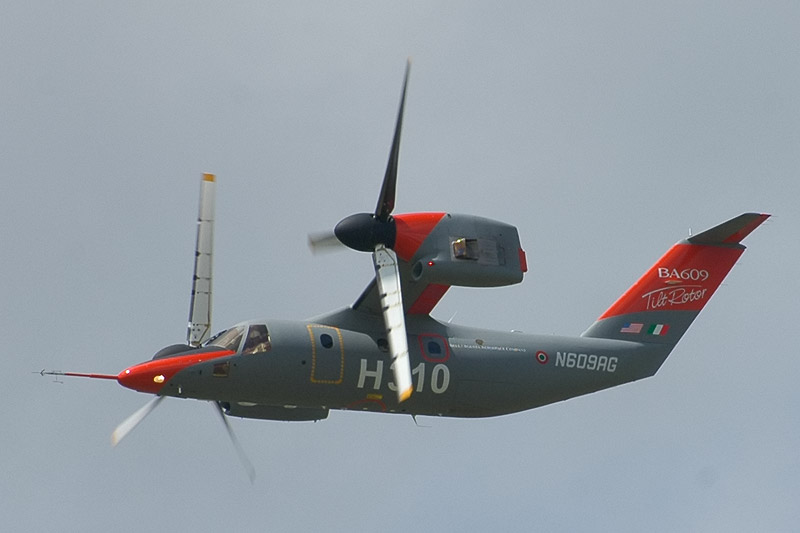
The Leonardo AW609, formerly the AgustaWestland AW609, and originally the Bell-Agusta BA609, is a twin-engined tiltrotor VTOL aircraft with an overall configuration similar to that of the Bell Boeing V-22 Osprey. It is capable of landing vertically like a helicopter while having a range and speed in excess of conventional rotorcraft. The AW609 is aimed at the civil aviation market, in particular VIP customers and offshore oil and gas operators. It has progressed from a concept in the late 1990s, to development and testing, and is working towards certification in the 2020s.
The BA609 drew on experience gained from Bell's earlier experimental tiltrotor, the XV-15. In 1996, Bell and Boeing formed a partnership to develop a civil tiltrotor aircraft. In March 1998, Boeing pulled out of the project. In September 1998, Agusta became a partner in the development program. This led to the establishment of the Bell/Agusta Aerospace Company (BAAC), a joint venture between Bell Helicopter and AgustaWestland, to develop and manufacture the aircraft, which was named Bell-Agusta AB-609; the two companies simultaneously worked on a conventional medium helicopter project (the Agusta-Bell AB139).
The Italian government subsidized Agusta's development of a military tiltrotor, and as the AW609 has civilian aspects, the European Commission requires AgustaWestland to pay back progressive amounts per aircraft to the Italian state to avoid a distortion of competition. As of 2015[update], Bell continues to perform contract work on the AW609 program, while considering commercial potential for the bigger V-280 tiltrotor, where military production may reach larger numbers and hence reduce unit cost. In 2016, Bell preferred the 609 for commercial applications and kept the V-280 for military use only. Bell stated that conventional helicopters were not part of Bell's future for military customers.
The aircraft's purpose is to take off and land vertically, but fly faster than a helicopter. Over 45 different aircraft have flown proving VTOL and STOL capabilities, of which the V-22, Harrier "jump jet" family, Yakovlev Yak-38 and Lockheed Martin F-35 Lightning II jets have proceeded to production. By 2008, Bell had estimated that very light jets and large offshore helicopters like the Sikorsky S-92 had reduced the potential market for tiltrotors. Also in 2008, it was reported that limited funding of the program by both Bell and AgustaWestland had resulted in slow flight testing progress.
In September 2009, AgustaWestland chief executive Giuseppe Orsi said that corporate parent Finmeccanica had authorised buying Bell Helicopter out of the program to speed it up, as Bell was dissatisfied with the commercial prospects and wanted to spend the resources on other programs. In 2013 AgustaWestland estimated a market of 700 aircraft over 20 years. By 2011, negotiations centred on the full transfer of technologies shared with the V-22, however Bell stated that no technology was shared with the V-22. At the 2011 Paris Air Show, AgustaWestland stated that it will assume full ownership of the programme, redesignating the aircraft as "AW609", and that Bell Helicopter will remain in the role of component design and certification. In November 2011, the exchange of ownership was completed, following the granting of regulatory approval - media estimated that the transfer happened at little cost.
On 6 December 2002, the first ground tests of the BA609 prototype began. The first flight took place on 7 March 2003 in Arlington, Texas, flown by test pilots Roy Hopkins and Dwayne Williams. After 14 hours of helicopter-mode flight testing, the prototype was moved to a ground testing rig to study the operational effects of the conversion modes. Following the completion of ground-based testing, on 3 June 2005 the prototype resumed flight testing, focusing on the expansion of its flight envelope. On 22 July 2005, the first conversion from helicopter to aeroplane mode while in flight took place.
By October 2008, 365 flight-hours had been logged by two prototype aircraft. The AW609 demonstrated a safe dual-engine failure in normal cruise flight on 15 May 2009. By February 2012, this had risen to 650 hours, and it was reported that 85 per cent of the AW609's flight envelope had been explored. Test pilot Paul Edwards has stated that the AW609 was not susceptible to the vortex ring state phenomena, naturally slipping out of the vortex on its own since both rotors will not simultaneously enter the vortex ring state.
In 2011, AgustaWestland began construction of a third prototype. That prototype was still not fully assembled by February 2015. The company plans to conduct test flights in Italy in the summer of 2015. AgustaWestland planned to then disassemble it and ship it to Philadelphia, Pennsylvania, to prepare it for tests of the de-icing system in Minnesota. A fourth prototype, to be used in the development and testing of new avionics and control systems, was also underway. By November 2012, over 700 flight hours had been accumulated by the two operational prototypes. In January 2014, it was reported that in excess of 850 flying hours had been accumulated by the two prototypes. Accumulated flight data is used to further develop representative simulators, which are in turn being used to support the development program.
Leonardo AW609
The Leonardo AW609, formerly the AgustaWestland AW609, and originally the Bell-Agusta BA609, is a twin-engined tiltrotor VTOL aircraft with an overall configuration similar to that of the Bell Boeing V-22 Osprey. It is capable of landing vertically like a helicopter while having a range and speed in excess of conventional rotorcraft. The AW609 is aimed at the civil aviation market, in particular VIP customers and offshore oil and gas operators. It has progressed from a concept in the late 1990s, to development and testing, and is working towards certification in the 2020s.
The BA609 drew on experience gained from Bell's earlier experimental tiltrotor, the XV-15. In 1996, Bell and Boeing formed a partnership to develop a civil tiltrotor aircraft. In March 1998, Boeing pulled out of the project. In September 1998, Agusta became a partner in the development program. This led to the establishment of the Bell/Agusta Aerospace Company (BAAC), a joint venture between Bell Helicopter and AgustaWestland, to develop and manufacture the aircraft, which was named Bell-Agusta AB-609; the two companies simultaneously worked on a conventional medium helicopter project (the Agusta-Bell AB139).
The Italian government subsidized Agusta's development of a military tiltrotor, and as the AW609 has civilian aspects, the European Commission requires AgustaWestland to pay back progressive amounts per aircraft to the Italian state to avoid a distortion of competition. As of 2015[update], Bell continues to perform contract work on the AW609 program, while considering commercial potential for the bigger V-280 tiltrotor, where military production may reach larger numbers and hence reduce unit cost. In 2016, Bell preferred the 609 for commercial applications and kept the V-280 for military use only. Bell stated that conventional helicopters were not part of Bell's future for military customers.
The aircraft's purpose is to take off and land vertically, but fly faster than a helicopter. Over 45 different aircraft have flown proving VTOL and STOL capabilities, of which the V-22, Harrier "jump jet" family, Yakovlev Yak-38 and Lockheed Martin F-35 Lightning II jets have proceeded to production. By 2008, Bell had estimated that very light jets and large offshore helicopters like the Sikorsky S-92 had reduced the potential market for tiltrotors. Also in 2008, it was reported that limited funding of the program by both Bell and AgustaWestland had resulted in slow flight testing progress.
In September 2009, AgustaWestland chief executive Giuseppe Orsi said that corporate parent Finmeccanica had authorised buying Bell Helicopter out of the program to speed it up, as Bell was dissatisfied with the commercial prospects and wanted to spend the resources on other programs. In 2013 AgustaWestland estimated a market of 700 aircraft over 20 years. By 2011, negotiations centred on the full transfer of technologies shared with the V-22, however Bell stated that no technology was shared with the V-22. At the 2011 Paris Air Show, AgustaWestland stated that it will assume full ownership of the programme, redesignating the aircraft as "AW609", and that Bell Helicopter will remain in the role of component design and certification. In November 2011, the exchange of ownership was completed, following the granting of regulatory approval - media estimated that the transfer happened at little cost.
On 6 December 2002, the first ground tests of the BA609 prototype began. The first flight took place on 7 March 2003 in Arlington, Texas, flown by test pilots Roy Hopkins and Dwayne Williams. After 14 hours of helicopter-mode flight testing, the prototype was moved to a ground testing rig to study the operational effects of the conversion modes. Following the completion of ground-based testing, on 3 June 2005 the prototype resumed flight testing, focusing on the expansion of its flight envelope. On 22 July 2005, the first conversion from helicopter to aeroplane mode while in flight took place.
By October 2008, 365 flight-hours had been logged by two prototype aircraft. The AW609 demonstrated a safe dual-engine failure in normal cruise flight on 15 May 2009. By February 2012, this had risen to 650 hours, and it was reported that 85 per cent of the AW609's flight envelope had been explored. Test pilot Paul Edwards has stated that the AW609 was not susceptible to the vortex ring state phenomena, naturally slipping out of the vortex on its own since both rotors will not simultaneously enter the vortex ring state.
In 2011, AgustaWestland began construction of a third prototype. That prototype was still not fully assembled by February 2015. The company plans to conduct test flights in Italy in the summer of 2015. AgustaWestland planned to then disassemble it and ship it to Philadelphia, Pennsylvania, to prepare it for tests of the de-icing system in Minnesota. A fourth prototype, to be used in the development and testing of new avionics and control systems, was also underway. By November 2012, over 700 flight hours had been accumulated by the two operational prototypes. In January 2014, it was reported that in excess of 850 flying hours had been accumulated by the two prototypes. Accumulated flight data is used to further develop representative simulators, which are in turn being used to support the development program.
Recent media
Recent media