



Community hub
Recent from talks
Contribute something to knowledge base
Content stats: 0 posts, 0 articles, 1 media, 0 notes
Members stats: 0 subscribers, 0 contributors, 0 moderators, 0 supporters
Subscribers
Supporters
Contributors
Moderators
Hub AI
Leptoptilos robustus AI simulator
(@Leptoptilos robustus_simulator)
Hub AI
Leptoptilos robustus AI simulator
(@Leptoptilos robustus_simulator)
Leptoptilos robustus
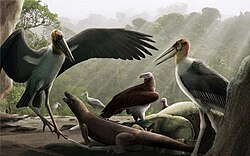
Leptoptilos robustus (from lepto [Greek: thin, slender] + ptilo [Greek: soft feather] and robustus [Latin: strong]) is an extinct species of large-bodied stork belonging to the genus Leptoptilos (which also includes the marabou stork and the adjutants) that lived on the island of Flores in Indonesia during the Late Pleistocene. It stood at about 180 cm (5 ft 11 in) tall and weighed up to an estimated 16 kg (35 lb). Due to its large size, L. robustus likely occupied a terrestrial predatory or scavenging niche, likely heavily relying on the dwarfed elephant relative Stegodon florensis for a large part of its diet, and probably competing with Homo floresiensis, Komodo dragons and Trigonoceps vultures for food resources. The majority of the discoveries are concentrated in Liang Bua cave located slightly north of Ruteng in the East Nusa Tenggara province.
In 2010, Meijer and Awe Due named the species based on four specimens including the holotype distal left tibiotarsus (LB-Av-155), partial left carpometacarpus (LB-Av-1), distal left ulna (LB-Av-154) and complete left femur (LB-Av-140). The genus name Leptotilos is derived from the Greek word lepto meaning "thin or slender", which refers to the stork's slim build and the Greek word ptilo meaning "down or soft feather", referring to the soft feather down covering the frame of the members of Leptotilos stork. The species name, "robustus" is derived from Latin word, robur meaning "hardness or strength". The species name robustus is a reference to the notably large size of the tibiotarsus and the thickness of its cortex.
Debate over the relation between the Liang Bua specimen and other stork species was compared using the size measurements of the fragments found to extant species. It can be inferred from the recorded dimensions of the bones that L. robustus was substantially taller and heavier than other species of Leptoptilos, which reach a maximum weight of 9 kg. The only other known Leptoptilos species that outweighs robustus is Leptoptilos falconeri which is estimated to have reached up to 2 meters and weighed approximately 20 kg. L. robustus may have evolved in situ on Liang Bua from a flying ancestor. Unfortunately, the sparse fossil record of birds from South-East Asia makes the evolutionary history of robustus difficult to trace. Only Java has yielded other Leptoptilini fossils including L. dubius and L. titan from the Pleistocene. L. falconeri remains have been found in a wide geographical range from Central Asia, Africa, and Central Europe. This wide range is evidence that L. robustus may be at least descended from that species. The morphological differences between the two, however, rule out conspecificity. The dimensions of the fragments found suggest that L. robustus is most closely related to L. dubius, the two sharing a common ancestor.
L. robustus most likely had a slender body characteristic of extant members of Leptoptilos, but was much larger in body size and height, with individuals reaching up to at least 180 cm (5 ft 11 in) tall and weighing approximately 16 kg (35 lb). From Liang Bua, fragments of a left ulna, left carpometacarpus, left tibiotarsus, and a nearly complete left femur was discovered and described in 2010. In 2013, the tip of a maxilla, a left and right proximal scapula, two furculae, a humeral and ulnar, a right proximal radius, two right ossi carpi radiales, a right femur, four phalanges, and long bone fragments were additionally discovered and described. The bone fragments found of this species were indicative of its large size when compared to skeletal measurements from the extant species, Leptoptilos dubius. Due to having heavy bones and a heavy body it was formerly assumed that it rarely, if ever, flew. The thick-walled tibiotarsus, constituting the thickest of all other extant and extinct Leptoptilini species, is an unusual feature for flying birds which usually selects for minimum mass. As well as heavier than normal bone structure, measured size ratios were thought to suggest that it may have had reduced forelimbs and therefore flight capabilities. The body size was similar in dimension to L. dubius, with the exception of its tibiotarsus. However, the fragmentary nature of the ulna and the carpometacarpus found did not allow an accurate estimate of wingspan length and the question as to whether or not L. robustus could fly was formerly uncertain. A 2022 study, describing additional elements of the wing, found that there was no proportional reduction in the length of the wing as might be expected if it had reduced flight capabilities or was flightless, and thus it was likely fully flight-capable. The size of L. robustus is not unusual compared to many extinct members of the genus, which reached comparable sizes.
A fragment of a proximal left carpometacarpus was one of the bones discovered to be a part of robustus, consisting of half of the os metacarpale majus and the trochlea carpalis. Ventrally within the fossa infratrochlearis lies a 2-millimeter diameter pneumatic foramen, a feature that is characteristic of the genus Leptoptilos. The morphology of the trochlea carpalis was also similar when compared to those of extant Leptoptilini members. Measurements of the proximal width and depth of the carpometacarpi fell within the range of the extant species L. dubius, suggesting that L. robustus was closer to L. dubius' size based on carpometacarpal measurements alone.
A fragmented distal left ulna was found consisting of the distal articulation and a small part of the shaft. A distinct foramen is observable between the tuberculum carpale and the condylus ventralis ulnae. This foramen is present in extant Leptoptilos species. When comparing the minimum width and minimum depth of the robustus ulna to other extant Leptoptilos members, the values fell within the upper size range of L. dubius suggesting similar body length.
Two femurs were found on the left and right sides. The left femur was found nearly complete, broken in two and missing only the caput femoris. Evidence for large muscle attachment can be observed as a depression along the entire width of the femur. The shape of the femur is similar in morphology to the extinct species L. falconeri, but agrees more closely in length with L. dubius. However, comparing the minimum width and minimum depth of the shaft, the femur discovered falls within the range of L. dubius.
The tibiotarsus was found fragmented into three parts consisting of the shaft and distal end. The distal condyles were absent. The bone wall is thicker than the largest species of extant and extinct Leptoptilos. The size and shape of the sulcus extensorius discovered are very similar to L. dubius than to other extinct Leptoptilos species. The measurements of the tibiotarsus contrast with those of the carpometacarpus, ulna, and femur as being distinctly larger than other Leptoptilini species. The tibiotarsus lies very far outside the range of L. dubius and is more similar in size to L. siwalicensis.
Leptoptilos robustus
Leptoptilos robustus (from lepto [Greek: thin, slender] + ptilo [Greek: soft feather] and robustus [Latin: strong]) is an extinct species of large-bodied stork belonging to the genus Leptoptilos (which also includes the marabou stork and the adjutants) that lived on the island of Flores in Indonesia during the Late Pleistocene. It stood at about 180 cm (5 ft 11 in) tall and weighed up to an estimated 16 kg (35 lb). Due to its large size, L. robustus likely occupied a terrestrial predatory or scavenging niche, likely heavily relying on the dwarfed elephant relative Stegodon florensis for a large part of its diet, and probably competing with Homo floresiensis, Komodo dragons and Trigonoceps vultures for food resources. The majority of the discoveries are concentrated in Liang Bua cave located slightly north of Ruteng in the East Nusa Tenggara province.
In 2010, Meijer and Awe Due named the species based on four specimens including the holotype distal left tibiotarsus (LB-Av-155), partial left carpometacarpus (LB-Av-1), distal left ulna (LB-Av-154) and complete left femur (LB-Av-140). The genus name Leptotilos is derived from the Greek word lepto meaning "thin or slender", which refers to the stork's slim build and the Greek word ptilo meaning "down or soft feather", referring to the soft feather down covering the frame of the members of Leptotilos stork. The species name, "robustus" is derived from Latin word, robur meaning "hardness or strength". The species name robustus is a reference to the notably large size of the tibiotarsus and the thickness of its cortex.
Debate over the relation between the Liang Bua specimen and other stork species was compared using the size measurements of the fragments found to extant species. It can be inferred from the recorded dimensions of the bones that L. robustus was substantially taller and heavier than other species of Leptoptilos, which reach a maximum weight of 9 kg. The only other known Leptoptilos species that outweighs robustus is Leptoptilos falconeri which is estimated to have reached up to 2 meters and weighed approximately 20 kg. L. robustus may have evolved in situ on Liang Bua from a flying ancestor. Unfortunately, the sparse fossil record of birds from South-East Asia makes the evolutionary history of robustus difficult to trace. Only Java has yielded other Leptoptilini fossils including L. dubius and L. titan from the Pleistocene. L. falconeri remains have been found in a wide geographical range from Central Asia, Africa, and Central Europe. This wide range is evidence that L. robustus may be at least descended from that species. The morphological differences between the two, however, rule out conspecificity. The dimensions of the fragments found suggest that L. robustus is most closely related to L. dubius, the two sharing a common ancestor.
L. robustus most likely had a slender body characteristic of extant members of Leptoptilos, but was much larger in body size and height, with individuals reaching up to at least 180 cm (5 ft 11 in) tall and weighing approximately 16 kg (35 lb). From Liang Bua, fragments of a left ulna, left carpometacarpus, left tibiotarsus, and a nearly complete left femur was discovered and described in 2010. In 2013, the tip of a maxilla, a left and right proximal scapula, two furculae, a humeral and ulnar, a right proximal radius, two right ossi carpi radiales, a right femur, four phalanges, and long bone fragments were additionally discovered and described. The bone fragments found of this species were indicative of its large size when compared to skeletal measurements from the extant species, Leptoptilos dubius. Due to having heavy bones and a heavy body it was formerly assumed that it rarely, if ever, flew. The thick-walled tibiotarsus, constituting the thickest of all other extant and extinct Leptoptilini species, is an unusual feature for flying birds which usually selects for minimum mass. As well as heavier than normal bone structure, measured size ratios were thought to suggest that it may have had reduced forelimbs and therefore flight capabilities. The body size was similar in dimension to L. dubius, with the exception of its tibiotarsus. However, the fragmentary nature of the ulna and the carpometacarpus found did not allow an accurate estimate of wingspan length and the question as to whether or not L. robustus could fly was formerly uncertain. A 2022 study, describing additional elements of the wing, found that there was no proportional reduction in the length of the wing as might be expected if it had reduced flight capabilities or was flightless, and thus it was likely fully flight-capable. The size of L. robustus is not unusual compared to many extinct members of the genus, which reached comparable sizes.
A fragment of a proximal left carpometacarpus was one of the bones discovered to be a part of robustus, consisting of half of the os metacarpale majus and the trochlea carpalis. Ventrally within the fossa infratrochlearis lies a 2-millimeter diameter pneumatic foramen, a feature that is characteristic of the genus Leptoptilos. The morphology of the trochlea carpalis was also similar when compared to those of extant Leptoptilini members. Measurements of the proximal width and depth of the carpometacarpi fell within the range of the extant species L. dubius, suggesting that L. robustus was closer to L. dubius' size based on carpometacarpal measurements alone.
A fragmented distal left ulna was found consisting of the distal articulation and a small part of the shaft. A distinct foramen is observable between the tuberculum carpale and the condylus ventralis ulnae. This foramen is present in extant Leptoptilos species. When comparing the minimum width and minimum depth of the robustus ulna to other extant Leptoptilos members, the values fell within the upper size range of L. dubius suggesting similar body length.
Two femurs were found on the left and right sides. The left femur was found nearly complete, broken in two and missing only the caput femoris. Evidence for large muscle attachment can be observed as a depression along the entire width of the femur. The shape of the femur is similar in morphology to the extinct species L. falconeri, but agrees more closely in length with L. dubius. However, comparing the minimum width and minimum depth of the shaft, the femur discovered falls within the range of L. dubius.
The tibiotarsus was found fragmented into three parts consisting of the shaft and distal end. The distal condyles were absent. The bone wall is thicker than the largest species of extant and extinct Leptoptilos. The size and shape of the sulcus extensorius discovered are very similar to L. dubius than to other extinct Leptoptilos species. The measurements of the tibiotarsus contrast with those of the carpometacarpus, ulna, and femur as being distinctly larger than other Leptoptilini species. The tibiotarsus lies very far outside the range of L. dubius and is more similar in size to L. siwalicensis.
Recent media
Recent media