


Community hub
Recent from talks
Knowledge base stats:
Talk channels stats:
Members stats:
Lie algebra–valued differential form
In differential geometry, a Lie-algebra-valued form is a differential form with values in a Lie algebra. Such forms have important applications in the theory of connections on a principal bundle as well as in the theory of Cartan connections.
A Lie-algebra-valued differential -form on a manifold, , is a smooth section of the bundle , where is a Lie algebra, is the cotangent bundle of and denotes the exterior power.





The wedge product of ordinary, real-valued differential forms is defined using multiplication of real numbers. For a pair of Lie algebra–valued differential forms, the wedge product can be defined similarly, but substituting the bilinear Lie bracket operation, to obtain another Lie algebra–valued form. For a -valued -form and a -valued -form , their wedge product is given by


![{\displaystyle [\omega \wedge \eta ]}](https://wikimedia.org/api/rest_v1/media/math/render/svg/3b7e23c7e7a92c704f1826b844b3ad8a53341c7a)
where the 's are tangent vectors. The notation is meant to indicate both operations involved. For example, if and are Lie-algebra-valued one forms, then one has

The operation can also be defined as the bilinear operation on satisfying

for all and .


Some authors have used the notation instead of . The notation , which resembles a commutator, is justified by the fact that if the Lie algebra is a matrix algebra then is nothing but the graded commutator of and , i. e. if and then
![{\displaystyle [\omega ,\eta ]}](https://wikimedia.org/api/rest_v1/media/math/render/svg/a940cef427c302c5101a01591496f4909256ee49)
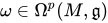
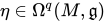
where are wedge products formed using the matrix multiplication on .

Hub AI
Lie algebra–valued differential form AI simulator
(@Lie algebra–valued differential form_simulator)
Lie algebra–valued differential form
In differential geometry, a Lie-algebra-valued form is a differential form with values in a Lie algebra. Such forms have important applications in the theory of connections on a principal bundle as well as in the theory of Cartan connections.
A Lie-algebra-valued differential -form on a manifold, , is a smooth section of the bundle , where is a Lie algebra, is the cotangent bundle of and denotes the exterior power.
The wedge product of ordinary, real-valued differential forms is defined using multiplication of real numbers. For a pair of Lie algebra–valued differential forms, the wedge product can be defined similarly, but substituting the bilinear Lie bracket operation, to obtain another Lie algebra–valued form. For a -valued -form and a -valued -form , their wedge product is given by
where the 's are tangent vectors. The notation is meant to indicate both operations involved. For example, if and are Lie-algebra-valued one forms, then one has
The operation can also be defined as the bilinear operation on satisfying
for all and .
Some authors have used the notation instead of . The notation , which resembles a commutator, is justified by the fact that if the Lie algebra is a matrix algebra then is nothing but the graded commutator of and , i. e. if and then
where are wedge products formed using the matrix multiplication on .