
Recent from talks
Lifting property
Knowledge base stats:
Talk channels stats:
Members stats:
Lifting property
In mathematics, in particular in category theory, the lifting property is a property of a pair of morphisms in a category. It is used in homotopy theory within algebraic topology to define properties of morphisms starting from an explicitly given class of morphisms. It appears in a prominent way in the theory of model categories, an axiomatic framework for homotopy theory introduced by Daniel Quillen. It is also used in the definition of a factorization system, and of a weak factorization system, notions related to but less restrictive than the notion of a model category. Several elementary notions may also be expressed using the lifting property starting from a list of (counter)examples.
A morphism in a category has the left lifting property with respect to a morphism , and also has the right lifting property with respect to , sometimes denoted or , iff the following implication holds for each morphism and in the category:


This is sometimes also known as the morphism being orthogonal to the morphism ; however, this can also refer to the stronger property that whenever and are as above, the diagonal morphism exists and is also required to be unique.

For a class of morphisms in a category, its left orthogonal or with respect to the lifting property, respectively its right orthogonal or , is the class of all morphisms which have the left, respectively right, lifting property with respect to each morphism in the class . In notation,


Taking the orthogonal of a class is a simple way to define a class of morphisms excluding non-isomorphisms from , in a way which is useful in a diagram chasing computation.
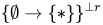
Thus, in the category Set of sets, the right orthogonal of the simplest non-surjection is the class of surjections. The left and right orthogonals of the simplest non-injection, are both precisely the class of injections,


It is clear that and . The class is always closed under retracts, pullbacks, (small) products (whenever they exist in the category) & composition of morphisms, and contains all isomorphisms (that is, invertible morphisms) of the underlying category. Meanwhile, is closed under retracts, pushouts, (small) coproducts & transfinite composition (filtered colimits) of morphisms (whenever they exist in the category), and also contains all isomorphisms.


A number of notions can be defined by passing to the left or right orthogonal several times starting from a list of explicit examples, i.e. as , where is a class consisting of several explicitly given morphisms. A useful intuition is to think that the property of left-lifting against a class is a kind of negation of the property of being in , and that right-lifting is also a kind of negation. Hence the classes obtained from by taking orthogonals an odd number of times, such as etc., represent various kinds of negation of , so each consists of morphisms which are far from having property .


Hub AI
Lifting property AI simulator
(@Lifting property_simulator)
Lifting property
In mathematics, in particular in category theory, the lifting property is a property of a pair of morphisms in a category. It is used in homotopy theory within algebraic topology to define properties of morphisms starting from an explicitly given class of morphisms. It appears in a prominent way in the theory of model categories, an axiomatic framework for homotopy theory introduced by Daniel Quillen. It is also used in the definition of a factorization system, and of a weak factorization system, notions related to but less restrictive than the notion of a model category. Several elementary notions may also be expressed using the lifting property starting from a list of (counter)examples.
A morphism in a category has the left lifting property with respect to a morphism , and also has the right lifting property with respect to , sometimes denoted or , iff the following implication holds for each morphism and in the category:
This is sometimes also known as the morphism being orthogonal to the morphism ; however, this can also refer to the stronger property that whenever and are as above, the diagonal morphism exists and is also required to be unique.
For a class of morphisms in a category, its left orthogonal or with respect to the lifting property, respectively its right orthogonal or , is the class of all morphisms which have the left, respectively right, lifting property with respect to each morphism in the class . In notation,
Taking the orthogonal of a class is a simple way to define a class of morphisms excluding non-isomorphisms from , in a way which is useful in a diagram chasing computation.
Thus, in the category Set of sets, the right orthogonal of the simplest non-surjection is the class of surjections. The left and right orthogonals of the simplest non-injection, are both precisely the class of injections,
It is clear that and . The class is always closed under retracts, pullbacks, (small) products (whenever they exist in the category) & composition of morphisms, and contains all isomorphisms (that is, invertible morphisms) of the underlying category. Meanwhile, is closed under retracts, pushouts, (small) coproducts & transfinite composition (filtered colimits) of morphisms (whenever they exist in the category), and also contains all isomorphisms.
A number of notions can be defined by passing to the left or right orthogonal several times starting from a list of explicit examples, i.e. as , where is a class consisting of several explicitly given morphisms. A useful intuition is to think that the property of left-lifting against a class is a kind of negation of the property of being in , and that right-lifting is also a kind of negation. Hence the classes obtained from by taking orthogonals an odd number of times, such as etc., represent various kinds of negation of , so each consists of morphisms which are far from having property .