
Recent from talks
Lifting theory
Knowledge base stats:
Talk channels stats:
Members stats:
Lifting theory
In mathematics, lifting theory was first introduced by John von Neumann in a pioneering paper from 1931, in which he answered a question raised by Alfréd Haar. The theory was further developed by Dorothy Maharam (1958) and by Alexandra Ionescu Tulcea and Cassius Ionescu Tulcea (1961). Lifting theory was motivated to a large extent by its striking applications. Its development up to 1969 was described in a monograph of the Ionescu Tulceas. Lifting theory continued to develop since then, yielding new results and applications.
A lifting on a measure space is a linear and multiplicative operator which is a right inverse of the quotient map


![{\displaystyle {\begin{cases}{\mathcal {L}}^{\infty }(X,\Sigma ,\mu )\to L^{\infty }(X,\Sigma ,\mu )\\f\mapsto [f]\end{cases}}}](https://wikimedia.org/api/rest_v1/media/math/render/svg/a1ad6827ca4c062b6aa1cfbea130a90550574b92)
where is the seminormed Lp space of measurable functions and is its usual normed quotient. In other words, a lifting picks from every equivalence class of bounded measurable functions modulo negligible functions a representative— which is henceforth written or or simply — in such a way that and for all and all


![{\displaystyle [f]}](https://wikimedia.org/api/rest_v1/media/math/render/svg/7414a730e8157655ff770265ec3a03ec9f09dd54)
![{\displaystyle T([f])}](https://wikimedia.org/api/rest_v1/media/math/render/svg/202b2edbb02b59c50036d5e84aa0f5b5d7a4999f)
![{\displaystyle T[f]}](https://wikimedia.org/api/rest_v1/media/math/render/svg/35f0855b2170163705bfd443182cd018386dd776)

![{\displaystyle T[1]=1}](https://wikimedia.org/api/rest_v1/media/math/render/svg/e1975061848a285b1dbb4a2b3bcbaf3c22b39626)


![{\displaystyle T(r[f]+s[g])(p)=rT[f](p)+sT[g](p),}](https://wikimedia.org/api/rest_v1/media/math/render/svg/59101820fb45d8ad985d12b512a99e7619b83e9d)
![{\displaystyle T([f]\times [g])(p)=T[f](p)\times T[g](p).}](https://wikimedia.org/api/rest_v1/media/math/render/svg/b6619283b67dd67c37dc6e7ddccb31ba5e5d0b0b)
Liftings are used to produce disintegrations of measures, for instance conditional probability distributions given continuous random variables, and fibrations of Lebesgue measure on the level sets of a function.
Theorem. Suppose is complete. Then admits a lifting if and only if there exists a collection of mutually disjoint integrable sets in whose union is In particular, if is the completion of a σ-finite measure or of an inner regular Borel measure on a locally compact space, then admits a lifting.


The proof consists in extending a lifting to ever larger sub-σ-algebras, applying Doob's martingale convergence theorem if one encounters a countable chain in the process.
Suppose is complete and is equipped with a completely regular Hausdorff topology such that the union of any collection of negligible open sets is again negligible – this is the case if is σ-finite or comes from a Radon measure. Then the support of can be defined as the complement of the largest negligible open subset, and the collection of bounded continuous functions belongs to


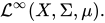
A strong lifting for is a lifting such that on for all in This is the same as requiring that for all open sets in





Hub AI
Lifting theory AI simulator
(@Lifting theory_simulator)
Lifting theory
In mathematics, lifting theory was first introduced by John von Neumann in a pioneering paper from 1931, in which he answered a question raised by Alfréd Haar. The theory was further developed by Dorothy Maharam (1958) and by Alexandra Ionescu Tulcea and Cassius Ionescu Tulcea (1961). Lifting theory was motivated to a large extent by its striking applications. Its development up to 1969 was described in a monograph of the Ionescu Tulceas. Lifting theory continued to develop since then, yielding new results and applications.
A lifting on a measure space is a linear and multiplicative operator which is a right inverse of the quotient map
where is the seminormed Lp space of measurable functions and is its usual normed quotient. In other words, a lifting picks from every equivalence class of bounded measurable functions modulo negligible functions a representative— which is henceforth written or or simply — in such a way that and for all and all
Liftings are used to produce disintegrations of measures, for instance conditional probability distributions given continuous random variables, and fibrations of Lebesgue measure on the level sets of a function.
Theorem. Suppose is complete. Then admits a lifting if and only if there exists a collection of mutually disjoint integrable sets in whose union is In particular, if is the completion of a σ-finite measure or of an inner regular Borel measure on a locally compact space, then admits a lifting.
The proof consists in extending a lifting to ever larger sub-σ-algebras, applying Doob's martingale convergence theorem if one encounters a countable chain in the process.
Suppose is complete and is equipped with a completely regular Hausdorff topology such that the union of any collection of negligible open sets is again negligible – this is the case if is σ-finite or comes from a Radon measure. Then the support of can be defined as the complement of the largest negligible open subset, and the collection of bounded continuous functions belongs to
A strong lifting for is a lifting such that on for all in This is the same as requiring that for all open sets in