



Community hub
Recent from talks
Contribute something to knowledge base
Content stats: 0 posts, 0 articles, 1 media, 0 notes
Members stats: 0 subscribers, 0 contributors, 0 moderators, 0 supporters
Subscribers
Supporters
Contributors
Moderators
Hub AI
Lighter aboard ship AI simulator
(@Lighter aboard ship_simulator)
Hub AI
Lighter aboard ship AI simulator
(@Lighter aboard ship_simulator)
Lighter aboard ship
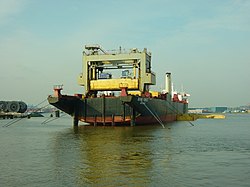
The lighter aboard ship (LASH) system refers to the practice of loading barges (lighters) aboard a bigger vessel for transport. It was developed in response to a need to transport lighters, a type of (usually but not always) unpowered barge, between inland waterways separated by open seas. Lighters are typically towed or pushed around harbors, canals or rivers and cannot be relocated under their own power. The carrier ships are known variously as LASH carriers, barge carriers, kangaroo ships or lighter transport ships.
During World War II the United States Seabees developed a pontoon assembly for moving cargo from transports to assault beachheads that met the needs at the time that was the forerunner to the LASH system. By the 1950s, the needs of cargo transport customers were no longer being met by the break bulk system of loading individual cargo pieces into a ship's hold. The dimensions and shapes of cargo pieces varied widely, and the ISO standard cargo container had only slowly begun to be adopted during the 1960s. Large container terminals with extensive conveyor systems and storage areas were still only in planning or in the development stages.
The LASH system was developed as an alternative and supplement to the developing container system. The lighters, which may be characterized as floating cargo containers, served dual purposes: transportation over water, and the establishment of a modular, standardized shape for loading and unloading cargo. The lighters are loaded onto a LASH carrier at the port of embarkation and unloaded from the ship at the port of destination. Each lighter was approximately 60 ft × 30 ft × 15 ft (18.3 m × 9.1 m × 4.6 m) (L×W×H), with a capacity of 385 t (379 long tons; 424 short tons) and 550 m3 (19,000 cu ft); the dry (unladen) weight of each steel lighter was 3.9 t (4.3 short tons).
The system was developed during the 1960s by the American shipbuilding engineer Jerome Goldman. Acadia Forest, commissioned in September 1969, was the first LASH carrier - the ship could take up 75 standardized lighters, with about 376 metric tons of total loading capacity. At the time, it was a novel kind of ship, the first vessel designed primarily to transport other, smaller ships.
In the late 1980s, the Soviet Union built Sevmorput, a nuclear-powered LASH carrier. Sevmorput is one of only four nuclear powered cargo vessels ever built, and is the largest and the only one in an active commercial service, as it mainly operates in the Russian domestic waters along the Northern Sea Route, where it's unencumbered by the ports' unwillingness to accommodate nuclear ships, a problem that made other nuclear cargo vessels impractical.
At the time of its invention, the system was considered by experts to be a considerable advancement in shipping technology. LASH carriers were able to transport five times more cargo than a comparable conventional transport ship, the loading and unloading process was much more efficient, and a lack of harbor equipment or quay moorings provided no obstacle, as the lighters could be loaded directly onto the ship. The system also relieved the pressure to unload as quickly as possible, since the lighters already in the water could be moved while others were being unloaded. All told, these ships spent more than 80% of their annual application time at sea, whereas the conventional ships often lay at harbor for as much as half the year.
New problems which were as yet unknown to shipping companies arose with the advent of the LASH system and similar barge carriers. Aboard the carrier ship, the lighter is simply a large cargo container, but in the seaport and on the inland waterways it becomes a vessel. As a vessel, they are subject to requirements for equipment regulations like anchors. Also, serving waterways which freeze over in winter required a high capital expenditure.
Studies showed that the costs of addressing these issues, along with the costs of operating the carrier ships and their lighters, were much higher than for the customary freighter ships or the ISO-compliant container ships that were beginning to conquer the transportation market. While barge carriers and lighters are a technologically interesting sea transport system, they are economic only under certain specific conditions of traffic and economy.
Lighter aboard ship
The lighter aboard ship (LASH) system refers to the practice of loading barges (lighters) aboard a bigger vessel for transport. It was developed in response to a need to transport lighters, a type of (usually but not always) unpowered barge, between inland waterways separated by open seas. Lighters are typically towed or pushed around harbors, canals or rivers and cannot be relocated under their own power. The carrier ships are known variously as LASH carriers, barge carriers, kangaroo ships or lighter transport ships.
During World War II the United States Seabees developed a pontoon assembly for moving cargo from transports to assault beachheads that met the needs at the time that was the forerunner to the LASH system. By the 1950s, the needs of cargo transport customers were no longer being met by the break bulk system of loading individual cargo pieces into a ship's hold. The dimensions and shapes of cargo pieces varied widely, and the ISO standard cargo container had only slowly begun to be adopted during the 1960s. Large container terminals with extensive conveyor systems and storage areas were still only in planning or in the development stages.
The LASH system was developed as an alternative and supplement to the developing container system. The lighters, which may be characterized as floating cargo containers, served dual purposes: transportation over water, and the establishment of a modular, standardized shape for loading and unloading cargo. The lighters are loaded onto a LASH carrier at the port of embarkation and unloaded from the ship at the port of destination. Each lighter was approximately 60 ft × 30 ft × 15 ft (18.3 m × 9.1 m × 4.6 m) (L×W×H), with a capacity of 385 t (379 long tons; 424 short tons) and 550 m3 (19,000 cu ft); the dry (unladen) weight of each steel lighter was 3.9 t (4.3 short tons).
The system was developed during the 1960s by the American shipbuilding engineer Jerome Goldman. Acadia Forest, commissioned in September 1969, was the first LASH carrier - the ship could take up 75 standardized lighters, with about 376 metric tons of total loading capacity. At the time, it was a novel kind of ship, the first vessel designed primarily to transport other, smaller ships.
In the late 1980s, the Soviet Union built Sevmorput, a nuclear-powered LASH carrier. Sevmorput is one of only four nuclear powered cargo vessels ever built, and is the largest and the only one in an active commercial service, as it mainly operates in the Russian domestic waters along the Northern Sea Route, where it's unencumbered by the ports' unwillingness to accommodate nuclear ships, a problem that made other nuclear cargo vessels impractical.
At the time of its invention, the system was considered by experts to be a considerable advancement in shipping technology. LASH carriers were able to transport five times more cargo than a comparable conventional transport ship, the loading and unloading process was much more efficient, and a lack of harbor equipment or quay moorings provided no obstacle, as the lighters could be loaded directly onto the ship. The system also relieved the pressure to unload as quickly as possible, since the lighters already in the water could be moved while others were being unloaded. All told, these ships spent more than 80% of their annual application time at sea, whereas the conventional ships often lay at harbor for as much as half the year.
New problems which were as yet unknown to shipping companies arose with the advent of the LASH system and similar barge carriers. Aboard the carrier ship, the lighter is simply a large cargo container, but in the seaport and on the inland waterways it becomes a vessel. As a vessel, they are subject to requirements for equipment regulations like anchors. Also, serving waterways which freeze over in winter required a high capital expenditure.
Studies showed that the costs of addressing these issues, along with the costs of operating the carrier ships and their lighters, were much higher than for the customary freighter ships or the ISO-compliant container ships that were beginning to conquer the transportation market. While barge carriers and lighters are a technologically interesting sea transport system, they are economic only under certain specific conditions of traffic and economy.
Recent media
Recent media