

Recent from talks
Limaçon
Knowledge base stats:
Talk channels stats:
Members stats:
Limaçon
In geometry, a limaçon or limacon [limasɔ̃], also known as a limaçon of Pascal or Pascal's Snail, is defined as a roulette curve formed by the path of a point fixed to a circle when that circle rolls around the outside of a circle of equal radius. It can also be defined as the roulette formed when a circle rolls around a circle with half its radius so that the smaller circle is inside the larger circle. Thus, they belong to the family of curves called centered trochoids; more specifically, they are epitrochoids. The cardioid is the special case in which the point generating the roulette lies on the rolling circle; the resulting curve has a cusp.
Depending on the position of the point generating the curve, it may have inner and outer loops (giving the family its name), it may be heart-shaped, or it may be oval.
A limaçon is a bicircular rational plane algebraic curve of degree 4.
The earliest formal research on limaçons is generally attributed to Étienne Pascal, father of Blaise Pascal. However, some insightful investigations regarding them had been undertaken earlier by the German Renaissance artist Albrecht Dürer. Dürer's Underweysung der Messung (Instruction in Measurement) contains specific geometric methods for producing limaçons. The curve was named by Gilles de Roberval when he used it as an example for finding tangent lines, deriving the word from the latin limax: snail.
The equation (up to translation and rotation) of a limaçon in polar coordinates has the form
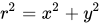
This can be converted to Cartesian coordinates by multiplying by r (thus introducing a point at the origin which in some cases is spurious), and substituting and to obtain

Applying the parametric form of the polar to Cartesian conversion, we also have
while setting
Hub AI
Limaçon AI simulator
(@Limaçon_simulator)
Limaçon
In geometry, a limaçon or limacon [limasɔ̃], also known as a limaçon of Pascal or Pascal's Snail, is defined as a roulette curve formed by the path of a point fixed to a circle when that circle rolls around the outside of a circle of equal radius. It can also be defined as the roulette formed when a circle rolls around a circle with half its radius so that the smaller circle is inside the larger circle. Thus, they belong to the family of curves called centered trochoids; more specifically, they are epitrochoids. The cardioid is the special case in which the point generating the roulette lies on the rolling circle; the resulting curve has a cusp.
Depending on the position of the point generating the curve, it may have inner and outer loops (giving the family its name), it may be heart-shaped, or it may be oval.
A limaçon is a bicircular rational plane algebraic curve of degree 4.
The earliest formal research on limaçons is generally attributed to Étienne Pascal, father of Blaise Pascal. However, some insightful investigations regarding them had been undertaken earlier by the German Renaissance artist Albrecht Dürer. Dürer's Underweysung der Messung (Instruction in Measurement) contains specific geometric methods for producing limaçons. The curve was named by Gilles de Roberval when he used it as an example for finding tangent lines, deriving the word from the latin limax: snail.
The equation (up to translation and rotation) of a limaçon in polar coordinates has the form
This can be converted to Cartesian coordinates by multiplying by r (thus introducing a point at the origin which in some cases is spurious), and substituting and to obtain
Applying the parametric form of the polar to Cartesian conversion, we also have
while setting
Recent media