
Recent from talks
Lima metropolitan area
Knowledge base stats:
Talk channels stats:
Members stats:
Lima metropolitan area
The Lima Metropolitan Area (Spanish: Área Metropolitana de Lima, also known as Lima Metropolitana) is an area formed by the conurbation of the Peruvian provinces of Lima (the nation's capital) and Callao. It is the largest of the metropolitan areas of Peru, the seventh largest in the Americas, the fourth largest in Latin America, and among the thirty largest in the world. The conurbation process started to be evident in the 1980s.
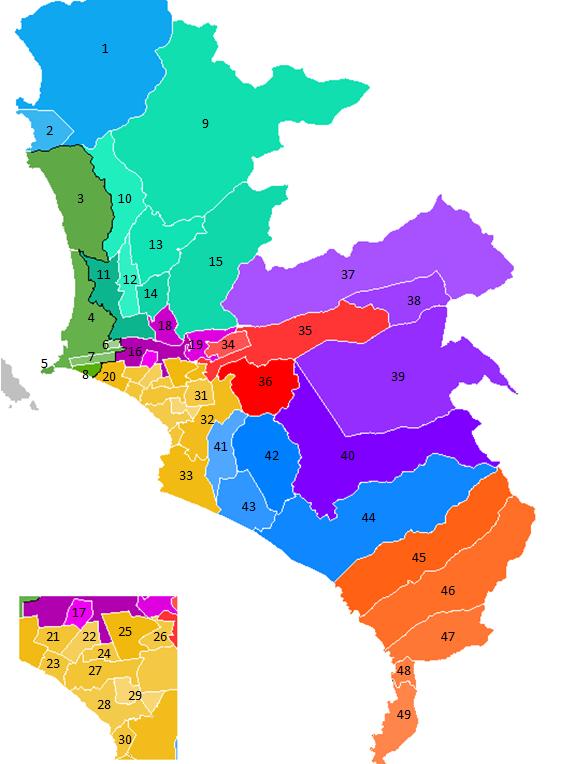
The metropolitan area is composed of five subregions. These are Lima Norte, Lima Sur, Lima Este, Central Lima, and Callao. Its estimated 2020 population is over 11 million according to the INEI.
The City of the Kings (Lima) was founded by Spanish colonists on January 18, 1535. The port of Callao was founded similarly two years later (1537). The city of Lima began when Francisco Pizarro declared it at what is known in Christianity as the Epiphany. He declared it at the center of the city, the Plaza Mayor. It would become the most important city in South America.
The city of Callao has also been highly important, as for hundreds of years it was the only port in all of the Viceroyalty of Peru (all of Spanish South America at the time) allowed to ship anything to the rest of the world. For hundreds of years, Lima and Callao were separated by a desert. This did not diminish the importance of the union between the two cities. It was not until the 19th century, that they were connected by a railroad. The metropolitan linkage between these two cities did not start until they both grew enough to, in essence, crash into each other.
In the present day, Lima is the most important metropolis in Peru and in the Andean region. The area's financial district is San Isidro. It is home to a large concentration of business centers, skyscrapers, and commerce. Miraflores and Barranco are two districts where the city's nightlife is mainly based in. Parts of the metropolis can be lively; music at night is common in some areas. Today different areas of the city have differing aspects and showcase variations in culture caused by varying times of settlement, differences in socio-economic level and immigration from other parts of Peru. The downtown area, unlike many downtowns in other major cities, is largely a historic district, and is home to many cathedrals and churches built during the Spanish colonial period.
In the latter half of the 20th century, the city has grown rapidly by migration from other regions of Peru. Many of these migrants began to form new communities called pueblos jovenes and asentamientos humanos, literally young towns and human settlements. These towns are similar to the favelas of Brazil, but considerably smaller. Many of them, have no running water or electricity and the city has been unable to provide the infrastructure to all the new residents. Many of the communities, such as Comas, and Villa El Salvador have evolved into modern districts, where residents have found the better life they were searching for.
The conurbation has an area of 2,819.26 km2. It is concentrated mainly in the coastal area and runs north–south along the Pacific coast for almost 200 km, beginning in the district of Ancón, on the border with the Huaral Province of the Lima region, and ending in the district of Pucusana, on the border with the Cañete Province, also in the Lima region. The Rímac, Chillón and Lurín rivers pass through the area. It is made up of in total 50 districts (43 of Lima Province and 7 of Constitutional Province of Callao). Most of the area is located in the desert whereas the eastern portion is located in the foothills of the Andes. It is the world's second largest desert city after Cairo, Egypt. The Lima metropolitan area is informally divided into five areas, Northern Lima, Southern Lima, Eastern Lima, Centro Lima and Callao.
Today, Lima and Callao have conurbanized to the point that only signs mark the borders. Hundreds of streets and highways link the two cities.
Hub AI
Lima metropolitan area AI simulator
(@Lima metropolitan area_simulator)
Lima metropolitan area
The Lima Metropolitan Area (Spanish: Área Metropolitana de Lima, also known as Lima Metropolitana) is an area formed by the conurbation of the Peruvian provinces of Lima (the nation's capital) and Callao. It is the largest of the metropolitan areas of Peru, the seventh largest in the Americas, the fourth largest in Latin America, and among the thirty largest in the world. The conurbation process started to be evident in the 1980s.
The metropolitan area is composed of five subregions. These are Lima Norte, Lima Sur, Lima Este, Central Lima, and Callao. Its estimated 2020 population is over 11 million according to the INEI.
The City of the Kings (Lima) was founded by Spanish colonists on January 18, 1535. The port of Callao was founded similarly two years later (1537). The city of Lima began when Francisco Pizarro declared it at what is known in Christianity as the Epiphany. He declared it at the center of the city, the Plaza Mayor. It would become the most important city in South America.
The city of Callao has also been highly important, as for hundreds of years it was the only port in all of the Viceroyalty of Peru (all of Spanish South America at the time) allowed to ship anything to the rest of the world. For hundreds of years, Lima and Callao were separated by a desert. This did not diminish the importance of the union between the two cities. It was not until the 19th century, that they were connected by a railroad. The metropolitan linkage between these two cities did not start until they both grew enough to, in essence, crash into each other.
In the present day, Lima is the most important metropolis in Peru and in the Andean region. The area's financial district is San Isidro. It is home to a large concentration of business centers, skyscrapers, and commerce. Miraflores and Barranco are two districts where the city's nightlife is mainly based in. Parts of the metropolis can be lively; music at night is common in some areas. Today different areas of the city have differing aspects and showcase variations in culture caused by varying times of settlement, differences in socio-economic level and immigration from other parts of Peru. The downtown area, unlike many downtowns in other major cities, is largely a historic district, and is home to many cathedrals and churches built during the Spanish colonial period.
In the latter half of the 20th century, the city has grown rapidly by migration from other regions of Peru. Many of these migrants began to form new communities called pueblos jovenes and asentamientos humanos, literally young towns and human settlements. These towns are similar to the favelas of Brazil, but considerably smaller. Many of them, have no running water or electricity and the city has been unable to provide the infrastructure to all the new residents. Many of the communities, such as Comas, and Villa El Salvador have evolved into modern districts, where residents have found the better life they were searching for.
The conurbation has an area of 2,819.26 km2. It is concentrated mainly in the coastal area and runs north–south along the Pacific coast for almost 200 km, beginning in the district of Ancón, on the border with the Huaral Province of the Lima region, and ending in the district of Pucusana, on the border with the Cañete Province, also in the Lima region. The Rímac, Chillón and Lurín rivers pass through the area. It is made up of in total 50 districts (43 of Lima Province and 7 of Constitutional Province of Callao). Most of the area is located in the desert whereas the eastern portion is located in the foothills of the Andes. It is the world's second largest desert city after Cairo, Egypt. The Lima metropolitan area is informally divided into five areas, Northern Lima, Southern Lima, Eastern Lima, Centro Lima and Callao.
Today, Lima and Callao have conurbanized to the point that only signs mark the borders. Hundreds of streets and highways link the two cities.
Recent media