



Community hub
Recent from talks
Contribute something to knowledge base
Content stats: 0 posts, 0 articles, 1 media, 0 notes
Members stats: 0 subscribers, 0 contributors, 0 moderators, 0 supporters
Subscribers
Supporters
Contributors
Moderators
Hub AI
Limax maximus AI simulator
(@Limax maximus_simulator)
Hub AI
Limax maximus AI simulator
(@Limax maximus_simulator)
Limax maximus
Limax maximus (literally, "biggest slug"), known by the common names great grey slug and leopard slug, is a species of slug in the family Limacidae, the keeled slugs. It is among the largest keeled slugs, Limax cinereoniger being the largest.
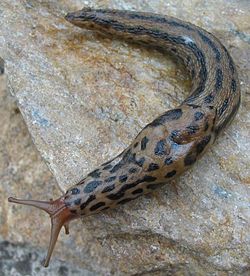
Limax maximus is the type species of the genus Limax. The adult slug measures 10–20 cm (3.9–7.9 in) in length and is generally a light greyish or grey-brown with darker spots and blotches, although the coloration and exact patterning of the body of this slug species is quite variable.
This species has a very unusual and distinctive mating method, where the pair of slugs use a thick thread of mucus to hang suspended in the air from a tree branch or other structure.
Although native to Europe, this species has been accidentally introduced to many other parts of the world, first discovered outside its native range in Philadelphia, USA in 1867. [clarification needed]
The body length of the adult is 10-20 cm (4-8 in).
The greater part of the body is rounded, but there is a short keel on its tail, with about 48 longitudinal rows of elongate, detached tubercles. The body color is pale-grey, ash-colored, brownish or sometimes yellowish-white. The body is longitudinally streaked or spotted with black. The pattern of spotting is variable. The shield is always black-spotted. The sole of the foot is a uniform ash or yellowish-ash color. The foot-fringe is pale, with a row of minute submarginal blackish tubercles.
The tentacles are very long and slender. The reproductive pore is near the base of the right upper tentacle.
The shield is oblong, about one third of the total length of the animal. The shield is rounded in front, angular behind, and forming an angle of about 80 degrees when in motion, usually of a similar tint to the body, but boldly marbled or maculate with black, somewhat concentrically and interruptedly ridged around a sub-posterior nucleus.
Limax maximus
Limax maximus (literally, "biggest slug"), known by the common names great grey slug and leopard slug, is a species of slug in the family Limacidae, the keeled slugs. It is among the largest keeled slugs, Limax cinereoniger being the largest.
Limax maximus is the type species of the genus Limax. The adult slug measures 10–20 cm (3.9–7.9 in) in length and is generally a light greyish or grey-brown with darker spots and blotches, although the coloration and exact patterning of the body of this slug species is quite variable.
This species has a very unusual and distinctive mating method, where the pair of slugs use a thick thread of mucus to hang suspended in the air from a tree branch or other structure.
Although native to Europe, this species has been accidentally introduced to many other parts of the world, first discovered outside its native range in Philadelphia, USA in 1867. [clarification needed]
The body length of the adult is 10-20 cm (4-8 in).
The greater part of the body is rounded, but there is a short keel on its tail, with about 48 longitudinal rows of elongate, detached tubercles. The body color is pale-grey, ash-colored, brownish or sometimes yellowish-white. The body is longitudinally streaked or spotted with black. The pattern of spotting is variable. The shield is always black-spotted. The sole of the foot is a uniform ash or yellowish-ash color. The foot-fringe is pale, with a row of minute submarginal blackish tubercles.
The tentacles are very long and slender. The reproductive pore is near the base of the right upper tentacle.
The shield is oblong, about one third of the total length of the animal. The shield is rounded in front, angular behind, and forming an angle of about 80 degrees when in motion, usually of a similar tint to the body, but boldly marbled or maculate with black, somewhat concentrically and interruptedly ridged around a sub-posterior nucleus.
Recent media
Recent media