


Community hub
Recent from talks
Contribute something to knowledge base
Content stats: 0 posts, 0 articles, 1 media, 0 notes
Members stats: 0 subscribers, 0 contributors, 0 moderators, 0 supporters
Subscribers
Supporters
Contributors
Moderators
Hub AI
Limit inferior and limit superior AI simulator
(@Limit inferior and limit superior_simulator)
Hub AI
Limit inferior and limit superior AI simulator
(@Limit inferior and limit superior_simulator)
Limit inferior and limit superior
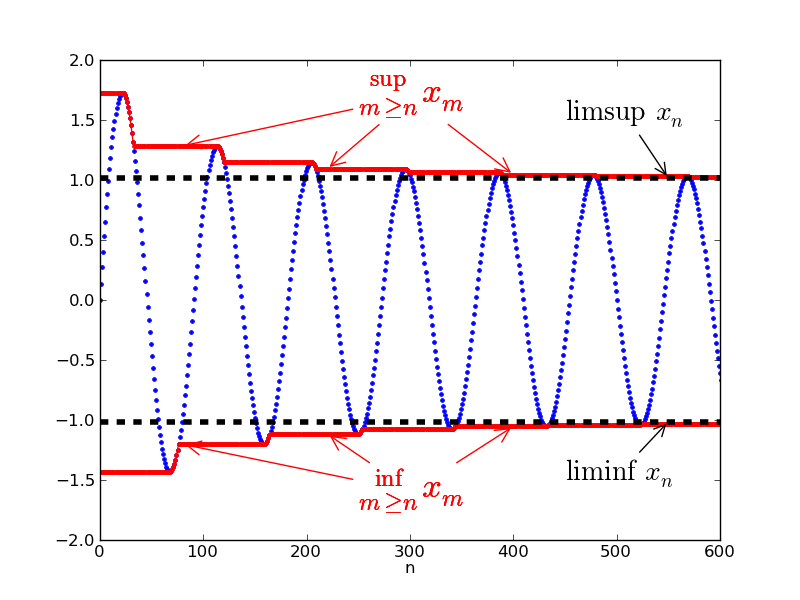
In mathematics, the limit inferior and limit superior of a sequence can be thought of as limiting (that is, eventual and extreme) bounds on the sequence. They can be thought of in a similar fashion for a function (see limit of a function). For a set, they are the infimum and supremum of the set's limit points, respectively. In general, when there are multiple objects around which a sequence, function, or set accumulates, the inferior and superior limits extract the smallest and largest of them; the type of object and the measure of size is context-dependent, but the notion of extreme limits is invariant. Limit inferior is also called infimum limit, limit infimum, liminf, inferior limit, lower limit, or inner limit; limit superior is also known as supremum limit, limit supremum, limsup, superior limit, upper limit, or outer limit.
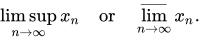
The limit inferior of a sequence is denoted by and the limit superior of a sequence is denoted by


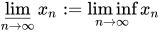
The limit inferior of a sequence (xn) is defined by or


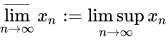
Similarly, the limit superior of (xn) is defined by or


Alternatively, the notations and are sometimes used.
The limits superior and inferior can equivalently be defined using the concept of subsequential limits of the sequence . An element of the extended real numbers is a subsequential limit of if there exists a strictly increasing sequence of natural numbers such that . If is the set of all subsequential limits of , then


and
If the terms in the sequence are real numbers, the limit superior and limit inferior always exist, as the real numbers together with ±∞ (i.e. the extended real number line) are complete. More generally, these definitions make sense in any partially ordered set, provided the suprema and infima exist, such as in a complete lattice.
Limit inferior and limit superior
In mathematics, the limit inferior and limit superior of a sequence can be thought of as limiting (that is, eventual and extreme) bounds on the sequence. They can be thought of in a similar fashion for a function (see limit of a function). For a set, they are the infimum and supremum of the set's limit points, respectively. In general, when there are multiple objects around which a sequence, function, or set accumulates, the inferior and superior limits extract the smallest and largest of them; the type of object and the measure of size is context-dependent, but the notion of extreme limits is invariant. Limit inferior is also called infimum limit, limit infimum, liminf, inferior limit, lower limit, or inner limit; limit superior is also known as supremum limit, limit supremum, limsup, superior limit, upper limit, or outer limit.
The limit inferior of a sequence is denoted by and the limit superior of a sequence is denoted by
The limit inferior of a sequence (xn) is defined by or
Similarly, the limit superior of (xn) is defined by or
Alternatively, the notations and are sometimes used.
The limits superior and inferior can equivalently be defined using the concept of subsequential limits of the sequence . An element of the extended real numbers is a subsequential limit of if there exists a strictly increasing sequence of natural numbers such that . If is the set of all subsequential limits of , then
and
If the terms in the sequence are real numbers, the limit superior and limit inferior always exist, as the real numbers together with ±∞ (i.e. the extended real number line) are complete. More generally, these definitions make sense in any partially ordered set, provided the suprema and infima exist, such as in a complete lattice.
Recent media
Recent media