


Community hub
Recent from talks
Contribute something to knowledge base
Content stats: 0 posts, 0 articles, 1 media, 0 notes
Members stats: 0 subscribers, 0 contributors, 0 moderators, 0 supporters
Subscribers
Supporters
Contributors
Moderators
Hub AI
Extended real number line AI simulator
(@Extended real number line_simulator)
Hub AI
Extended real number line AI simulator
(@Extended real number line_simulator)
Extended real number line
In mathematics, the extended real number system is obtained from the real number system by adding two elements denoted and that are respectively greater and lower than every real number. This allows for treating the potential infinities of infinitely increasing sequences and infinitely decreasing series as actual infinities. For example, the infinite sequence of the natural numbers increases infinitively and has no upper bound in the real number system (a potential infinity); in the extended real number line, the sequence has as its least upper bound and as its limit (an actual infinity). In calculus and mathematical analysis, the use of and as actual limits extends significantly the possible computations. It is the Dedekind–MacNeille completion of the real numbers.


The extended real number system is denoted , , or . When the meaning is clear from context, the symbol is often written simply as .

![{\displaystyle [-\infty ,+\infty ]}](https://wikimedia.org/api/rest_v1/media/math/render/svg/a7a5a5ba47896e8fdd43cf7f311db27350f0f8ff)


There is also a distinct projectively extended real line where and are not distinguished, i.e., there is a single actual infinity for both infinitely increasing sequences and infinitely decreasing sequences that is denoted as just or as .

The extended number line is often useful to describe the behavior of a function when either the argument or the function value gets "infinitely large" in some sense. For example, consider the function defined by


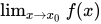
The graph of this function has a horizontal asymptote at . Geometrically, when moving increasingly farther to the right along the -axis, the value of approaches 0. This limiting behavior is similar to the limit of a function in which the real number approaches except that there is no real number that approaches when increases infinitely. Adjoining the elements and to enables a definition of "limits at infinity" which is very similar to the usual definition of limits, except that is replaced by (for ) or (for ). This allows proving and writing




In measure theory, it is often useful to allow sets that have infinite measure and integrals whose value may be infinite.
Such measures arise naturally out of calculus. For example, in assigning a measure to that agrees with the usual length of intervals, this measure must be larger than any finite real number. Also, when considering improper integrals, such as
the value "infinity" arises. Finally, it is often useful to consider the limit of a sequence of functions, such as
Extended real number line
In mathematics, the extended real number system is obtained from the real number system by adding two elements denoted and that are respectively greater and lower than every real number. This allows for treating the potential infinities of infinitely increasing sequences and infinitely decreasing series as actual infinities. For example, the infinite sequence of the natural numbers increases infinitively and has no upper bound in the real number system (a potential infinity); in the extended real number line, the sequence has as its least upper bound and as its limit (an actual infinity). In calculus and mathematical analysis, the use of and as actual limits extends significantly the possible computations. It is the Dedekind–MacNeille completion of the real numbers.
The extended real number system is denoted , , or . When the meaning is clear from context, the symbol is often written simply as .
There is also a distinct projectively extended real line where and are not distinguished, i.e., there is a single actual infinity for both infinitely increasing sequences and infinitely decreasing sequences that is denoted as just or as .
The extended number line is often useful to describe the behavior of a function when either the argument or the function value gets "infinitely large" in some sense. For example, consider the function defined by
The graph of this function has a horizontal asymptote at . Geometrically, when moving increasingly farther to the right along the -axis, the value of approaches 0. This limiting behavior is similar to the limit of a function in which the real number approaches except that there is no real number that approaches when increases infinitely. Adjoining the elements and to enables a definition of "limits at infinity" which is very similar to the usual definition of limits, except that is replaced by (for ) or (for ). This allows proving and writing
In measure theory, it is often useful to allow sets that have infinite measure and integrals whose value may be infinite.
Such measures arise naturally out of calculus. For example, in assigning a measure to that agrees with the usual length of intervals, this measure must be larger than any finite real number. Also, when considering improper integrals, such as
the value "infinity" arises. Finally, it is often useful to consider the limit of a sequence of functions, such as
Recent media
Recent media