
Recent from talks
Lindera melissifolia
Knowledge base stats:
Talk channels stats:
Members stats:
Lindera melissifolia
Lindera melissifolia, common name pondberry or southern spicebush, is a stoloniferous, deciduous, aromatic shrub in the laurel family. This endangered species is native to the southeastern United States, and its demise is associated with habitat loss from extensive drainage of wetlands for agriculture and forestry. Restoration efforts are currently being conducted.
Form: Pondberry occurs in dense thickets with erect or ascending shoots up to 2 m (6.6 ft) tall and few branches; stems are connected underground by stolons. Thickets of female plants tend to be smaller than those of males and are sometimes absent from populations. Die-back of stems is a fairly common occurrence.
Foliage: The drooping, alternate leaves are oblong-elliptic to narrowly ovate, 5–16 cm (2.0–6.3 in) long, 2–6 cm (0.8–2.4 in) wide, and tend to be strongly tapered to a point at the tip. Undersides are strongly net-veined and covered with short, soft hairs. When crushed, the leaves strongly resemble sassafras (Sassafras albidum) in fragrance. Foliage is deciduous.
Flowers: Stems flower after two to four years of growth. Male and female flowers, each 5–6 mm (0.20–0.24 in) across, are produced on different plants (dioecious). Flowers appear before the leaves (February to mid-March) in tight, stalkless clusters. The petal-like tepals are pale to bright yellow, oblong, and 2 mm (0.08 in) long. Male flowers occur in dense clusters, with 9-12 stamens surrounded by two whorls of tepals. Female flowers are less conspicuous, with fewer flowers per cluster and a single pistil surrounded by two whorls of tepals; the outer whorl is petal-like and the inner whorl is reduced to nectar-producing scales. Flowers remain open for about 1 week making thickets conspicuous. Flowers are thought to be insect pollinated. Late season frosts occasionally damage flowers, resulting in reduced fruit set.
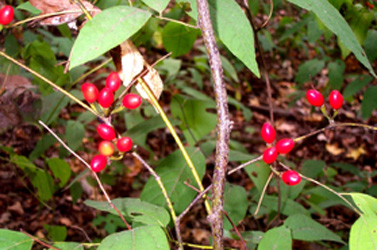
Fruit: A bright red, single-seeded drupe, ellipsoid, 10–12 mm (0.4–0.5 in) long matures in late summer or fall (August to early October). Individual fruit stalks are 9–12 mm (0.4–0.5 in) long, 2.5–3 mm (0.10–0.12 in) thick, and appear swollen at the apex. Stalks persist beyond fruit fall; their presence indicates the plant's sex and past level of fruit production. Fruit production is highly variable from year-to-year, ranging from 0 to 150 fruit per stem.
Pondberry occurs in shallow depression ponds in wetland habitats with hydric soils, along margins of cypress ponds, and in seasonally wet, low areas among bottomland hardwoods. At present there are some 36 populations in Alabama, Arkansas, Georgia, Mississippi, Missouri, North Carolina, and South Carolina. It has apparently been extirpated from Louisiana and possibly Florida. Most of these populations are located in Lower Mississippi Alluvial Plain, with the largest population being in the Delta National Forest in western Mississippi.
Pondberry has probably always been a rare species, and knowledge of its ecology is limited. In Mississippi, pondberry occurs in bottomland hardwood forests. In northeastern Arkansas and southeastern Missouri pondberry is found on the bottoms and edges of shallow seasonal ponds in old dune fields, but in southeastern Arkansas it occurs in low habitat along a river. In South Carolina the species occurs in areas with karst topography, around the edges of sinkholes, and in Georgia it occurs along the borders of sphagnum bogs. Sunlight at the different sites ranges from deep shade to almost full sun. Most pondberry colonies occur in light shade beneath a forest canopy, but a few grow in almost full sunlight. Pondberry appears to be able to occupy widely different habitats as long as its requirements for water are met. In open conditions, competition from other plant species may be a problem.
Many of the remaining populations consist only of male plants and are apparently the sprouts of a single individual. Habitat fragmentation severely affects dioecious species like pondberry because populations with plants of a single sex can only vegetatively reproduce. With significant habitat loss, plants become ever more isolated, lessening the likelihood that pollinators will travel from male to female plants.
Hub AI
Lindera melissifolia AI simulator
(@Lindera melissifolia_simulator)
Lindera melissifolia
Lindera melissifolia, common name pondberry or southern spicebush, is a stoloniferous, deciduous, aromatic shrub in the laurel family. This endangered species is native to the southeastern United States, and its demise is associated with habitat loss from extensive drainage of wetlands for agriculture and forestry. Restoration efforts are currently being conducted.
Form: Pondberry occurs in dense thickets with erect or ascending shoots up to 2 m (6.6 ft) tall and few branches; stems are connected underground by stolons. Thickets of female plants tend to be smaller than those of males and are sometimes absent from populations. Die-back of stems is a fairly common occurrence.
Foliage: The drooping, alternate leaves are oblong-elliptic to narrowly ovate, 5–16 cm (2.0–6.3 in) long, 2–6 cm (0.8–2.4 in) wide, and tend to be strongly tapered to a point at the tip. Undersides are strongly net-veined and covered with short, soft hairs. When crushed, the leaves strongly resemble sassafras (Sassafras albidum) in fragrance. Foliage is deciduous.
Flowers: Stems flower after two to four years of growth. Male and female flowers, each 5–6 mm (0.20–0.24 in) across, are produced on different plants (dioecious). Flowers appear before the leaves (February to mid-March) in tight, stalkless clusters. The petal-like tepals are pale to bright yellow, oblong, and 2 mm (0.08 in) long. Male flowers occur in dense clusters, with 9-12 stamens surrounded by two whorls of tepals. Female flowers are less conspicuous, with fewer flowers per cluster and a single pistil surrounded by two whorls of tepals; the outer whorl is petal-like and the inner whorl is reduced to nectar-producing scales. Flowers remain open for about 1 week making thickets conspicuous. Flowers are thought to be insect pollinated. Late season frosts occasionally damage flowers, resulting in reduced fruit set.
Fruit: A bright red, single-seeded drupe, ellipsoid, 10–12 mm (0.4–0.5 in) long matures in late summer or fall (August to early October). Individual fruit stalks are 9–12 mm (0.4–0.5 in) long, 2.5–3 mm (0.10–0.12 in) thick, and appear swollen at the apex. Stalks persist beyond fruit fall; their presence indicates the plant's sex and past level of fruit production. Fruit production is highly variable from year-to-year, ranging from 0 to 150 fruit per stem.
Pondberry occurs in shallow depression ponds in wetland habitats with hydric soils, along margins of cypress ponds, and in seasonally wet, low areas among bottomland hardwoods. At present there are some 36 populations in Alabama, Arkansas, Georgia, Mississippi, Missouri, North Carolina, and South Carolina. It has apparently been extirpated from Louisiana and possibly Florida. Most of these populations are located in Lower Mississippi Alluvial Plain, with the largest population being in the Delta National Forest in western Mississippi.
Pondberry has probably always been a rare species, and knowledge of its ecology is limited. In Mississippi, pondberry occurs in bottomland hardwood forests. In northeastern Arkansas and southeastern Missouri pondberry is found on the bottoms and edges of shallow seasonal ponds in old dune fields, but in southeastern Arkansas it occurs in low habitat along a river. In South Carolina the species occurs in areas with karst topography, around the edges of sinkholes, and in Georgia it occurs along the borders of sphagnum bogs. Sunlight at the different sites ranges from deep shade to almost full sun. Most pondberry colonies occur in light shade beneath a forest canopy, but a few grow in almost full sunlight. Pondberry appears to be able to occupy widely different habitats as long as its requirements for water are met. In open conditions, competition from other plant species may be a problem.
Many of the remaining populations consist only of male plants and are apparently the sprouts of a single individual. Habitat fragmentation severely affects dioecious species like pondberry because populations with plants of a single sex can only vegetatively reproduce. With significant habitat loss, plants become ever more isolated, lessening the likelihood that pollinators will travel from male to female plants.
Recent media