



Community hub
Recent from talks
Contribute something to knowledge base
Content stats: 0 posts, 0 articles, 1 media, 0 notes
Members stats: 0 subscribers, 0 contributors, 0 moderators, 0 supporters
Subscribers
Supporters
Contributors
Moderators
Hub AI
Line infantry AI simulator
(@Line infantry_simulator)
Hub AI
Line infantry AI simulator
(@Line infantry_simulator)
Line infantry
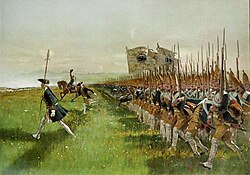
Line infantry was the type of infantry that trained and organized to fight in linear formations, usually arranged two or three ranks deep, to deliver coordinated volleys of musket or rifle fire. This method of warfare began in the late sixteenth and early seventeenth centuries, with its origins commonly attributed to reforms by Maurice of Nassau and the Dutch army. Dutch practices were soon adopted by other European armies and became widespread through military manuals, the movement of officers, and the training of foreign troops by Dutch instructors. Further development occurred in the eighteenth century under leaders such as Frederick the Great of Prussia, who refined drill, discipline, and the use of concentrated musket fire. His methods made the Prussian infantry a model for other European powers. The tactics and organization of line infantry reached their most widespread application during the Napoleonic Wars, when massed ranks of soldiers firing in volleys formed the core of European armies on large battlefields.
Line infantry continued to play a central role in major conflicts into the nineteenth century. The American Civil War saw some of the last large-scale uses of linear tactics, although changes in weapon technology were already making such formations increasingly risky. The introduction of rifled muskets and then breech-loading rifles, along with advances in artillery, increased the range, accuracy, and lethality of battlefield fire. These changes made dense lines of infantry more vulnerable and reduced the effectiveness of traditional line tactics. By the late nineteenth century, most armies had shifted to looser formations and new approaches to infantry combat, leading to the decline of line infantry as the standard method of organization and fighting.
In the 16th and 17th century most battles where fought in squares or tercios composed of pikemen with smaller squares of musketeers at all four corners. The formation first appeared in Spain in 1534, and was initially composed of 12 companies of 250 men, each company being subdivided into ten squads (esquadras) of 25 men.
Advances in weaponry during this period led to major changes in military tactics. Spanish commanders tested various methods to improve the effectiveness of firearms, but Maurice of Nassau introduced the most successful approach in the 1590s. He drew inspiration from Roman military writers and began incorporating exercises such as forming and reforming ranks, drilling, and parading. William Louis of Nassau, Maurice’s cousin, realized after reading Aelian’s Tactics that rotating ranks of musketeers could maintain a steady rate of fire. This system allowed soldiers to fire in groups, then move to the back to reload while another group fired, creating a continuous stream of musket fire and addressing the slow firing rate of muzzle-loading muskets.
This development changed how armies deployed on the battlefield. Forces now spread out more, both to increase the effectiveness of their own gunfire and to lessen their vulnerability to enemy fire. The linear arrangement of troops meant more soldiers could fire at the enemy at once, which increased the lethality of engagements. However, this also meant that more soldiers faced direct combat, requiring greater discipline, skill, and courage from each individual. Success depended on soldiers and entire units executing complex maneuvers quickly and in coordination. To achieve this, the Nassau family reduced the size of military units for better training and control.
Companies became smaller, and large regiments were replaced by more manageable battalions. Count John of Nassau contributed to these reforms by creating drill books and founding a military academy at Siegen in 1616 to educate young officers. The curriculum included practical instruction with weapons, maps, and models, and the academy’s first director published manuals based on Dutch methods. These Dutch training techniques and tactical systems quickly spread throughout Europe, especially in Protestant regions, as many foreigners served in the Dutch army or learned from published treatises.
Gustav II Adolf of Sweden was among the earliest commanders to make extensive use of the new tactics. He had learned from Jacob De la Gardie, a former student at the military academy in Siegen, who brought Dutch influences to Sweden. Gustavus maintained the basic structure of Maurice of Nassau’s linear formations but made his arrangements more flexible and mobile, placing stronger emphasis on the integration of different troop types within his army. One of Gustavus’s main innovations was to increase the number of musketeers in his formations and to reduce the depth of the combat line to six ranks, compared to the customary ten.
He also replaced older arquebuses with improved matchlock muskets, initially fired from forked rests and later by lighter models that could be used from the shoulder. For greater efficiency, Gustavus introduced paper cartridges that contained both gunpowder and a ball, allowing soldiers to load and fire more quickly. With these, each musketeer carried a bandoleer or belt holding up to fifteen ready-to-use cartridges, which simplified the loading process on the battlefield.
Line infantry
Line infantry was the type of infantry that trained and organized to fight in linear formations, usually arranged two or three ranks deep, to deliver coordinated volleys of musket or rifle fire. This method of warfare began in the late sixteenth and early seventeenth centuries, with its origins commonly attributed to reforms by Maurice of Nassau and the Dutch army. Dutch practices were soon adopted by other European armies and became widespread through military manuals, the movement of officers, and the training of foreign troops by Dutch instructors. Further development occurred in the eighteenth century under leaders such as Frederick the Great of Prussia, who refined drill, discipline, and the use of concentrated musket fire. His methods made the Prussian infantry a model for other European powers. The tactics and organization of line infantry reached their most widespread application during the Napoleonic Wars, when massed ranks of soldiers firing in volleys formed the core of European armies on large battlefields.
Line infantry continued to play a central role in major conflicts into the nineteenth century. The American Civil War saw some of the last large-scale uses of linear tactics, although changes in weapon technology were already making such formations increasingly risky. The introduction of rifled muskets and then breech-loading rifles, along with advances in artillery, increased the range, accuracy, and lethality of battlefield fire. These changes made dense lines of infantry more vulnerable and reduced the effectiveness of traditional line tactics. By the late nineteenth century, most armies had shifted to looser formations and new approaches to infantry combat, leading to the decline of line infantry as the standard method of organization and fighting.
In the 16th and 17th century most battles where fought in squares or tercios composed of pikemen with smaller squares of musketeers at all four corners. The formation first appeared in Spain in 1534, and was initially composed of 12 companies of 250 men, each company being subdivided into ten squads (esquadras) of 25 men.
Advances in weaponry during this period led to major changes in military tactics. Spanish commanders tested various methods to improve the effectiveness of firearms, but Maurice of Nassau introduced the most successful approach in the 1590s. He drew inspiration from Roman military writers and began incorporating exercises such as forming and reforming ranks, drilling, and parading. William Louis of Nassau, Maurice’s cousin, realized after reading Aelian’s Tactics that rotating ranks of musketeers could maintain a steady rate of fire. This system allowed soldiers to fire in groups, then move to the back to reload while another group fired, creating a continuous stream of musket fire and addressing the slow firing rate of muzzle-loading muskets.
This development changed how armies deployed on the battlefield. Forces now spread out more, both to increase the effectiveness of their own gunfire and to lessen their vulnerability to enemy fire. The linear arrangement of troops meant more soldiers could fire at the enemy at once, which increased the lethality of engagements. However, this also meant that more soldiers faced direct combat, requiring greater discipline, skill, and courage from each individual. Success depended on soldiers and entire units executing complex maneuvers quickly and in coordination. To achieve this, the Nassau family reduced the size of military units for better training and control.
Companies became smaller, and large regiments were replaced by more manageable battalions. Count John of Nassau contributed to these reforms by creating drill books and founding a military academy at Siegen in 1616 to educate young officers. The curriculum included practical instruction with weapons, maps, and models, and the academy’s first director published manuals based on Dutch methods. These Dutch training techniques and tactical systems quickly spread throughout Europe, especially in Protestant regions, as many foreigners served in the Dutch army or learned from published treatises.
Gustav II Adolf of Sweden was among the earliest commanders to make extensive use of the new tactics. He had learned from Jacob De la Gardie, a former student at the military academy in Siegen, who brought Dutch influences to Sweden. Gustavus maintained the basic structure of Maurice of Nassau’s linear formations but made his arrangements more flexible and mobile, placing stronger emphasis on the integration of different troop types within his army. One of Gustavus’s main innovations was to increase the number of musketeers in his formations and to reduce the depth of the combat line to six ranks, compared to the customary ten.
He also replaced older arquebuses with improved matchlock muskets, initially fired from forked rests and later by lighter models that could be used from the shoulder. For greater efficiency, Gustavus introduced paper cartridges that contained both gunpowder and a ball, allowing soldiers to load and fire more quickly. With these, each musketeer carried a bandoleer or belt holding up to fifteen ready-to-use cartridges, which simplified the loading process on the battlefield.
Recent media
Recent media