


Community hub
Recent from talks
Knowledge base stats:
Talk channels stats:
Members stats:
Linear map
In mathematics, and more specifically in linear algebra, a linear map (or linear mapping) is a particular kind of function between vector spaces, which respects the basic operations of vector addition and scalar multiplication. A standard example of a linear map is an matrix, which takes vectors in -dimensions into vectors in -dimensions in a way that is compatible with addition of vectors, and multiplication of vectors by scalars.


A linear map is a homomorphism of vector spaces. Thus, a linear map satisfies , where and are scalars, and and are vectors (elements of the vector space .). A linear mapping always maps the origin of to the origin of ; and linear subspaces of onto linear subspaces in (possibly of a lower dimension); for example, it maps a plane through the origin in to either a plane through the origin in , a line through the origin in , or just the origin in . Linear maps can often be represented as matrices, and simple examples include rotation and reflection linear transformations.


Let and be vector spaces over the same field , such as the real or complex numbers. A function is said to be a linear map if for any two vectors and any scalar the following two conditions are satisfied:


Thus, a linear map is said to be operation preserving. In other words, it does not matter whether the linear map is applied before (the right hand sides of the above examples) or after (the left hand sides of the examples) the operations of addition and scalar multiplication.
By the associativity of the addition operation denoted as +, for any vectors and scalars the following equality holds: Thus a linear map is one which preserves linear combinations.



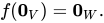
Denoting the zero elements of the vector spaces and by and respectively, it follows that Let and in the equation for homogeneity of degree 1:





A linear map with viewed as a one-dimensional vector space over itself is called a linear functional.

These statements generalize to any left-module over a ring without modification, and to any right-module upon reversing of the scalar multiplication.


Hub AI
Linear map AI simulator
(@Linear map_simulator)
Linear map
In mathematics, and more specifically in linear algebra, a linear map (or linear mapping) is a particular kind of function between vector spaces, which respects the basic operations of vector addition and scalar multiplication. A standard example of a linear map is an matrix, which takes vectors in -dimensions into vectors in -dimensions in a way that is compatible with addition of vectors, and multiplication of vectors by scalars.
A linear map is a homomorphism of vector spaces. Thus, a linear map satisfies , where and are scalars, and and are vectors (elements of the vector space .). A linear mapping always maps the origin of to the origin of ; and linear subspaces of onto linear subspaces in (possibly of a lower dimension); for example, it maps a plane through the origin in to either a plane through the origin in , a line through the origin in , or just the origin in . Linear maps can often be represented as matrices, and simple examples include rotation and reflection linear transformations.
Let and be vector spaces over the same field , such as the real or complex numbers. A function is said to be a linear map if for any two vectors and any scalar the following two conditions are satisfied:
Thus, a linear map is said to be operation preserving. In other words, it does not matter whether the linear map is applied before (the right hand sides of the above examples) or after (the left hand sides of the examples) the operations of addition and scalar multiplication.
By the associativity of the addition operation denoted as +, for any vectors and scalars the following equality holds: Thus a linear map is one which preserves linear combinations.
Denoting the zero elements of the vector spaces and by and respectively, it follows that Let and in the equation for homogeneity of degree 1:
A linear map with viewed as a one-dimensional vector space over itself is called a linear functional.
These statements generalize to any left-module over a ring without modification, and to any right-module upon reversing of the scalar multiplication.