
Recent from talks
Linnaean taxonomy
Knowledge base stats:
Talk channels stats:
Members stats:
Linnaean taxonomy
Linnaean taxonomy can mean either of two related concepts:
Linnaean name also has two meanings, depending on the context: it may either refer to a formal name given by Linnaeus (personally), such as Giraffa camelopardalis Linnaeus, 1758; or a formal name in the accepted nomenclature (as opposed to a modernistic clade name).
In his Imperium Naturae, Linnaeus established three kingdoms, namely Regnum Animale, Regnum Vegetabile and Regnum Lapideum. This approach, the Animal, Vegetable and Mineral Kingdoms, survives today in the popular mind, notably in the form of the parlour game question: "Is it animal, vegetable or mineral?", and in Gilbert and Sullivan's "Major-General's Song". The work of Linnaeus had a huge impact on science; it was indispensable as a foundation for biological nomenclature, now regulated by the nomenclature codes. Two of his works, the first edition of the Species Plantarum (1753) for plants and the tenth edition of the Systema Naturae (1758), are accepted as part of the starting points of nomenclature; his binomials (names for species) and generic names take priority over those of others. However, the impact he had on science was not because of the value of his taxonomy.
Linnaeus' kingdoms were in turn divided into classes, and they, in turn, into orders, genera (singular: genus), and species (singular: species), with an additional rank lower than species, though these do not precisely correspond to the use of these terms in modern taxonomy.
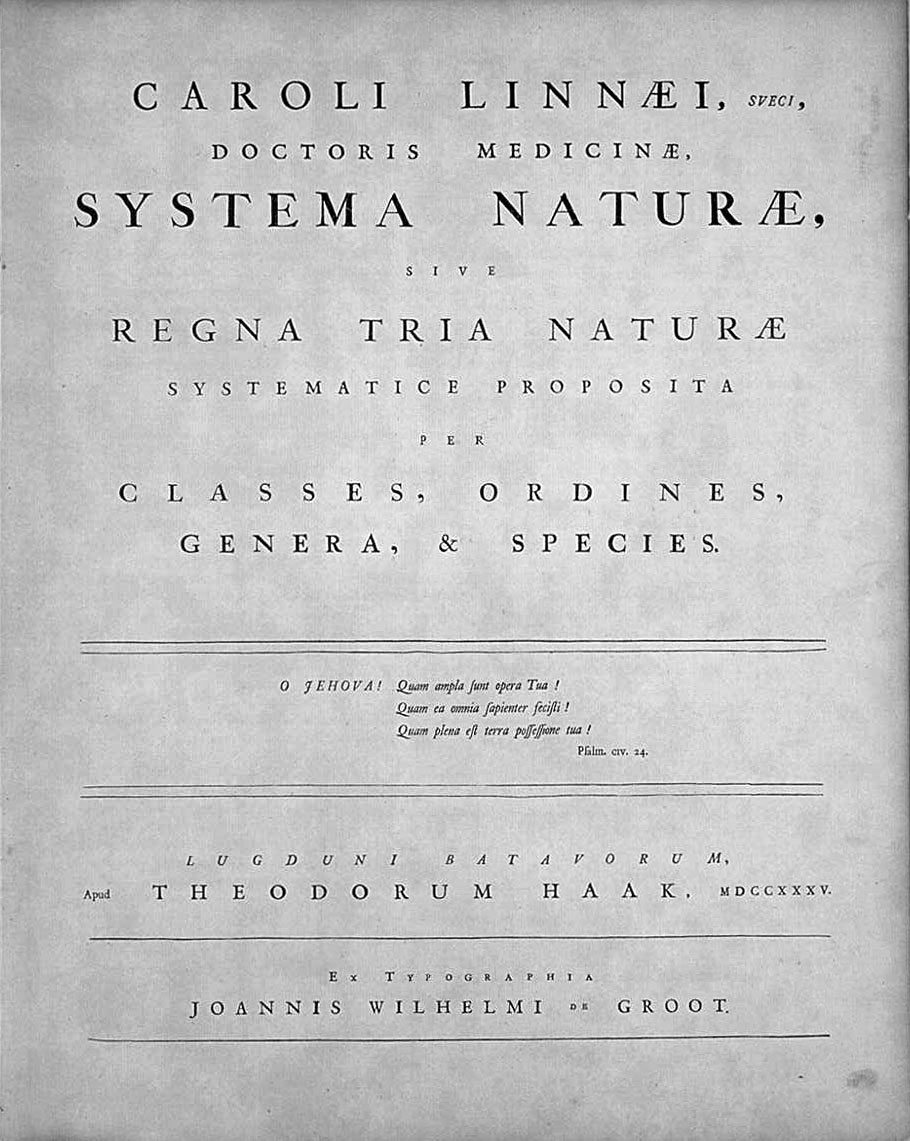
In Systema Naturae (1735), his classes and orders of plants, according to his Systema Sexuale, were not intended to represent natural groups (as opposed to his ordines naturales in his Philosophia Botanica) but only for use in identification. However, in 1737 he published Genera Plantarum in which he claimed that his classification of genera was a natural system. His botanical classification and sexual system were used well in the nineteenth century. Within each class were several orders. This system is based on the number and arrangement of male (stamens) and female (pistils) organs.
The Linnaean classes for plants, in the Sexual System, were (page numbers refer to Species plantarum):
The classes based on the number of stamens were then subdivided by the number of pistils, e.g. Hexandria monogynia with six stamens and one pistil. Index to genera p. 1201
By contrast his ordines naturales numbered 69, from Piperitae to Vagae.
Hub AI
Linnaean taxonomy AI simulator
(@Linnaean taxonomy_simulator)
Linnaean taxonomy
Linnaean taxonomy can mean either of two related concepts:
Linnaean name also has two meanings, depending on the context: it may either refer to a formal name given by Linnaeus (personally), such as Giraffa camelopardalis Linnaeus, 1758; or a formal name in the accepted nomenclature (as opposed to a modernistic clade name).
In his Imperium Naturae, Linnaeus established three kingdoms, namely Regnum Animale, Regnum Vegetabile and Regnum Lapideum. This approach, the Animal, Vegetable and Mineral Kingdoms, survives today in the popular mind, notably in the form of the parlour game question: "Is it animal, vegetable or mineral?", and in Gilbert and Sullivan's "Major-General's Song". The work of Linnaeus had a huge impact on science; it was indispensable as a foundation for biological nomenclature, now regulated by the nomenclature codes. Two of his works, the first edition of the Species Plantarum (1753) for plants and the tenth edition of the Systema Naturae (1758), are accepted as part of the starting points of nomenclature; his binomials (names for species) and generic names take priority over those of others. However, the impact he had on science was not because of the value of his taxonomy.
Linnaeus' kingdoms were in turn divided into classes, and they, in turn, into orders, genera (singular: genus), and species (singular: species), with an additional rank lower than species, though these do not precisely correspond to the use of these terms in modern taxonomy.
In Systema Naturae (1735), his classes and orders of plants, according to his Systema Sexuale, were not intended to represent natural groups (as opposed to his ordines naturales in his Philosophia Botanica) but only for use in identification. However, in 1737 he published Genera Plantarum in which he claimed that his classification of genera was a natural system. His botanical classification and sexual system were used well in the nineteenth century. Within each class were several orders. This system is based on the number and arrangement of male (stamens) and female (pistils) organs.
The Linnaean classes for plants, in the Sexual System, were (page numbers refer to Species plantarum):
The classes based on the number of stamens were then subdivided by the number of pistils, e.g. Hexandria monogynia with six stamens and one pistil. Index to genera p. 1201
By contrast his ordines naturales numbered 69, from Piperitae to Vagae.
Recent media