



Community hub
Recent from talks
Contribute something to knowledge base
Content stats: 0 posts, 0 articles, 1 media, 0 notes
Members stats: 0 subscribers, 0 contributors, 0 moderators, 0 supporters
Subscribers
Supporters
Contributors
Moderators
Hub AI
Little Falls station AI simulator
(@Little Falls station_simulator)
Hub AI
Little Falls station AI simulator
(@Little Falls station_simulator)
Little Falls station
Little Falls is an active commuter railroad station in the eponymous township of Little Falls, Passaic County, New Jersey. The station, located at the end of Union Boulevard, serves trains of NJ Transit's Montclair–Boonton Line only during rush hour. Trains go between New York Penn Station, Hoboken Terminal to Dover and Hackettstown. The station is one of several stops west of Great Notch Yard and east of Denville station that does not have electrified railroad service, resulting in less frequent service. Little Falls station contains a single low-level side platform and the former Erie Railroad-built brick station depot.
Railroad service in Little Falls began on January 1, 1873 with the opening of the Montclair Railway, a short line that would become the New York and Greenwood Lake Railway, a subsidiary of the Erie Railroad. Originally one of four stations in the township built by the Erie Railroad, Little Falls is the last remaining station after Great Notch closed on January 17, 2010. Montclair State University station is also within the municipality.
The first railroad service through Little Falls came on January 1, 1873 with the opening of the Montclair Railway from Jersey City to Sterling Forest on the shore of Greenwood Lake. At the time of opening, the line had two stations in the township: Great Notch and one called Little Falls. Little Falls station was 18 miles (29 km) and 63 minutes from Jersey City, serving twelve trains per day. Joseph Cooke was named the first station agent at Little Falls station in 1873. He also served as the telegraph operator.
Little Falls at the time of the railroad opening was a small community, with a local school, stores, churches and the Beattie Carpet Mill, which opened in 1842. The municipality also had two stagecoach runs to Paterson and three runs of mail service. At the time of opening, the township saw the railroad as beneficial for the community, given that trips to get to any area railroad station would involve a ride by horse of at least 1-mile (1.6 km). Speculation was that a new station on the line would promote rapid development of the area as people would want to move on a permanent and temporary basis to Little Falls. However, they felt that the growth would be held back by wealthy landowners who did not want to sell their land for development, despite the profit opportunities.
The original station depot at Little Falls was a small shanty for Cooke to use. In mid-July 1879, the New York and Greenwood Lake Railway (the successor of the Montclair Railway) announced that they would replace the shanty with a new station depot. Reacting to an article in the Montclair Times suggesting that the railroad make Little Falls a major terminus instead of Montclair Heights station, the railroad announced that they would build a new station depot, a brick structure that would be open by August 1879.
Little Falls station and the Boonton Line fell under the guise of the Consolidated Rail Corporation (Conrail) on April 1, 1976 after the federal government took over the Erie Lackawanna Railroad. By October 1976, local officials were asking the New Jersey Department of Transportation (NJDOT) about funding to refurbish the two active stations in the township. NJDOT stated that they did not have funds left from a 1968 state bond issue and that they would have to rely on other sources for funding to repair the stations. Officials showed concern about the poor condition of both railroad stations, stating that they were both in a dilapidated state and were problems for traffic in the area. Little Falls station had the depot and the parking lot in poor condition, with the latter having few or no markings.
Passaic County's planner, John Mancinelli, performed a study of all the active railroad stations in the county, suggesting that a new park and ride could be built on County Route 620 (Clove Road) at the site of a defunct quarry owned by Montclair State College to replace Great Notch and Montclair Heights stations. Mancinelli suggested that since Conrail owned the Little Falls station parking lot, that they would be able to get the agency to improve it with a little municipal force.
Progress languished through early 1977 and by June, the only thing accomplished was the installation of a fence. Little Falls station had potholes growing in the un-maintained parking lot, which also was poorly lit while the depot had bricks falling off the frame. The municipality stated that routine maintenance should not be their responsibility, but Conrail responded that they would not spend the money out of pocket to upgrade the facilities and that any project would have to come from state funding. NJDOT added that Conrail should be the one to maintain the depots and that Conrail had a poor track record on getting things done. Joseph Harvey, a public relations officer for Conrail, added that the options for the station would be maintenance or demolition of the two station depots. Harvey stated that if maintenance were occurring on routine basis that it would be better to level the structures. He reiterated that any funding would need 100% reimbursement from the state, requiring approvals from Little Falls, Passaic County, NJDOT and Conrail.
Little Falls station
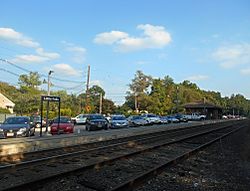
Little Falls is an active commuter railroad station in the eponymous township of Little Falls, Passaic County, New Jersey. The station, located at the end of Union Boulevard, serves trains of NJ Transit's Montclair–Boonton Line only during rush hour. Trains go between New York Penn Station, Hoboken Terminal to Dover and Hackettstown. The station is one of several stops west of Great Notch Yard and east of Denville station that does not have electrified railroad service, resulting in less frequent service. Little Falls station contains a single low-level side platform and the former Erie Railroad-built brick station depot.
Railroad service in Little Falls began on January 1, 1873 with the opening of the Montclair Railway, a short line that would become the New York and Greenwood Lake Railway, a subsidiary of the Erie Railroad. Originally one of four stations in the township built by the Erie Railroad, Little Falls is the last remaining station after Great Notch closed on January 17, 2010. Montclair State University station is also within the municipality.
The first railroad service through Little Falls came on January 1, 1873 with the opening of the Montclair Railway from Jersey City to Sterling Forest on the shore of Greenwood Lake. At the time of opening, the line had two stations in the township: Great Notch and one called Little Falls. Little Falls station was 18 miles (29 km) and 63 minutes from Jersey City, serving twelve trains per day. Joseph Cooke was named the first station agent at Little Falls station in 1873. He also served as the telegraph operator.
Little Falls at the time of the railroad opening was a small community, with a local school, stores, churches and the Beattie Carpet Mill, which opened in 1842. The municipality also had two stagecoach runs to Paterson and three runs of mail service. At the time of opening, the township saw the railroad as beneficial for the community, given that trips to get to any area railroad station would involve a ride by horse of at least 1-mile (1.6 km). Speculation was that a new station on the line would promote rapid development of the area as people would want to move on a permanent and temporary basis to Little Falls. However, they felt that the growth would be held back by wealthy landowners who did not want to sell their land for development, despite the profit opportunities.
The original station depot at Little Falls was a small shanty for Cooke to use. In mid-July 1879, the New York and Greenwood Lake Railway (the successor of the Montclair Railway) announced that they would replace the shanty with a new station depot. Reacting to an article in the Montclair Times suggesting that the railroad make Little Falls a major terminus instead of Montclair Heights station, the railroad announced that they would build a new station depot, a brick structure that would be open by August 1879.
Little Falls station and the Boonton Line fell under the guise of the Consolidated Rail Corporation (Conrail) on April 1, 1976 after the federal government took over the Erie Lackawanna Railroad. By October 1976, local officials were asking the New Jersey Department of Transportation (NJDOT) about funding to refurbish the two active stations in the township. NJDOT stated that they did not have funds left from a 1968 state bond issue and that they would have to rely on other sources for funding to repair the stations. Officials showed concern about the poor condition of both railroad stations, stating that they were both in a dilapidated state and were problems for traffic in the area. Little Falls station had the depot and the parking lot in poor condition, with the latter having few or no markings.
Passaic County's planner, John Mancinelli, performed a study of all the active railroad stations in the county, suggesting that a new park and ride could be built on County Route 620 (Clove Road) at the site of a defunct quarry owned by Montclair State College to replace Great Notch and Montclair Heights stations. Mancinelli suggested that since Conrail owned the Little Falls station parking lot, that they would be able to get the agency to improve it with a little municipal force.
Progress languished through early 1977 and by June, the only thing accomplished was the installation of a fence. Little Falls station had potholes growing in the un-maintained parking lot, which also was poorly lit while the depot had bricks falling off the frame. The municipality stated that routine maintenance should not be their responsibility, but Conrail responded that they would not spend the money out of pocket to upgrade the facilities and that any project would have to come from state funding. NJDOT added that Conrail should be the one to maintain the depots and that Conrail had a poor track record on getting things done. Joseph Harvey, a public relations officer for Conrail, added that the options for the station would be maintenance or demolition of the two station depots. Harvey stated that if maintenance were occurring on routine basis that it would be better to level the structures. He reiterated that any funding would need 100% reimbursement from the state, requiring approvals from Little Falls, Passaic County, NJDOT and Conrail.
Recent media
Recent media