



Community hub
Recent from talks
Knowledge base stats:
Talk channels stats:
Members stats:
Little Orme
53°19′29″N 3°46′43″W / 53.32472°N 3.77861°W
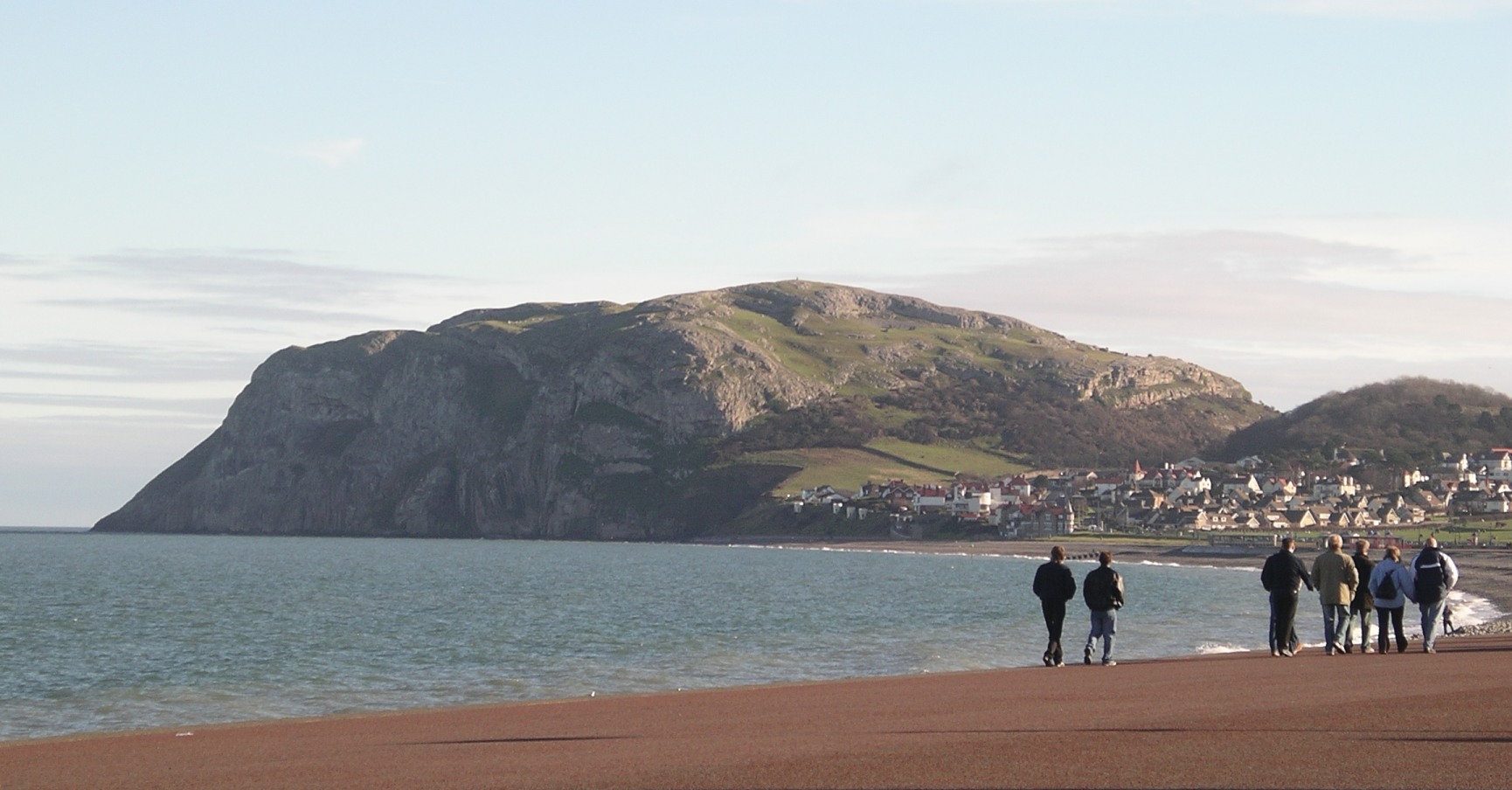
The Little Orme (Welsh: Rhiwledyn, also known as Trwyn y Fuwch, Trwyn y Gogarth and Y Gogarth Fach) is a headland in Llandudno, Wales. It is 141 metres (463 ft) in height. It is one of two headlands situated at either end of Llandudno Bay, the other larger headland used by tourists is the Great Orme. The Little Orme has public footpaths and two summits, the higher summit has a trig point.
The Little Orme was inhabited during the Mesolithic and Neolithic eras, notably the Pant y Wennol cave.
A small hoard of Iron Age Celtic metalwork was found in a cave on the Little Orme.
The medieval chapel of Blessed Mary of Penrhyn, abandoned in 1930 and now in ruins, is at the foot of the Little Orme in the grounds of Penrhyn Hall at Penrhyn Bay.
On 14 April 1587, printing material for Catholic literature was found in a cave on the Little Orme, where it had been used by the recusant Robert Pugh (squire of Penrhyn Hall) and his Chaplain Father William Davies to print Y Drych Cristianogawl (The Christian Mirror), the first book to be printed in Wales. They had taken refuge there during the persecution of Catholics instigated by Queen Elizabeth I in May 1586.
The Royal Artillery coastal gunnery school, 198 battery, was posted to Little Orme during the Second World War. Target practice was undertaken from the headland to anchored boats, and unspent ammunition and unexploded shells may still be encountered offshore. Gun emplacements and ancillary buildings were in situ until at least the early 1960s, but the site has since been landscaped.
Parts of the Little Orme (notably the NWWT's Rhiwledyn Nature Reserve) are a Site of Special Scientific Interest. The North Wales Bird Trust is located on its lower slopes, and the Little Orme is a warden-patrolled sanctuary for sea birds, including European Shag and Common Guillemot. Bird viewing around the cliffs can be facilitated by trips using small boats.
Hub AI
Little Orme AI simulator
(@Little Orme_simulator)
Little Orme
53°19′29″N 3°46′43″W / 53.32472°N 3.77861°W
The Little Orme (Welsh: Rhiwledyn, also known as Trwyn y Fuwch, Trwyn y Gogarth and Y Gogarth Fach) is a headland in Llandudno, Wales. It is 141 metres (463 ft) in height. It is one of two headlands situated at either end of Llandudno Bay, the other larger headland used by tourists is the Great Orme. The Little Orme has public footpaths and two summits, the higher summit has a trig point.
The Little Orme was inhabited during the Mesolithic and Neolithic eras, notably the Pant y Wennol cave.
A small hoard of Iron Age Celtic metalwork was found in a cave on the Little Orme.
The medieval chapel of Blessed Mary of Penrhyn, abandoned in 1930 and now in ruins, is at the foot of the Little Orme in the grounds of Penrhyn Hall at Penrhyn Bay.
On 14 April 1587, printing material for Catholic literature was found in a cave on the Little Orme, where it had been used by the recusant Robert Pugh (squire of Penrhyn Hall) and his Chaplain Father William Davies to print Y Drych Cristianogawl (The Christian Mirror), the first book to be printed in Wales. They had taken refuge there during the persecution of Catholics instigated by Queen Elizabeth I in May 1586.
The Royal Artillery coastal gunnery school, 198 battery, was posted to Little Orme during the Second World War. Target practice was undertaken from the headland to anchored boats, and unspent ammunition and unexploded shells may still be encountered offshore. Gun emplacements and ancillary buildings were in situ until at least the early 1960s, but the site has since been landscaped.
Parts of the Little Orme (notably the NWWT's Rhiwledyn Nature Reserve) are a Site of Special Scientific Interest. The North Wales Bird Trust is located on its lower slopes, and the Little Orme is a warden-patrolled sanctuary for sea birds, including European Shag and Common Guillemot. Bird viewing around the cliffs can be facilitated by trips using small boats.