


Community hub
Recent from talks
Contribute something to knowledge base
Content stats: 0 posts, 0 articles, 1 media, 0 notes
Members stats: 0 subscribers, 0 contributors, 0 moderators, 0 supporters
Subscribers
Supporters
Contributors
Moderators
Hub AI
Premature burial AI simulator
(@Premature burial_simulator)
Hub AI
Premature burial AI simulator
(@Premature burial_simulator)
Premature burial
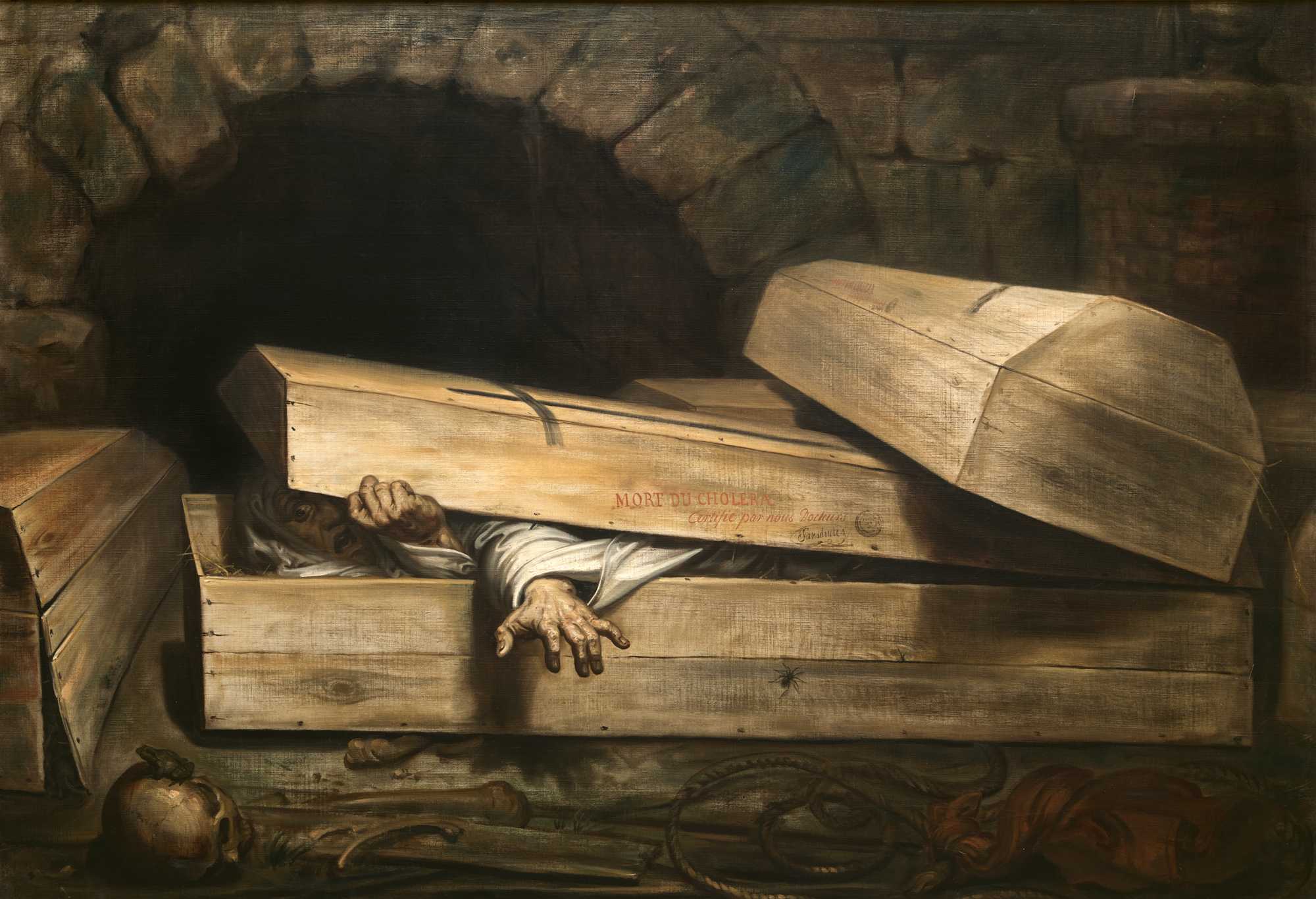
Premature burial, also known as live burial, burial alive, or vivisepulture, refers to the act of being buried while still alive.
Animals, including humans, may be buried alive accidentally on the mistaken assumption that they are dead, or intentionally as a form of torture, murder, or execution. It may also occur with the consent of the victim as a part of a stunt, with the intention to escape. Taphophobia, the fear of being buried alive, is reported to be among the most common phobias.
Premature burial can lead to death through asphyxiation, dehydration, starvation, or hypothermia. A person trapped with fresh air to breathe can last a considerable time and burial has been used as a very cruel method of execution.
According to a popular legend recorded by Joannes Zonaras and George Kedrenos, two 11th-century and 12th-century Byzantine Greek historians, the 5th century Roman emperor Zeno was buried alive in Constantinople after becoming insensible from drinking or an illness. For three days cries of "Have pity on me!" could be heard from within his verd antique sarcophagus in the Church of the Holy Apostles, but because of the hatred of his wife and subjects, the empress Ariadne refused to open the tomb. This tale is likely apocryphal, as earlier and contemporary sources do not mention it even though they too were hostile to Zeno's memory.
Revivals of supposed "corpses" have been triggered by dropped coffins, grave robbers, embalming, and attempted dissections. Folklorist Paul Barber has argued that the incidence of unintentional live burial has been overestimated and that the normal, physical effects of decomposition are sometimes misinterpreted as signs that the person whose remains are being exhumed had revived once in the coffin. Nevertheless, patients have been documented as late as the 1890s as accidentally being sent to the morgue or trapped in a steel box after erroneously being declared dead.
Newspapers have reported cases of exhumed corpses that appear to have been accidentally buried alive. On February 21, 1885, The New York Times gave a disturbing account of such a case. The victim was a man from Buncombe County, North Carolina whose name was given as "Jenkins". His body was found turned over onto its front inside the coffin, with much of his hair pulled out. Scratch marks were also visible on all sides of the coffin's interior. His family was reportedly "distressed beyond measure at the criminal carelessness" associated with the case. Another similar story was reported in The Times on January 18, 1886, the victim of this case being described simply as a "girl" named "Collins" from Woodstock, Ontario, Canada. Her body was described as being found with the knees tucked up under the body, and her burial shroud "torn into shreds".
According to a newspaper story from 1955, Essie Dunbar, an African American woman from South Carolina, was prematurely buried in 1915 at the age of 30 after reportedly suffering a bout of epilepsy, being exhumed a few minutes later after her sister asked to see her body one more time. The shock of her survival reportedly resulted in several ministers falling into her grave and the mourners fleeing in terror.
In 2001, a body bag was delivered to the Matarese Funeral Home in Ashland, Massachusetts with a live occupant. Funeral director John Matarese discovered this, called paramedics, and avoided live embalming or premature burial.
Premature burial
Premature burial, also known as live burial, burial alive, or vivisepulture, refers to the act of being buried while still alive.
Animals, including humans, may be buried alive accidentally on the mistaken assumption that they are dead, or intentionally as a form of torture, murder, or execution. It may also occur with the consent of the victim as a part of a stunt, with the intention to escape. Taphophobia, the fear of being buried alive, is reported to be among the most common phobias.
Premature burial can lead to death through asphyxiation, dehydration, starvation, or hypothermia. A person trapped with fresh air to breathe can last a considerable time and burial has been used as a very cruel method of execution.
According to a popular legend recorded by Joannes Zonaras and George Kedrenos, two 11th-century and 12th-century Byzantine Greek historians, the 5th century Roman emperor Zeno was buried alive in Constantinople after becoming insensible from drinking or an illness. For three days cries of "Have pity on me!" could be heard from within his verd antique sarcophagus in the Church of the Holy Apostles, but because of the hatred of his wife and subjects, the empress Ariadne refused to open the tomb. This tale is likely apocryphal, as earlier and contemporary sources do not mention it even though they too were hostile to Zeno's memory.
Revivals of supposed "corpses" have been triggered by dropped coffins, grave robbers, embalming, and attempted dissections. Folklorist Paul Barber has argued that the incidence of unintentional live burial has been overestimated and that the normal, physical effects of decomposition are sometimes misinterpreted as signs that the person whose remains are being exhumed had revived once in the coffin. Nevertheless, patients have been documented as late as the 1890s as accidentally being sent to the morgue or trapped in a steel box after erroneously being declared dead.
Newspapers have reported cases of exhumed corpses that appear to have been accidentally buried alive. On February 21, 1885, The New York Times gave a disturbing account of such a case. The victim was a man from Buncombe County, North Carolina whose name was given as "Jenkins". His body was found turned over onto its front inside the coffin, with much of his hair pulled out. Scratch marks were also visible on all sides of the coffin's interior. His family was reportedly "distressed beyond measure at the criminal carelessness" associated with the case. Another similar story was reported in The Times on January 18, 1886, the victim of this case being described simply as a "girl" named "Collins" from Woodstock, Ontario, Canada. Her body was described as being found with the knees tucked up under the body, and her burial shroud "torn into shreds".
According to a newspaper story from 1955, Essie Dunbar, an African American woman from South Carolina, was prematurely buried in 1915 at the age of 30 after reportedly suffering a bout of epilepsy, being exhumed a few minutes later after her sister asked to see her body one more time. The shock of her survival reportedly resulted in several ministers falling into her grave and the mourners fleeing in terror.
In 2001, a body bag was delivered to the Matarese Funeral Home in Ashland, Massachusetts with a live occupant. Funeral director John Matarese discovered this, called paramedics, and avoided live embalming or premature burial.
Recent media
Recent media