Hubbry Logo
Premature burialPremature burialMain
Open search
Premature burial
Community hub
Premature burial
logo
8 pages, 0 posts
0 subscribers
Be the first to start a discussion here.
Contribute something
Premature burial
Premature burial
from Wikipedia

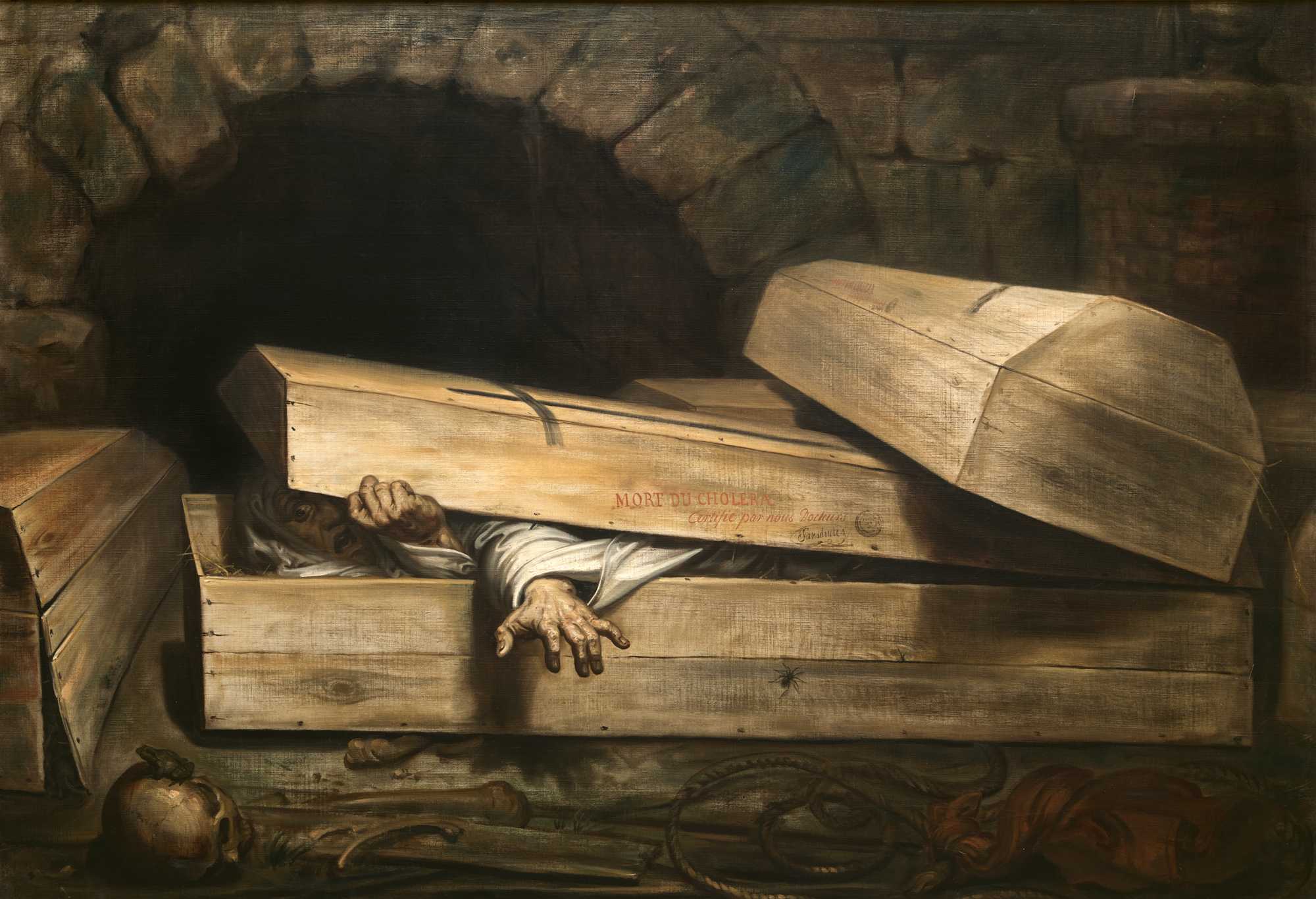
Antoine Wiertz's painting of a man buried alive

Premature burial, also known as live burial, burial alive, or vivisepulture, refers to the act of being buried while still alive.

Animals, including humans, may be buried alive accidentally on the mistaken assumption that they are dead, or intentionally as a form of torture, murder, or execution. It may also occur with the consent of the victim as a part of a stunt, with the intention to escape. Taphophobia, the fear of being buried alive, is reported to be among the most common phobias.[1]

Physiology

[edit]

Premature burial can lead to death through asphyxiation, dehydration, starvation, or hypothermia. A person trapped with fresh air to breathe can last a considerable time and burial has been used as a very cruel method of execution.

Types

[edit]

Unintentional

[edit]

Accidental burial

[edit]

According to a popular legend recorded by Joannes Zonaras and George Kedrenos, two 11th-century and 12th-century Byzantine Greek historians, the 5th century Roman emperor Zeno was buried alive in Constantinople after becoming insensible from drinking or an illness.[2] For three days cries of "Have pity on me!" could be heard from within his verd antique sarcophagus in the Church of the Holy Apostles, but because of the hatred of his wife and subjects, the empress Ariadne refused to open the tomb.[3] This tale is likely apocryphal, as earlier and contemporary sources do not mention it even though they too were hostile to Zeno's memory.[3]

Revivals of supposed "corpses" have been triggered by dropped coffins, grave robbers, embalming, and attempted dissections.[4] Folklorist Paul Barber has argued that the incidence of unintentional live burial has been overestimated and that the normal, physical effects of decomposition are sometimes misinterpreted as signs that the person whose remains are being exhumed had revived once in the coffin.[5] Nevertheless, patients have been documented as late as the 1890s as accidentally being sent to the morgue or trapped in a steel box after erroneously being declared dead.[6]

Newspapers have reported cases of exhumed corpses that appear to have been accidentally buried alive. On February 21, 1885, The New York Times gave a disturbing account of such a case. The victim was a man from Buncombe County, North Carolina whose name was given as "Jenkins". His body was found turned over onto its front inside the coffin, with much of his hair pulled out. Scratch marks were also visible on all sides of the coffin's interior. His family was reportedly "distressed beyond measure at the criminal carelessness" associated with the case.[7] Another similar story was reported in The Times on January 18, 1886, the victim of this case being described simply as a "girl" named "Collins" from Woodstock, Ontario, Canada. Her body was described as being found with the knees tucked up under the body, and her burial shroud "torn into shreds".[8]

According to a newspaper story from 1955, Essie Dunbar, an African American woman from South Carolina, was prematurely buried in 1915 at the age of 30 after reportedly suffering a bout of epilepsy, being exhumed a few minutes later after her sister asked to see her body one more time. The shock of her survival reportedly resulted in several ministers falling into her grave and the mourners fleeing in terror.[9]

In 2001, a body bag was delivered to the Matarese Funeral Home in Ashland, Massachusetts with a live occupant. Funeral director John Matarese discovered this, called paramedics, and avoided live embalming or premature burial.[10][11]

In 2014 in Peraia, Thessaloniki, in Macedonia, Greece, the police discovered that a 45-year-old woman was buried alive and died of asphyxia after being declared clinically dead by a private hospital; she was discovered just shortly after being buried, by children playing near the cemetery who heard screams from inside the earth; her family was reported to be considering suing the hospital which was responsible.[12] In 2015, it was reported that a separate incident also occurred in 2014 in Peraia, Thessaloniki. In Macedonia, Greece, a police investigation concluded that a 49-year-old woman was buried alive after being declared dead due to cancer; her family reported that they could hear her scream from inside the earth at the cemetery shortly after burial, and the investigation revealed that she died of heart failure inside her coffin. Later, it was discovered that medication given to her by her physicians as part of her cancer treatment was what caused her to be mistakenly declared clinically dead.[13]

In 2018, according to some reports, Rosangela Almeida dos Santos (Riachão das Neves, Brazil) was also buried alive. The woman, who was declared dead in hospital at the age of 37, was soon buried, but visitors to the cemetery heard noises coming from the depths of her grave. After 11 days, the grave was dug up and the woman's mutilated body was discovered. Some say she was buried alive and tried to get out of the coffin. She was already dead at the time of the excavation. It is believed that she may have died not long before. The incident was also recorded on video.[14][15]

The family of Timesha Beauchamp of Southfield, Michigan called 911 on August 23, 2020, when they found her unresponsive at home. Upon arrival, paramedics found her to be unresponsive and not breathing. After they provided cardiopulmonary resuscitation for 30 minutes, she was pronounced dead by a local emergency department physician based on the medical information provided by the paramedics on the scene. Resuscitation efforts were discontinued, and Beauchamp was taken to a funeral home in Detroit. Staff at the funeral home were preparing to embalm her body when they found her to be breathing.[16] She was taken to Children's Hospital of Michigan, where she died on October 18, 2020.[17][18]

In 2022, a body bag was delivered to a Shanghai funeral home during the Omicron variant of the COVID-19 pandemic. Two of the employees detected life signs in the bag, saved the woman and stopped a premature burial.[19]

Natural disasters

[edit]

Natural disasters (earthquakes, landslides, mudslides, avalanches) have also buried people alive, as have collapsing mines.

Attempts at prevention

[edit]
A burial vault built c. 1890 with internal escape hatches to allow the victim of accidental premature burial to escape

According to the history of Nicephorus and perhaps because of the legend of Zeno's premature entombment, or perhaps for other reasons, the Proconnesian marble sarcophagus of the 7th-century emperor Heraclius was left open, on his own instructions, for three days after his interment in the Church of the Holy Apostles' Mausoleum of Justinian.[3]

According to Shane McCorristine, one of the purposes of an Irish wake (which entailed a prolonged waiting period before burial) was to ensure that the person was definitely dead.[20]

Robert Robinson died in Manchester in 1791. A movable glass pane was inserted in his coffin, and the mausoleum had a door for purposes of inspection by a watchman, who was to see if he breathed on the glass. He instructed his relatives to visit his grave periodically to check that he was actually dead.[21]

Safety coffins were devised to prevent premature burial, although there is no evidence that any have ever been successfully used to save an accidentally buried person. On 5 December 1882, J. G. Krichbaum received U.S. patent 268,693[22] for his "Device For Life In Buried Persons". It consisted of a movable periscope-like pipe that provided air and, when rotated or pushed by the person interred, indicated to passersby that someone was buried alive. The patent text refers to "that class of devices for indicating life in buried persons", suggesting that such inventions were common at the time.

In 1890, a family designed and built a burial vault at the Wildwood Cemetery in Williamsport, Pennsylvania, with an internal hatch to allow the victim of accidental premature burial to escape. The vault had an air supply and was lined in felt to protect a panic-stricken victim from self-inflicted injury before the escape. Bodies were to be removed from the casket before interment.[23]

The London Association for the Prevention of Premature Burial was co-founded in 1896 by William Tebb[24] and Walter Hadwen. Tebb suggested methods such as stethoscopic auscultation of the heart and lungs, application of electric current, and artificial ventilation.[25]

Intentional

[edit]

Execution

[edit]
Killing the Scholars and Burning the Books, anonymous 18th century Chinese painted album leaf depicts Confucian scholars being buried alive in Imperial China during the 3rd century BC

The burning of books and burying of scholars (simplified Chinese: 焚书坑儒; traditional Chinese: 焚書坑儒; pinyin: fénshū kēngrú) was purportedly carried out by Qin Shi Huang, the first emperor of a unified China. Books and texts deemed to be subversive were burned and 460 Confucian scholars were reportedly buried alive in 212 BC.[26] Modern scholars doubt these events – Sima Qian, author of the account of these events in the Records of the Grand Historian, was an official of the Han dynasty, which could be expected to portray the previous rulers unfavorably.[27] The single most numerous case of people being buried alive as a way of execution was after the Battle of Changping, where around 200,000 surviving and captured soldiers of the state of Zhao were buried alive.

Tacitus, in his work Germania, records that German tribes practiced two forms of capital punishment; the first where the victim was hanged from a tree, and another where the victim was tied to a wicker frame, pushed face down into the mud and buried. The first was used to make an example of traitors; the second was used for punishment of dishonorable or shameful vices, such as cowardice. According to Tacitus, the Ancient Germans thought that crime should be exposed, whereas infamy should be buried out of sight.[28]

Fleta, a medieval commentary on English common law, specified live burial as the punishment for sodomy, bestiality and those who had dealings with Jews.[29]

Herodotus in his book Histories wrote that burying people alive was an ancient Persian custom, which they practiced in order to be blessed by gods.

They [Xerxes and his troops] marched into the Nine Ways of the Edonian to the bridges and found the banks of the Strymon united by a bridge, but being informed that this place was called by the name of the Nine Ways, they buried alive so many in it so many sons and daughter of inhabitants. It is a Persian custom to bury people alive for I have heard that Amestris, wife of Xerxes, having grown old, caused fourteen children of the best families in Persia to be buried alive, to show her gratitude to the god who is said to be beneath the earth.[30]

In ancient Rome, a Vestal Virgin convicted of violating her vows of celibacy was "buried alive" by being sealed in a cave with a small amount of bread and water,[31] ostensibly so that the goddess Vesta could save her were she truly innocent, essentially making it into a trial by ordeal. Vesta never intervened.[32] This practice was, strictly speaking, immurement (being walled up and left to die) rather than premature burial. According to Christian tradition, a number of saints were martyred this way, including Saint Castulus[33] and Saint Vitalis of Milan.[34]

In Denmark, in the Ribe city statute, which was promulgated in 1269, a female thief was to be buried alive, and in the law by Queen Margaret I, adulterous women were to be punished with premature burial, men with beheading.[35]

In old Swedish province laws ("landskapslagarna"), live burial ("kvick i jord", literally "live into earth"), could be stipulated for a variety of crimes, most notably theft of money or goods of more than one mark's value, though only for women; men were instead hanged. Men could be sentenced to be buried alive as a punishment for bestiality.[36]

In 1611, within Sunnerbo härad in Småland, Sweden, a man faced a death sentence from the Sunnerbo district court for committing bestiality with a horse. The court's archives indicate that the prescribed punishment was either burial alive or burning at the stake, along with the animal. However, the final outcome remains unknown, as the sentence required the King's approval and the relevant documents from that period are believed to be lost.[37]

In 1616, the 18-year old farmhand Tiufrid was sentenced by the governor in Jönköping, Sweden, Nils Stiernsköld, to be buried alive together with the cow with which he had committed bestiality. The execution was carried out in January 1616 at Kinnevalds häradsting (district court). The court records tell how Tiufrid was buried, together with the animal, inside a large stone mound.[38]

Within the Holy Roman Empire a variety of offenses, including rape, infanticide, and theft, could be punished with live burial. For example, the Schwabenspiegel, a law code from the 13th century, specified that the rape of a virgin should be punished by live burial (whereas the rapist of a non-virgin was to be beheaded).[39] Female murderers of their own employers also risked being buried alive. In Augsburg in 1505, for example, a 12-year-old boy and a 13-year-old girl were found guilty of killing their master in conspiracy with the cook. The boy was beheaded, and the girl and the cook were buried alive beneath the gallows.[40] The jurist Eduard Henke observed that in the Middle Ages, live burial of women guilty of infanticide was a "very frequent" punishment in city statutes and Landrechten. For example, he notes those in Hesse, Bohemia, and Tyrol.[41] The Berlinisches Stadtbuch records that between 1412 and 1447, 10 women were buried alive there,[42] and as late as 1583, the archbishop of Bremen promulgated (alongside the somewhat milder 1532 Constitutio Criminalis Carolina punishment of drowning) live burial as an alternate execution method for punishing mothers found guilty of infanticide.[43]

As noted by Elias Pufendorf,[43] a woman buried alive would afterward be impaled through the heart. This combined punishment of live burial and impalement was practiced in Nuremberg until 1508 also for women found guilty of theft, but the city council decided in 1515 that the punishment was too cruel and opted for drowning instead.[44] Impalement was, however, not always mentioned together with live burial. Eduard Osenbrüggen relates how the live burial of a woman convicted of infanticide could be pronounced in a court verdict. For example, in a 1570 case in Ensisheim:

The verdict commanded the executioner to place the perpetrator in the grave alive, "and place two layers of thorns, the one beneath, the other above her. Prior to that he should place a bowl over her face, in which he had made a hole, and to give her through that (in order that she would live for a longer time and expiate the evil act she was condemned for), a reed/tube into the mouth, then jump three times upon her, and lastly cover her with earth".[45]

In this particular case, however, some noblewomen made an appeal for relative mercy, and the convicted woman was drowned instead.[46]

Dieter Furcht speculates that the impalement was not so much to be regarded as an execution method, but as a way to prevent the condemned from becoming an avenging, undead Wiedergänger.[47] In medieval Italy, unrepentant murderers were buried alive, head down, feet in the air, a practice referred to in passing in Canto XIX of Dante's Inferno.[48]

In the Faroe Islands, a powerful 14th-century female landowner in the village of Húsavík was said to have buried two servants alive.

Jan Luyken's drawing of the Anabaptist Anna Utenhoven being buried alive at Vilvoorde in 1597. In the drawing, her head is still above the ground and the priest is exhorting her to recant her faith, while the executioner stands ready to completely cover her up upon her refusal.

In the 16th century Habsburg Netherlands, when the Catholic authorities made a prolonged effort to stamp out the Protestant churches, live burial was commonly used as the punishment for women found guilty of heresy. The last to be so executed was Anna Utenhoven, an Anabaptist buried alive at Vilvoorde in 1597. Reportedly, when her head was still above the ground she was given the last chance to recant her faith, and upon her refusal, she was completely covered up and suffocated. The case aroused a great deal of protest in the rebellious northern provinces and foiled the peace feelers which King Philip III was at the time extending to the Dutch. Thereafter the Habsburg authorities avoided further such cases, punishing heresy with fines and deportations rather than death.[citation needed]

In the seventeenth century in feudal Russia, live burial as an execution method was known as "the pit" and used against women who were condemned for killing their husbands. In 1689, the punishment of live burial was changed to beheading.[49]

Among some contemporary indigenous people of Brazil with no or limited contact with the outside world, children with disabilities or other undesirable traits are still customarily buried alive.[50]

During the Holocaust many victims of mass executions were not shot dead and instead buried alive. Some people were able to escape the mass graves after the execution was over.[51]

During Mao Zedong's regime, there are some accounts that premature burials were used in executions.[52]

Wars

[edit]

Premature burial has been used during wars and by mafia organizations.

Serbian officials are documented to have buried living Bulgarian civilians from Pehčevo (now in the Republic of North Macedonia) during the Balkan Wars.[53] During World War II, Japanese soldiers were documented to have buried living Chinese civilians, notably during the Nanking Massacre.[54] This method of execution was also used by German leaders against Jews, Romani, and Soviet civilians in Ukraine and Belarus during World War II.[55][56][57][58][59]

During the Algerian War, French troops used to bury Algerian prisoners or civilians alive.[60]

During the Vietnam War, live burials by the Viet Cong were documented during the massacre at Huế in 1968.

During the Gulf War, Iraqi soldiers were knowingly buried alive by American tanks of the First Infantry Division shoveling earth into their trenches. Estimates for the number of soldiers killed this way vary: one source puts it at "between 80 and 250", while Colonel Anthony Moreno suggested it may have been thousands.[61][62]

In 2014, ISIS buried Yazidi women and children alive in an attempt to annihilate the Yazidi religion.[63]

Voluntary

[edit]
16th-century Portuguese illustration from the Códice Casanatense, depicting a Hindu ritual, in which a widow is buried alive with her dead husband

On rare occasions, people have willingly arranged to be buried alive, reportedly as a demonstration of their controversial ability to survive such an event. In one story taking place around 1840, Sadhu Haridas, an Indian yogi, is said to have been buried in the presence of a British military officer and under the supervision of the local maharajah, by being placed in a sealed bag in a wooden box in a vault. The vault was then interred, the earth was flattened over the site, and crops were sown over the place for a very long time. The whole location was guarded day and night to prevent fraud and the site was dug up twice in a ten-month period to verify the burial before the yogi was finally dug out and slowly revived in the presence of another officer. The yogi said that his only fear during his "wonderful sleep" was being eaten by underground worms. However, according to current medical science, it is not possible for a human to survive for a period of ten months without food, water, and air.[64] According to other sources the entire burial was 40 days long. The Indian government has since made the act of voluntary premature burial illegal, because of the unintended deaths of individuals attempting to recreate this feat.

In 1992, escape artist Bill Shirk was buried alive under seven tons of dirt and cement in a Plexiglas coffin. The coffin collapsed and almost killed Shirk.[65]

In 2010, a Russian man died after being buried alive to try to overcome his fear of death but was crushed to death by the earth on top of him. The following year, another Russian died after being buried overnight in a makeshift coffin "for good luck".[66]

In 2021, the YouTuber MrBeast was voluntarily buried alive for 50 hours. This event was documented and filmed. In late 2023, he again buried himself alive for one week.[67]

Buried Alive is a controversial art and lecture performance series by art-tech group monochrom.[68] Participants have the opportunity to be buried alive in a coffin for fifteen to twenty minutes. As a framework program monochrom offers lectures about the history of the science of determining death and the medical and cultural history of premature burial.

Myths and legends

[edit]

St. Oran was a druid living on the island of Iona in Scotland's Inner Hebrides. He became a follower of St. Columba, who brought Christianity to Iona from Ireland in 563 AD. When St. Columba had repeated problems building the original Iona Abbey, citing interference from the Devil, St. Oran offered himself as a human sacrifice and was buried alive. He was later dug up and found to be still alive, but when he described the afterlife he had seen and how it involved no heaven or hell, he was ordered to be covered up again. The building of the abbey went ahead, untroubled, and St. Oran's chapel marks the spot where the saint was buried.[69]

In Greek mythology, Philonome was buried alive by her husband Cycnus for falsely accusing his son Tenes of raping her, which had caused Cycnus to unjustly exile Tenes.[70] The princess Leucothoe was buried alive by her father for losing her virginity.[71]

In the fourteenth through nineteenth centuries, a popular tale about premature burial in European folklore was the "Lady with the Ring". In the story, a woman who was prematurely buried awakens to frighten a grave robber who is attempting to cut a ring off her finger.[72]

The TV show MythBusters tested the myth to see if someone could survive being buried alive for two hours before being rescued. Host Jamie Hyneman attempted the feat, but when his steel coffin began to bend under the weight of the earth used to cover it, the experiment was aborted.[73]

See also

[edit]

References

[edit]

Bibliography

[edit]
[edit]
Revisions and contributorsEdit on WikipediaRead on Wikipedia
from Grokipedia

Premature burial, also termed vivisepulture, refers to the entombment of an individual while they remain physiologically alive, typically arising from diagnostic errors in ascertaining .
This occurrence, though rare and often unverified historically, engendered profound —the dread of live interment—especially during the 18th and 19th centuries, when rudimentary methods for death certification predominated, reliant primarily on absence of or breath absent observable . Sensational claims posited that up to 10% of burials might have been premature, inferred from postures of exhumed cadavers, yet such assertions lacked empirical substantiation and were amplified by literary and media accounts rather than rigorous documentation.
In response, inventors devised safety coffins featuring bells, escape tubes, or flags to signal revival, alongside waiting mortuaries (Leichenhaus) where bodies lingered under observation; however, records indicate zero verified resuscitations in major facilities, such as those processing over a million corpses in early 19th-century , underscoring the fear's disproportion to documented peril. Conditions mimicking , including , Guillain-Barré syndrome, or drug-induced , contributed to historical anxieties, but modern protocols—incorporating electrocardiograms, electroencephalograms, and responsiveness assessments—have minimized risks to exceptional cases, such as mass casualty events devoid of trained personnel.

Physiological Foundations

Conditions Mimicking Death

Certain physiological states can profoundly suppress , including , respiration, and reflexes, to levels undetectable by pre-modern diagnostic methods like manual or observation of chest movement, thereby mimicking death through reduced metabolic activity and neurological shutdown. , characterized by muscular rigidity, fixity of posture irrespective of stimuli, and diminished responsiveness, arises from disruptions in function often linked to conditions such as , , or drug toxicity, leading to a trance-like immobility with slowed that historically evaded detection as life. In , patients maintain rigid poses for extended periods, with sensitivity to pain and external input markedly reduced, simulating the onset of and post-mortem stillness. Cholera, caused by Vibrio cholerae toxin-induced massive intestinal fluid loss, triggers where exceeds 10-20% of body weight, collapsing circulation and inducing coma-like states with thready or absent peripheral pulses, cold clammy skin, and sunken features resembling cadaveric changes. This shock mechanism deprives tissues of oxygen, slowing cerebral and cardiac function to near imperceptibility, as seen in untreated cases where victims exhibit grayish and minimal reflexes before potential recovery with rehydration, though mortality reached 50% or higher in severe 19th-century epidemics without intravenous intervention. Neurological shutdown from hypoxia and further mimics by halting voluntary and involuntary movements. Deep hypothermia, defined as core body temperature below 28°C, enforces a suspended animation-like state by decelerating enzymatic reactions and cellular , reducing oxygen demand and yielding (heart rates as low as 20-40 beats per minute), shallow respirations, fixed pupils, and absent corneal reflexes—signs historically interpreted as lethal given the lack of thermometry precision before the . Causal pathways involve and slowed conduction in myocardial fibers from cold-induced alterations, allowing survival after prolonged exposure, such as immersion in near-freezing water, where evade tactile or visual confirmation until rewarming. Oxygen deprivation in hypothermic tissues parallels effects in other comas, preserving viability without evident animation.

Limitations of Historical Diagnostics

Prior to the 19th century, physicians primarily relied on observable signs such as the absence of , breath, and voluntary movement to declare , criteria that proved unreliable in states of profound or where vital functions could become imperceptible without deeper examination. , involving rigid immobility and reduced responsiveness, was documented in historical medical accounts as mimicking , with cases reported in 18th-century texts where patients revived after presumed due to this trance-like condition. Similarly, severe induced an appearance of "perfect " through suppressed respiration and circulation, as noted by French surgeon Moricheau-Beaupré in early 19th-century observations of asphyxia-like states. The absence of diagnostic tools exacerbated these errors; the , invented by in 1816, was the first instrument allowing of heart and lung sounds to confirm absent cardiac activity more reliably, prior to which reliance on manual often failed in low-temperature or low-metabolic scenarios. Epidemics, such as outbreaks in the , compounded risks by necessitating rapid burials to curb contagion, with bodies interred within hours of apparent death to avoid disease spread, bypassing prolonged observation. Despite widespread anecdotal reports—sometimes inflated to claim 10% of burials as premature—verified instances remained exceedingly rare, with British medical authorities by the late 19th century asserting no authenticated cases in modern records, underscoring confirmation bias in unverified exhumations where contorted postures were misinterpreted as signs of revival rather than postmortem changes. Autopsy data from the era, when performed, revealed few true misdiagnoses amid thousands of claims, attributable to the causal primacy of decomposition as the definitive post-mortem indicator rather than transient vital suspensions.

Historical Context and Incidence

Pre-Modern Fears and Reports

Fears of premature burial trace back to antiquity, where Greco-Roman medical texts described conditions like and syncope that mimicked death, potentially leading to erroneous declarations during illnesses or rituals. Hippocratic writings noted patients reviving after apparent demise, fostering unease about hasty interments, though no verified cases from this era survive scrutiny due to reliance on anecdotal physician reports rather than empirical confirmation. In medieval Europe, epidemics such as the exacerbated risks through accelerated burial practices, where bodies were interred within hours to curb contagion, often bypassing prolonged observation. misdiagnoses compounded this, as the disease's progressive numbness and coma-like states were sometimes conflated with death, prompting rapid isolation burials without vital checks, per contemporary medical chronicles. By the , European accounts proliferated amid ongoing plagues and wars, with wartime exigencies demanding swift disposals of the fallen, as evidenced by records from conflicts like the showing interments within days of battlefield recovery. A notable unverified report from involves London butcher Lawrence Cawthorn, who fell into a deep coma after illness; his landlady, motivated by inheritance, declared him dead sans medical verification and arranged hasty burial at St. Giles churchyard, only for exhumation to reveal a fresh corpse suggesting struggle, as detailed in the contemporary The Most Lamentable and Deplorable Accident. Such narratives, echoed in 18th-century exhumed findings of undisturbed graves with purported interior scratches—attributed to revival attempts—remain apocryphal, lacking forensic validation and often sensationalized in broadsheets to highlight diagnostic limitations during outbreaks. Empirical burial ledgers from epidemic-hit regions, like London's during 1665 plague, indicate over 80% of victims buried within 24-48 hours, prioritizing over individual confirmation and thus elevating inadvertent live interment probabilities. These pre-modern reports underscore baseline anxieties rooted in verifiable hasty customs rather than widespread incidence, with most claims unconfirmed by modern standards.

19th-Century Obsession and Verified Cases

The apprehension of reached a zenith in the , propelled by recurrent pandemics—such as the global outbreaks from 1817 to and subsequent waves—that necessitated rapid interments to curb contagion, often before unequivocal signs of appeared, alongside the 1846 introduction of ether , which induced cataleptic states mimicking . These factors, compounded by incomplete diagnostic tools like absent reflexes or , fueled a cultural preoccupation, evidenced by the proliferation of anti-premature burial societies across and . William Tebb and Edward Perry Vollum's 1896 treatise Premature Burial and How It May Be Prevented, revised in 1905, cataloged approximately 700 purported instances of premature interment or narrow escapes, including 149 claimed actual live burials, drawn from historical anecdotes, medical reports, and public testimonies spanning centuries but concentrated in the 1800s. However, rigorous scrutiny reveals scant verification; most accounts lacked autopsies or eyewitness corroboration, relying instead on secondhand narratives prone to , with only isolated cases, such as exhumed bodies showing minimal decay or scratch marks on interiors, achieving partial substantiation through contemporary journalism or legal inquests. Edgar Allan Poe's 1844 tale "," which enumerated real and fabricated precedents to heighten its narrator's , exerted outsized influence by embedding the dread in popular imagination, though Poe himself drew from prevailing medical debates rather than inventing the motif. Empirical countermeasures, including Germany's Leichenhaus (waiting mortuaries) established in cities like and from the early 1800s, monitored over 465,000 presumed corpses between 1822 and 1845 via bells, airflow systems, and attendants, yet documented zero authenticated revivals, suggesting the peril was vastly overstated. Analogous French facilities, such as those in , reported similarly null outcomes despite vigilant observation, aligning with medical assessments that dismissed the incidence as negligible—far below anecdotal tallies—and attributable more to diagnostic error than systemic oversight. This disconnect highlights a reliance on unverified over data, as periodicals and journals critiqued the hysteria for inflating rare or apneic episodes into epidemic threats.

Classification of Instances

Unintentional Premature Burial

Unintentional premature burial occurs when individuals are interred alive due to diagnostic errors mistaking reversible states of unconsciousness—such as , profound , or drug-induced —for irreversible death, often in isolated, resource-limited, or expedited settings like remote villages or wartime . These errors stem primarily from limitations in historical vital sign detection, where absence of or breath failed to distinguish from cessation, rather than the physiological conditions themselves, which were rare even then. Documented instances remain exceedingly scarce, with most 19th-century reports relying on anecdotal exhumations showing scratch marks or contorted positions, later attributable to post-mortem rigor or rather than premortem struggle. For example, early newspaper accounts from 1885 described exhumed bodies with apparent signs of resistance, but systematic verification was absent, underscoring how amplified unverified claims amid widespread . In disaster scenarios, such as earthquakes, landslides, or mine collapses, chaotic recovery efforts have occasionally entombed presumed fatalities who were merely immobilized survivors, effectively burying them alive without malice. During the , a man was rescued after 27 days trapped in rubble, having been overlooked amid assumptions of universal fatality in collapsed structures. Similarly, historical mine incidents, like the 1936 Moose River collapse in , involved workers buried under debris and initially counted among the dead, though efforts later extracted some alive after prolonged entombment. These cases highlight causal factors like incomplete body recovery in mass casualties, where visual identification errors or resource constraints lead to premature sealing of sites, but they differ from coffined burial by lacking ritual interment. Empirical reviews indicate such entombments, while tragic, are not systematically mistaken for burial but arise from operational haste, with survival hinging on air pockets rather than oversight alone. Post-1900, unintentional has approached empirical elimination in developed contexts, attributable to standardized protocols including —which requires arterial incision confirming blood flow absence—and routine autopsies in unnatural deaths, reducing misdiagnosis risks to negligible levels. No peer-reviewed studies document confirmed coffined live s after widespread adoption of these practices around , contrasting 19th-century assertions of up to 10% incidence that lacked rigorous data and were driven by . Brief overlaps with early mitigation, such as coffin bells or escape vaults tested in the late 1800s, yielded few validated activations—typically dismissed as animal interference or fabrication upon exhumation—further evidencing the phenomenon's rarity even before modern diagnostics. In contemporary disasters, advanced imaging and sustained search protocols minimize entombment errors, rendering unintentional live a vestige of pre-medical certainty eras.

Intentional Premature Burial

Intentional premature burial involves the deliberate interment of living individuals, primarily as a method of execution in punitive contexts, warfare, or exceptional rituals, where perpetrators confirm the victim's to ensure prolonged or retribution. This distinguishes it from accidental misdiagnoses by emphasizing premeditated causation, often prioritizing resource efficiency in mass killings over swift death, though it inflicts extended physiological torment via asphyxiation, , and panic-induced cardiac strain. In historical punitive applications, mandated live burial for Vestal Virgins violating chastity vows, entombing them in underground chambers with minimal provisions to starve or suffocate, as recorded in practices from the era through the . Medieval and extended this to heretics and specific offenders; for instance, under 13th-century Danish law, female thieves faced live , contrasting quicker for males, to underscore gender-differentiated severity. A documented case occurred on July 19, 1597, when Anabaptist Anneken van den Hove was buried alive in near for refusing Catholic , marking one of the last such heresy executions in the , with contemporary accounts detailing her public procession and entombment up to the neck before full covering. Wartime instances highlight mass-scale intent, as in the 1937 Nanking Massacre where Japanese forces buried living Chinese prisoners of war in pits, verified through survivor testimonies and post-war tribunals documenting thousands of such cases amid broader atrocities. Similarly, Nazi operations during included live interments of civilians and POWs in , though often conflated with shootings; experiments in occupied China explicitly tested live burial on prisoners, combining punitive and pseudo-scientific motives with outcomes of rapid organ failure from soil compression and hypoxia. Ritual or voluntary forms remain rare and empirically contested, lacking widespread verifiable precedents beyond isolated cultural reports; while Hindu sati predominantly involved , not , claims of consensual live entombment ignore physiological realities of terror and pain, undermining relativist justifications through first-hand suffering accounts where coercion prevailed. Modern equivalents persist sporadically in conflict zones, such as insurgent executions in the , but prohibitions have curtailed documentation, with efficiency arguments in offset by heightened cruelty relative to firearms or explosives.

Prevention and Mitigation Efforts

Historical Devices and Protocols

Safety coffins emerged in the as mechanical contrivances designed to alert observers if a buried individual regained consciousness, typically featuring ropes attached to the occupant’s hand connected to surface bells or flags. By the early , over 30 such designs were patented in alone, incorporating elements like spring-loaded lids, breathing tubes, and escape ladders to facilitate signaling or egress. A notable American example, patented in 1868 as U.S. No. 81,437, included comprehensive alarm mechanisms such as bells and whistles activated by internal movement. In 1897, Polish inventor Michel de Karnice-Karnicki patented "Le Karnice," a sophisticated equipped with a system that detected chest movements to release oxygen, illuminate the interior, ring a bell, and raise a ; however, testing on a fresh revealed premature activation due to gases from , rendering it unreliable. These devices, while ingeniously engineered to address verifiable risks of misdiagnosed or , frequently malfunctioned from postmortem bodily shifts or , leading to false alarms without any documented instances of successful . Waiting mortuaries, or Leichenhäuser, provided an alternative protocol by housing bodies in supervised facilities until unmistakable decomposition occurred, with establishing such institutions from the early and mandating their use by the . These structures featured individual vaults with air tubes, bells, and constant guards to monitor for signs of life, exemplified by 's expansive facility circa 1880 accommodating up to 120 bodies in segregated wards for the affluent and indigent. Empirical records indicate minimal true revivals, with most alerts attributable to natural postmortem phenomena like rigor resolution or gas emissions, underscoring the protocols' prudence yet limited efficacy against exaggerated fears rather than frequent occurrences.

Evolution to Modern Standards

The introduction of the in the early , followed by its routine use in clinical practice by mid-century, allowed for precise of cardiac and respiratory activity, supplanting less reliable sensory checks like mirror fogging or arterial puncture. techniques, refined during the (1861–1865) and standardized thereafter, involved injecting formaldehyde-based solutions into the vascular system, chemically fixing tissues and rendering any potential revival biologically impossible. By the late , legal requirements in many jurisdictions mandated physician certification of death, incorporating these methods alongside observation of and , forming a tripartite examination protocol explicitly designed to avert premature interment. In the , advancements decoupled cardiopulmonary cessation from neurological function, addressing cases where sustained circulation in brain-dead individuals. The 1968 Harvard Ad Hoc Committee criteria defined irreversible —characterized by unreceptivity, apnea, absent reflexes, and electroencephalographic silence—as equivalent to , later refined into uniform protocols incorporating confirmatory tests like EEG and . These standards, adopted globally by the 1980s, ensured declaration of only after exhaustive exclusion of reversible states such as or drug intoxication, with empirical data showing no verified unintentional premature burials in developed nations thereafter. Contemporary protocols mandate waiting periods of 24–72 hours post-certification in various U.S. states, alongside requirements for suspicious deaths, grounded in statistical rarity rather than anecdotal fears. Medical reviews affirm the efficacy of these safeguards: a 2023 forensic analysis concludes that with modern diagnostics, the probability of erroneous approaches zero, debunking persistent claims of ongoing as unsubstantiated by case records or physiological evidence. No peer-reviewed documentation exists of confirmed unintentional under current standards in high-resource settings, underscoring the obsolescence of historical anxieties.

Cultural and Psychological Dimensions

Taphophobia and Societal Anxieties

, defined as the pathological fear of , arose from historical uncertainties in diagnosing , particularly amid epidemics like where comatose states mimicked demise and hasty interments were common to curb contagion. In the , this anxiety permeated European and American societies, fueled by medical limitations in confirming cessation of vital functions, such as distinguishing or deep from true . Public concern escalated to a , with elites particularly affected, prompting organizations like the 1896 Association for the Prevention of Premature Burial. Empirical assessments reveal the fear's disproportion to actual risks, as verified premature burials remained rare despite sensational reports claiming up to one-third of interments involved live individuals. Medical historian Jan Bondeson, reviewing centuries of records, found minimal substantiated cases, attributing persistence to , , and media amplification rather than causal evidence of frequent mishaps. By century's end, approximately 700 alleged instances were documented, yet rigorous scrutiny confirms most as unverified anecdotes, underscoring how diagnostic engendered outsized societal dread. Causally, taphophobia held legitimacy in pre-modern eras lacking reliable tests for brain death or putrefaction, but advanced protocols— including autopsy standards and vital monitoring—rendered it irrational by the 20th century. Contemporary persistence, as in isolated cases among older populations, reflects psychological holdovers disregarding empirical safeguards, with fears waning broadly as medical certainty improved. This evolution highlights how evidence-based reasoning supplants primal anxieties once grounded in real epistemic gaps.

Myths, Legends, and Exaggerations

Legends of frequently feature exhumed coffins bearing interior scratch marks, interpreted as signs of the interred individual regaining consciousness and frantically clawing at the lid in a futile bid for escape. These tales, prevalent in 19th-century European and American folklore, often lacked contemporaneous medical verification or reports, relying instead on anecdotal accounts from grave diggers or family members. A particularly widespread but apocryphal variant claimed that during 17th-century plague outbreaks in , one in 25 reopened coffins revealed such marks, prompting the invention of bells; this traces to unsubstantiated emails and has no basis in historical records. Similarly, stories of "vampiric" revivals—where exhumed bodies appeared to have gnawed their shrouds or exhibited disheveled hair—circulated as evidence of live interment, echoing motifs in but frequently tied to premature burial fears in Western narratives. These accounts, compiled in works like William Tebb's 1896 catalog of 149 purported live burials and 219 narrow escapes, amplified public anxieties despite minimal empirical support. Forensic and taphonomic analyses attribute such "scratch marks" not to human revival but to postmortem animal activity, such as or gnawing wood during , or to misinterpretations of natural decay processes like formation. Shroud-chewing legends, known as masticatio mortuorum, have been debunked as rodent scavenging, with no documented cases linking them to conscious . Grave bells, while patented in designs like Count Karnice-Karnicki's 1897 model, rarely activated due to live occupants; purported ringings were typically caused by wind, vermin, or mechanical failure, and associations with phrases like "" represent without historical grounding. Empirical scrutiny reveals stark disproportion: while and period media exaggerated risks—claiming up to 10% of burials as premature—observational from 19th-century "waiting mortuaries" (Leichenhaus), which monitored over 1,000 bodies annually in regions like from 1828 to 1849, recorded zero revivals, underscoring the rarity even absent modern diagnostics. This persistence of unverified tales over data-driven assessments highlights a cultural tendency toward , where aversion to diagnostic fostered fear-mongering narratives that outlasted the actual perils they purported to document.

Representations in Culture

Literature and Folklore

Edgar Allan Poe's short story "," first published in the Dollar Newspaper on July 31, 1844, prominently features the motif of being interred alive, portraying a narrator afflicted by who obsesses over historical accounts of mistaken death declarations. Poe drew from documented medical cases, such as apparent deaths due to states, to evoke dread of and helplessness, though the amplifies these for psychological terror rather than fidelity to verified incidents. In , premature burial appears in tales of revenants—corpses believed to revive due to improper interment or incomplete demise—often manifesting as figures clawing from graves, as in medieval sagas like the Asmundar Saga kappu, where a is voluntarily buried alive with a who gnaws his in reanimation. These narratives, rooted in pre-modern uncertainties about death verification, blend empirical concerns over signs with elements, influencing literary horror without constituting evidence of frequent occurrences. Literary treatments like Poe's explored themes of mortality's finality and visceral of suffocation, citing journals on recoveries to lend plausibility, yet distorted rarity into ubiquity for dramatic impact, thereby heightening cultural . This exaggeration spurred practical responses, including 19th-century patents for "safety coffins" equipped with bells or air tubes, as public anxieties—stoked by such fiction—prompted inventors to address perceived risks despite scant empirical validation of widespread premature interments.

Film, Media, and Contemporary Depictions

The 1962 horror film The Premature Burial, directed by Roger Corman and starring Ray Milland as a cataleptic aristocrat obsessed with entombment, directly adapts Edgar Allan Poe's tale to dramatize the visceral terror of awakening in a coffin, complete with mechanisms like bells and escape tools that underscore the era's taphophobic inventions. This production, released by American International Pictures, exemplifies early cinematic exploitation of premature burial as a claustrophobic horror trope, amplifying psychological dread through visual motifs of sealed vaults and futile struggles, despite the story's roots in 19th-century exaggerations rather than verified cases. Subsequent horror cinema has perpetuated the motif in over two dozen thrillers, portraying premature burial as a plausible peril in narratives ranging from revivals to medical mishaps, often sidelining empirical realities such as post-mortem indicators like and advanced diagnostics that render unintentional cases implausible in modern contexts. Films like the 1990's integrate it into explorations of near-death experiments, while buried-alive sequences recur in slasher and survival genres, transforming a historically rare —documented in fewer than 150 anecdotal instances before , per medical reviews—into a staple for , thereby inflating perceived risks without forensic substantiation. In contemporary media, true-crime documentaries occasionally address intentional in contexts like wartime atrocities or isolated murders, such as graphic reconstructions in mondo-style series depicting execution methods, but these emphasize deliberate over accidental error, aligning with verified forensic patterns where victims show signs of restraint or trauma incompatible with natural . Social platforms amplify unsubstantiated claims of modern unintentional burials, often viral anecdotes lacking evidence, which forensic analyses routinely debunk by confirming timelines and absence of revival indicators, yet such content thrives on algorithmic rather than data-driven scrutiny. This pattern reveals media's causal bias toward narrative plausibility over probabilistic truth: portrayals rarely incorporate safeguards like EEG monitoring or protocols that have eliminated documented unintentional cases since the mid-20th century, instead sustaining cultural anxieties through dramatic , as critiqued in analyses of horror's distortion of mortality facts. High-credibility sources, including peer-reviewed journals, affirm the trope's detachment from contemporary , where vital sign verification precludes burial of the living, underscoring how valorizes outlier fears at the expense of causal evidence from medical advancements.

Modern Relevance and Assessment

Rarity and Medical Safeguards

In modern healthcare systems employing standardized protocols, unintentional premature burial has become empirically negligible, with no verified cases documented in monitored settings since the widespread adoption of criteria in the late 1960s. The 1968 Harvard Ad Hoc Committee report established irreversible coma—defined by profound unreceptivity, unresponsiveness to stimuli, absence of spontaneous movement or breathing, lack of reflexes, and a flat electroencephalogram (EEG) after at least 24 hours—as equivalent to death, even with persisting cardiac function. This neurological standard, refined in subsequent guidelines like the 1981 President's Commission report and uniform determination of death acts, shifted certification from solely cardiopulmonary signs to comprehensive brain function assessment, eliminating ambiguities that fueled historical fears. Contemporary hospital protocols reinforce this through mandatory and multi-step verification: clinicians must confirm absent pupillary reflexes, corneal responses, reflexes, and motor responses to , followed by an apnea test demonstrating no respiratory drive after disconnection from ventilators. At minimum, a five-minute period assesses for , , breath sounds, and responsiveness, often supplemented by ECG or to rule out residual activity. Death watches in intensive care units, combined with legal mandates for autopsies in unexplained cases, provide layered assurance; for instance, U.S. and U.K. guidelines require two physicians to independently verify findings before certification. , routine in many jurisdictions prior to burial, introduces chemical fixatives incompatible with viable tissue, serving as a terminal safeguard. In resource-limited developing regions, risks persist marginally higher due to inconsistent access to EEG or prolonged ventilation, yet even there, peer-reviewed analyses attribute rare reports of "revived" individuals to initial misdiagnoses of or agonal states rather than true premature interment post-burial. Intentional burials or hasty dispositions during outbreaks (e.g., in ) dominate anomalies, not inadvertent errors in certified deaths. Overall, these protocols—grounded in empirical validation of irreversibility—have rendered unintentional premature burial a relic of pre-modern diagnostics, with global incidence approaching zero in verifiable contexts.

Empirical Evaluation of Risks

Historical estimates of premature burial incidence, though fueled by widespread anxiety in the 18th and 19th centuries, reveal a low empirical risk. Monitoring in waiting mortuaries, such as the one in where approximately 1 million corpses were observed between 1828 and 1849, yielded no documented revivals. Assertions of rates as high as 10% of burials being premature relied on anecdotal observations of exhumed bodies in contorted positions or with signs like shroud damage, which analysis attributes to post-mortem processes including , gas decomposition, or rodent activity rather than . Verified accidental cases remain scarce even historically, with most documented instances linked to intentional acts in contexts of or inadequate oversight, not systemic diagnostic failure. In modern medical practice, the probability falls below detectable levels in developed systems, estimated at less than 1 in billions of deaths given global annual mortality exceeding 50 million and the absence of confirmed accidental premature burials in peer-reviewed literature since the mid-20th century. determination, codified in protocols like those from the American Academy of Neurology, mandates irreversible , absent reflexes, and apnea testing, supplemented by ancillary exams such as achieving 100% . Apnea test complications occur in only 1.6–4.8% of cases, typically aborting rather than falsifying declarations, and prerequisites exclude reversible conditions, ensuring high reliability. Isolated reports from mass disasters or under-resourced regions highlight risks tied to absent qualified personnel, not flaws in standardized criteria. Controversies often mischaracterize ICU recoveries post-cardiac arrest—where patients remain under active monitoring without death declaration—as near-misses for burial, conflating transient asystole with irreversible brain failure. Skepticism toward brain death, including calls to revisit uniform determination acts, frequently arises from non-empirical sources prioritizing ethical or ideological objections over data from confirmatory testing and longitudinal studies validating protocol accuracy. Such views, while noting rare false positives in unstandardized applications, overlook causal evidence that modern safeguards—requiring dual physician consensus and exclusion of confounders—render accidental live burial causally improbable absent deliberate negligence. Looking ahead, biotechnological advances like involve for potential revival rather than conventional burial, introducing speculative revival uncertainties but not elevating empirical burial risks, as protocols emphasize verifiable stasis over fear-driven burial avoidance. Ongoing refinements in and biomarkers further entrench data-driven death certification, prioritizing causal irreversibility over historical phobias unsubstantiated by observation.

References

  1. https://www.sciencedirect.com/[science](/page/Science)/article/pii/S1752928X2300135X
Add your contribution
Related Hubs
Contribute something
User Avatar
No comments yet.