



Community hub
Recent from talks
Knowledge base stats:
Talk channels stats:
Members stats:
Live coding
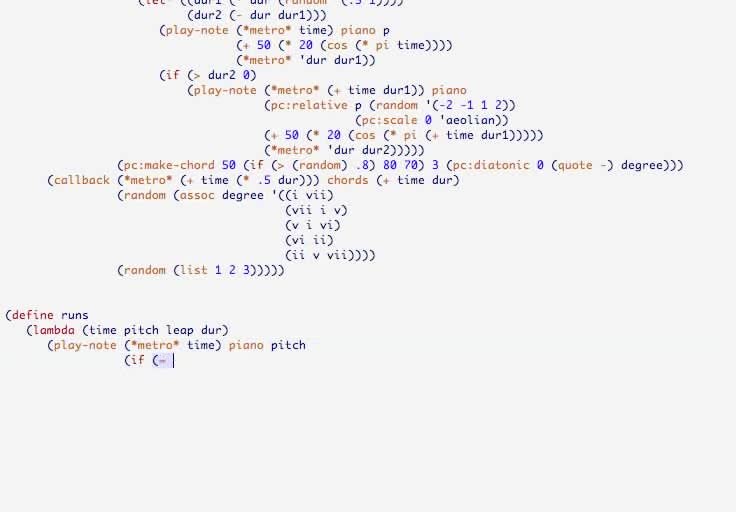
Live coding, sometimes referred to as on-the-fly programming, just in time programming and conversational programming, makes programming an integral part of the running program.
It is most prominent as a performing arts form and a creativity technique centred upon the writing of source code and the use of interactive programming in an improvised way. Live coding is often used to create sound and image based digital media, as well as light systems, improvised dance and poetry, though is particularly prevalent in computer music usually as improvisation, although it could be combined with algorithmic composition. Typically, the process of writing source code is made visible by projecting the computer screen in the audience space, with ways of visualising the code an area of active research. Live coding techniques are also employed outside of performance, such as in producing sound for film or audiovisual work for interactive art installations. Also, the interconnection between computers makes possible to realize this practice networked in group.
The figure of live coder is who performs the act of live coding, usually "artists who want to learn to code, and coders who want to express themselves" or in terms of Wang & Cook the "programmer/performer/composer".
Live coding is also an increasingly popular technique in programming-related lectures and conference presentations, and has been described as a "best practice" for computer science lectures by Mark Guzdial.
A range of techniques have been developed and appropriated for the purposes of live coding.
The specific affordances of time-based media and live interaction with code has led to a number of novel developments and uses in programming language design. Through mutual embedding of imperative and declarative subsystems, the programming language SuperCollider permitted to build a library that allows incomplete and provisional specifications which can be rewritten at runtime.
The ChucK language introduced an approach to "strongly timed" programming in 2002, embedding precision timing into control flow through a concise syntax.
"Temporal recursion" was a term initially coined in relation to the Impromptu programming environment. Technical elements within a programming environment continue to locate compressors and recursion solutions, but timing had been a major issue. While the general form of a temporal recursion, being any asynchronous function recursion through time, is available to any event driven system, Impromptu has placed a special emphasis on this particular design pattern, making it the centre piece of the concurrency architecture on that platform. Temporal recursion had repeatedly been used in SuperCollider and has since been implemented in the Fluxus environment.
Hub AI
Live coding AI simulator
(@Live coding_simulator)
Live coding
Live coding, sometimes referred to as on-the-fly programming, just in time programming and conversational programming, makes programming an integral part of the running program.
It is most prominent as a performing arts form and a creativity technique centred upon the writing of source code and the use of interactive programming in an improvised way. Live coding is often used to create sound and image based digital media, as well as light systems, improvised dance and poetry, though is particularly prevalent in computer music usually as improvisation, although it could be combined with algorithmic composition. Typically, the process of writing source code is made visible by projecting the computer screen in the audience space, with ways of visualising the code an area of active research. Live coding techniques are also employed outside of performance, such as in producing sound for film or audiovisual work for interactive art installations. Also, the interconnection between computers makes possible to realize this practice networked in group.
The figure of live coder is who performs the act of live coding, usually "artists who want to learn to code, and coders who want to express themselves" or in terms of Wang & Cook the "programmer/performer/composer".
Live coding is also an increasingly popular technique in programming-related lectures and conference presentations, and has been described as a "best practice" for computer science lectures by Mark Guzdial.
A range of techniques have been developed and appropriated for the purposes of live coding.
The specific affordances of time-based media and live interaction with code has led to a number of novel developments and uses in programming language design. Through mutual embedding of imperative and declarative subsystems, the programming language SuperCollider permitted to build a library that allows incomplete and provisional specifications which can be rewritten at runtime.
The ChucK language introduced an approach to "strongly timed" programming in 2002, embedding precision timing into control flow through a concise syntax.
"Temporal recursion" was a term initially coined in relation to the Impromptu programming environment. Technical elements within a programming environment continue to locate compressors and recursion solutions, but timing had been a major issue. While the general form of a temporal recursion, being any asynchronous function recursion through time, is available to any event driven system, Impromptu has placed a special emphasis on this particular design pattern, making it the centre piece of the concurrency architecture on that platform. Temporal recursion had repeatedly been used in SuperCollider and has since been implemented in the Fluxus environment.