



Community hub
Recent from talks
Knowledge base stats:
Talk channels stats:
Members stats:
Lobopodia
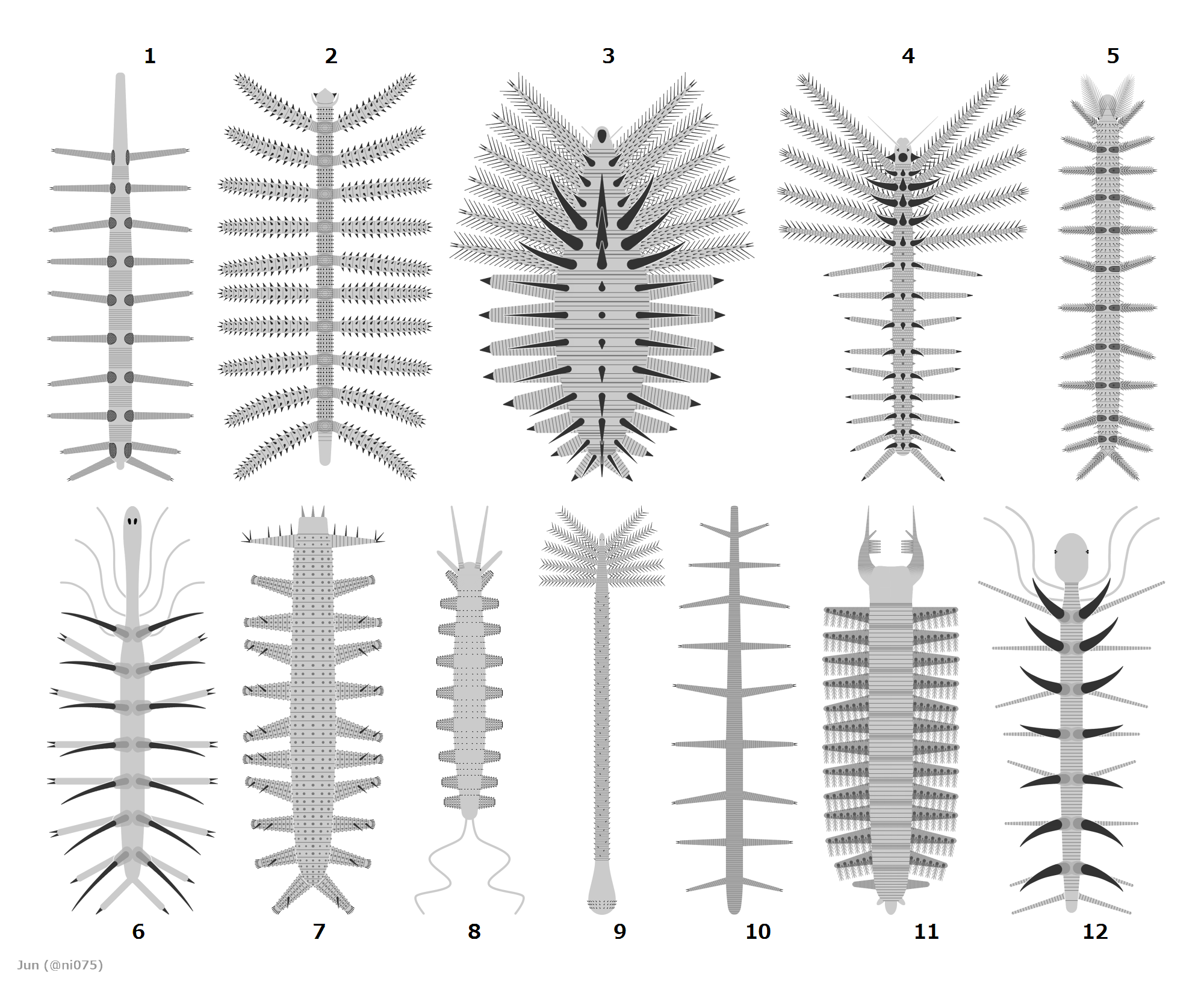
Lobopodians are members of the informal group Lobopodia (from Ancient Greek λοβός [lobós] 'lobe' and πόδα [podá] 'foot'),[citation needed] or the formally erected phylum Lobopoda Cavalier-Smith (1998). They are panarthropods with stubby legs called lobopods, a term which may also be used as a common name of this group as well. While the definition of lobopodians may differ between literatures, it usually refers to a group of soft-bodied, marine (and freshwater) worm-like fossil panarthropods such as Aysheaia and Hallucigenia. However, other genera like Kerygmachela and Pambdelurion (which have features similar to other groups) are often referred to as "gilled lobopodians".
The oldest near-complete fossil lobopodians date to the Lower Cambrian; some are also known from Ordovician, Silurian and Carboniferous Lagerstätten. Some bear toughened claws, plates or spines, which are commonly preserved as carbonaceous or mineralized microfossils in Cambrian strata. The grouping is considered to be paraphyletic, as the three living panarthropod groups (Arthropoda, Tardigrada and Onychophora) are thought to have evolved from lobopodian ancestors.
The lobopodian concept varies from author to author. Its most general sense refers to a suite of mainly Cambrian worm-like panarthropod taxa possessing lobopods – for example, Aysheaia, Hallucigenia, and Xenusion – which were traditionally united as "Xenusians" or "Xenusiids" (class Xenusia). Certain Dinocaridid genera, such as Opabinia, Pambdelurion, and Kerygmachela, may also be regarded as lobopodians, sometimes referred to more specifically as "gilled lobopodians" or "gilled lobopods". This traditional, informal usage of "Lobopodia" treats it as an evolutionary grade, including only extinct Panarthropods near the base of crown Panarthropoda. Crown Panarthropoda comprises the three extant Panarthropod phyla – Onychophora (velvet worms), Tardigrada (waterbears), and Arthropoda (arthropods) – as well as their most recent common ancestor and all of its descendants. Thus, in this usage, Lobopodia consists of various basal Panarthropods. This corresponds to "A" in the image to the left.
An alternative, broader definition of Lobopodia would also incorporate Onychophora and Tardigrada, the two living panarthropod phyla which still bear lobopodous limbs. This definition, corresponding to "C", is a morphological one, depending on the superficial similarity of appendages (the "lobopods"). Thus, it is paraphyletic, excluding the euarthropods, which are descendants of certain lobopodians, on the basis of their highly divergent limb morphology. "Lobopodia" has also been used to refer to a proposed sister clade to Arthropoda, consisting of the extant Onychophora and Tardigrada, as well as their most recent common ancestor and all of its descendants. This definition renders Lobopodia a monophyletic taxon, if indeed it is valid (that is, if Tardigrades and Onychophora are closer to one another than either is to Arthropoda), but would exclude all the euarthropod-line taxa traditionally considered lobopodians. Its validity is uncertain, however, as there are a number of hypotheses regarding the internal phylogeny of Panarthropoda. The broadest definition treats Lobopodia as a monophyletic superphylum equivalent in circumscription to Panarthropoda. By this definition, represented by "D" in the image, Lobopodia is no longer treated as an evolutionary grade but as a clade, containing not only the early, superficially "lobopodian" forms but also all of their descendants, including the extant Panarthropods.
Lobopodia has, historically, sometimes included Pentastomida, a group of parasitic panarthropods which were traditionally thought to be a unique phylum, but revealed by subsequent phylogenomic and anatomical studies to be a highly specialized taxon of crustaceans.
The better-known genera include Aysheaia, which was discovered in the Canadian Burgess Shale, and Hallucigenia, known from both the Chenjiang Maotianshan Shale and the Burgess Shale. Aysheaia pedunculata has a morphology apparently basic for lobopodians — for example, a significantly annulated cuticle, a terminal mouth opening, specialized frontalmost appendages, and stubby lobopods with terminal claws. Hallucigenia sparsa is famous for having a complex history of interpretation — it was originally reconstructed with long, stilt-like legs and mysterious fleshy dorsal protuberances, and was long considered a prime example of the way in which nature experimented with the most diverse and bizarre body designs during the Cambrian. However, further discoveries showed that this reconstruction had placed the animal upside-down: interpreting the "stilts" as dorsal spines made it clear that the fleshy "dorsal" protuberances were actually elongated lobopods. More recent reconstruction even exchanged the front and rear ends of the animal: it was revealed that the bulbous imprint previously thought to be a head was actually gut contents being expelled from the anus.
Microdictyon is another charismatic as well as the speciose genus of lobopodians resembling Hallucigenia, but instead of spines, it bore pairs of net-like plates, which are often found disarticulated and are known as an example of small shelly fossils (SSF). Xenusion has the oldest fossil record amongst the described lobopodians, which may trace back to Cambrian Stage 2. Luolishania is an iconic example of lobopodians with multiple pairs of specialized appendages. The gill lobopodians Kerygmachela and Pambdelurion shed light on the relationship between lobopodians and arthropods, as they have both lobopodian affinities and characteristics linked to the arthropod stem-group.
Most lobopodians were only a few centimeters in length, while some genera grew up to over 20 centimeters. Their bodies are annulated, although the presence of annulation may differ between position or taxa, and sometimes difficult to discern due to their close spacing and low relief on the fossil materials. Body and appendages are circular in cross-section.
Hub AI
Lobopodia AI simulator
(@Lobopodia_simulator)
Lobopodia
Lobopodians are members of the informal group Lobopodia (from Ancient Greek λοβός [lobós] 'lobe' and πόδα [podá] 'foot'),[citation needed] or the formally erected phylum Lobopoda Cavalier-Smith (1998). They are panarthropods with stubby legs called lobopods, a term which may also be used as a common name of this group as well. While the definition of lobopodians may differ between literatures, it usually refers to a group of soft-bodied, marine (and freshwater) worm-like fossil panarthropods such as Aysheaia and Hallucigenia. However, other genera like Kerygmachela and Pambdelurion (which have features similar to other groups) are often referred to as "gilled lobopodians".
The oldest near-complete fossil lobopodians date to the Lower Cambrian; some are also known from Ordovician, Silurian and Carboniferous Lagerstätten. Some bear toughened claws, plates or spines, which are commonly preserved as carbonaceous or mineralized microfossils in Cambrian strata. The grouping is considered to be paraphyletic, as the three living panarthropod groups (Arthropoda, Tardigrada and Onychophora) are thought to have evolved from lobopodian ancestors.
The lobopodian concept varies from author to author. Its most general sense refers to a suite of mainly Cambrian worm-like panarthropod taxa possessing lobopods – for example, Aysheaia, Hallucigenia, and Xenusion – which were traditionally united as "Xenusians" or "Xenusiids" (class Xenusia). Certain Dinocaridid genera, such as Opabinia, Pambdelurion, and Kerygmachela, may also be regarded as lobopodians, sometimes referred to more specifically as "gilled lobopodians" or "gilled lobopods". This traditional, informal usage of "Lobopodia" treats it as an evolutionary grade, including only extinct Panarthropods near the base of crown Panarthropoda. Crown Panarthropoda comprises the three extant Panarthropod phyla – Onychophora (velvet worms), Tardigrada (waterbears), and Arthropoda (arthropods) – as well as their most recent common ancestor and all of its descendants. Thus, in this usage, Lobopodia consists of various basal Panarthropods. This corresponds to "A" in the image to the left.
An alternative, broader definition of Lobopodia would also incorporate Onychophora and Tardigrada, the two living panarthropod phyla which still bear lobopodous limbs. This definition, corresponding to "C", is a morphological one, depending on the superficial similarity of appendages (the "lobopods"). Thus, it is paraphyletic, excluding the euarthropods, which are descendants of certain lobopodians, on the basis of their highly divergent limb morphology. "Lobopodia" has also been used to refer to a proposed sister clade to Arthropoda, consisting of the extant Onychophora and Tardigrada, as well as their most recent common ancestor and all of its descendants. This definition renders Lobopodia a monophyletic taxon, if indeed it is valid (that is, if Tardigrades and Onychophora are closer to one another than either is to Arthropoda), but would exclude all the euarthropod-line taxa traditionally considered lobopodians. Its validity is uncertain, however, as there are a number of hypotheses regarding the internal phylogeny of Panarthropoda. The broadest definition treats Lobopodia as a monophyletic superphylum equivalent in circumscription to Panarthropoda. By this definition, represented by "D" in the image, Lobopodia is no longer treated as an evolutionary grade but as a clade, containing not only the early, superficially "lobopodian" forms but also all of their descendants, including the extant Panarthropods.
Lobopodia has, historically, sometimes included Pentastomida, a group of parasitic panarthropods which were traditionally thought to be a unique phylum, but revealed by subsequent phylogenomic and anatomical studies to be a highly specialized taxon of crustaceans.
The better-known genera include Aysheaia, which was discovered in the Canadian Burgess Shale, and Hallucigenia, known from both the Chenjiang Maotianshan Shale and the Burgess Shale. Aysheaia pedunculata has a morphology apparently basic for lobopodians — for example, a significantly annulated cuticle, a terminal mouth opening, specialized frontalmost appendages, and stubby lobopods with terminal claws. Hallucigenia sparsa is famous for having a complex history of interpretation — it was originally reconstructed with long, stilt-like legs and mysterious fleshy dorsal protuberances, and was long considered a prime example of the way in which nature experimented with the most diverse and bizarre body designs during the Cambrian. However, further discoveries showed that this reconstruction had placed the animal upside-down: interpreting the "stilts" as dorsal spines made it clear that the fleshy "dorsal" protuberances were actually elongated lobopods. More recent reconstruction even exchanged the front and rear ends of the animal: it was revealed that the bulbous imprint previously thought to be a head was actually gut contents being expelled from the anus.
Microdictyon is another charismatic as well as the speciose genus of lobopodians resembling Hallucigenia, but instead of spines, it bore pairs of net-like plates, which are often found disarticulated and are known as an example of small shelly fossils (SSF). Xenusion has the oldest fossil record amongst the described lobopodians, which may trace back to Cambrian Stage 2. Luolishania is an iconic example of lobopodians with multiple pairs of specialized appendages. The gill lobopodians Kerygmachela and Pambdelurion shed light on the relationship between lobopodians and arthropods, as they have both lobopodian affinities and characteristics linked to the arthropod stem-group.
Most lobopodians were only a few centimeters in length, while some genera grew up to over 20 centimeters. Their bodies are annulated, although the presence of annulation may differ between position or taxa, and sometimes difficult to discern due to their close spacing and low relief on the fossil materials. Body and appendages are circular in cross-section.