
Recent from talks
Home Guard (United Kingdom)
Knowledge base stats:
Talk channels stats:
Members stats:
Home Guard (United Kingdom)
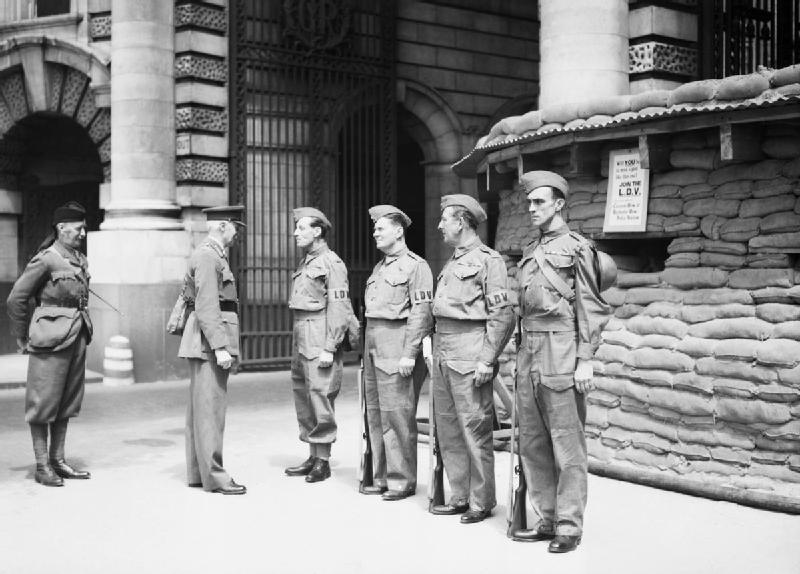
The Home Guard (initially Local Defence Volunteers or LDV) was an unpaid armed citizen militia supporting the 'Home Forces' of the British Army during the Second World War. Operational from 1940 to 1944, the Home Guard comprised more than 1.5 million local volunteers otherwise ineligible for military service, such as those who were too young, too old or medically unfit to join the regular armed services (regular military service was restricted to those aged 18 to 41) and those in reserved occupations. Excluding those already in the armed services, the civilian police or other civil defence volunteer organisations, approximately one in five men were Home Guard volunteers. Their primary role was to act as a secondary defence force in their home locality in case of invasion by the forces of Nazi Germany.
The Home Guard were initially ordered to observe, and report back to General Headquarters Home Forces, any airborne or seaborne invading forces in their local area; an order extended subsequently to harassing and obstructing the advance of the enemy even by a few hours to give the regular troops time to regroup. They were also tasked with guarding and defending key transport intersections and factories in rear areas against possible capture by paratroops or fifth columnists. An additional prime purpose was to maintain control of the civilian population in the event of an invasion, to forestall panic and to prevent communication routes from being blocked by refugees; so as to free the regular forces to fight the Germans. During the German bombing campaign of 'The Blitz' they were given the duty of seeking out and guarding unexploded bombs, in the course of which over 1,000 were killed. From 1942, the Home Guard manned coastal artillery and anti-aircraft gun and rocket batteries, releasing regular soldiers for the invasion of Europe. The Home Guard continued to man observation points and roadblocks, and to guard coastal areas of the United Kingdom and other strategically important sites such as airfields, factories and explosives stores, until late 1944, when they were stood down. They were formally disbanded on 31 December 1945, eight months after Germany's surrender.
Men aged 17 to 65 years could join, although the age limits were not strictly enforced. One platoon had a fourteen year old and three men in their eighties enrolled in it. Service was unpaid (although out-of-pocket expenses could be claimed) but gave a chance for older or inexperienced soldiers to support the war effort.
The origins of the Second World War Home Guard can be traced to Captain Tom Wintringham, who returned from the Spanish Civil War and wrote a book entitled How to Reform the Army. In the book, as well as many regular army reforms, Wintringham called for the creation of 12 divisions similar in composition to that of the International Brigades, which had been formed in Spain during the conflict. The divisions would be raised by voluntary enlistment targeting ex-servicemen and youths. Despite great interest by the War Office in the book's assertion that 'security is possible', Wintringham's call to train 100,000 men immediately was not implemented.[citation needed]
When the United Kingdom declared war on Germany on 3 September 1939, debates began in official circles about the possible ways in which the German military might invade Britain. In the first week of the conflict, numerous diplomatic and intelligence reports seemed to indicate that there was the possibility of an imminent German amphibious assault. Many government ministers and senior army officials, including the Commander in Chief Home Forces, General Walter Kirke, believed that the threat of invasion was greatly exaggerated and were sceptical, but others were not, including Winston Churchill, the new First Lord of the Admiralty.
Churchill argued that some form of home defence force should be raised from people who were ineligible to serve in the regular forces but wished to serve their country. In a letter to Samuel Hoare, the Lord Privy Seal, on 8 October 1939, Churchill called for a Home Guard force of 500,000 men over the age of 40 to be formed.
While government officials were debating the need for a home defence force, such forces were actually forming themselves without any official encouragement. In Essex, men not eligible for call-up into the armed forces were coming forward to join the self-styled "Legion of Frontiersmen". Officials were soon informed of the development of the legion, with the Adjutant-General, Sir Robert Gordon-Finlayson, arguing that the government should encourage the development of more unofficial organisations. The fear of invasion in 1939 quickly dissipated as it became evident that the German military was not in a position to launch an invasion of Britain; official enthusiasm for home defence forces waned and the legion appears to have dissolved itself at the same time.
The Battle of France began on 10 May 1940, with the Wehrmacht invading Belgium, the Netherlands and France. By 20 May, German forces had reached the English Channel, and on 28 May, the Belgian Army surrendered. The combination of the large-scale combined operations mounted by the Wehrmacht during the invasion of Norway in April and the prospect that much of the English Channel coast would soon be occupied made the prospect of a German invasion of the British Isles alarmingly real. Fears of an invasion grew rapidly, spurred on by reports both in the press and from official government bodies, of a fifth column operating in Britain that would aid an invasion by German airborne forces.
Hub AI
Home Guard (United Kingdom) AI simulator
(@Home Guard (United Kingdom)_simulator)
Home Guard (United Kingdom)
The Home Guard (initially Local Defence Volunteers or LDV) was an unpaid armed citizen militia supporting the 'Home Forces' of the British Army during the Second World War. Operational from 1940 to 1944, the Home Guard comprised more than 1.5 million local volunteers otherwise ineligible for military service, such as those who were too young, too old or medically unfit to join the regular armed services (regular military service was restricted to those aged 18 to 41) and those in reserved occupations. Excluding those already in the armed services, the civilian police or other civil defence volunteer organisations, approximately one in five men were Home Guard volunteers. Their primary role was to act as a secondary defence force in their home locality in case of invasion by the forces of Nazi Germany.
The Home Guard were initially ordered to observe, and report back to General Headquarters Home Forces, any airborne or seaborne invading forces in their local area; an order extended subsequently to harassing and obstructing the advance of the enemy even by a few hours to give the regular troops time to regroup. They were also tasked with guarding and defending key transport intersections and factories in rear areas against possible capture by paratroops or fifth columnists. An additional prime purpose was to maintain control of the civilian population in the event of an invasion, to forestall panic and to prevent communication routes from being blocked by refugees; so as to free the regular forces to fight the Germans. During the German bombing campaign of 'The Blitz' they were given the duty of seeking out and guarding unexploded bombs, in the course of which over 1,000 were killed. From 1942, the Home Guard manned coastal artillery and anti-aircraft gun and rocket batteries, releasing regular soldiers for the invasion of Europe. The Home Guard continued to man observation points and roadblocks, and to guard coastal areas of the United Kingdom and other strategically important sites such as airfields, factories and explosives stores, until late 1944, when they were stood down. They were formally disbanded on 31 December 1945, eight months after Germany's surrender.
Men aged 17 to 65 years could join, although the age limits were not strictly enforced. One platoon had a fourteen year old and three men in their eighties enrolled in it. Service was unpaid (although out-of-pocket expenses could be claimed) but gave a chance for older or inexperienced soldiers to support the war effort.
The origins of the Second World War Home Guard can be traced to Captain Tom Wintringham, who returned from the Spanish Civil War and wrote a book entitled How to Reform the Army. In the book, as well as many regular army reforms, Wintringham called for the creation of 12 divisions similar in composition to that of the International Brigades, which had been formed in Spain during the conflict. The divisions would be raised by voluntary enlistment targeting ex-servicemen and youths. Despite great interest by the War Office in the book's assertion that 'security is possible', Wintringham's call to train 100,000 men immediately was not implemented.[citation needed]
When the United Kingdom declared war on Germany on 3 September 1939, debates began in official circles about the possible ways in which the German military might invade Britain. In the first week of the conflict, numerous diplomatic and intelligence reports seemed to indicate that there was the possibility of an imminent German amphibious assault. Many government ministers and senior army officials, including the Commander in Chief Home Forces, General Walter Kirke, believed that the threat of invasion was greatly exaggerated and were sceptical, but others were not, including Winston Churchill, the new First Lord of the Admiralty.
Churchill argued that some form of home defence force should be raised from people who were ineligible to serve in the regular forces but wished to serve their country. In a letter to Samuel Hoare, the Lord Privy Seal, on 8 October 1939, Churchill called for a Home Guard force of 500,000 men over the age of 40 to be formed.
While government officials were debating the need for a home defence force, such forces were actually forming themselves without any official encouragement. In Essex, men not eligible for call-up into the armed forces were coming forward to join the self-styled "Legion of Frontiersmen". Officials were soon informed of the development of the legion, with the Adjutant-General, Sir Robert Gordon-Finlayson, arguing that the government should encourage the development of more unofficial organisations. The fear of invasion in 1939 quickly dissipated as it became evident that the German military was not in a position to launch an invasion of Britain; official enthusiasm for home defence forces waned and the legion appears to have dissolved itself at the same time.
The Battle of France began on 10 May 1940, with the Wehrmacht invading Belgium, the Netherlands and France. By 20 May, German forces had reached the English Channel, and on 28 May, the Belgian Army surrendered. The combination of the large-scale combined operations mounted by the Wehrmacht during the invasion of Norway in April and the prospect that much of the English Channel coast would soon be occupied made the prospect of a German invasion of the British Isles alarmingly real. Fears of an invasion grew rapidly, spurred on by reports both in the press and from official government bodies, of a fifth column operating in Britain that would aid an invasion by German airborne forces.
Recent media