Hubbry Logo
Locally connected spaceLocally connected spaceMain
Open search
Locally connected space
Community hub
Locally connected space
logo
8 pages, 0 posts
0 subscribers
Be the first to start a discussion here.
Locally connected space
from Wikipedia

In this topological space, V is a neighbourhood of p and it contains a connected open set (the dark green disk) that contains p.

In topology and other branches of mathematics, a topological space X is locally connected if every point admits a neighbourhood basis consisting of open connected sets.

As a stronger notion, the space X is locally path connected if every point admits a neighbourhood basis consisting of open path connected sets.

Background

[edit]

Throughout the history of topology, connectedness and compactness have been two of the most widely studied topological properties. Indeed, the study of these properties even among subsets of Euclidean space, and the recognition of their independence from the particular form of the Euclidean metric, played a large role in clarifying the notion of a topological property and thus a topological space. However, whereas the structure of compact subsets of Euclidean space was understood quite early on via the Heine–Borel theorem, connected subsets of (for n > 1) proved to be much more complicated. Indeed, while any compact Hausdorff space is locally compact, a connected space—and even a connected subset of the Euclidean plane—need not be locally connected (see below).

This led to a rich vein of research in the first half of the twentieth century, in which topologists studied the implications between increasingly subtle and complex variations on the notion of a locally connected space. As an example, the notion of connectedness im kleinen at a point and its relation to local connectedness will be considered later on in the article.

In the latter part of the twentieth century, research trends shifted to more intense study of spaces like manifolds, which are locally well understood (being locally homeomorphic to Euclidean space) but have complicated global behavior. By this it is meant that although the basic point-set topology of manifolds is relatively simple (as manifolds are essentially metrizable according to most definitions of the concept), their algebraic topology is far more complex. From this modern perspective, the stronger property of local path connectedness turns out to be more important: for instance, in order for a space to admit a universal cover it must be connected and locally path connected.

A space is locally connected if and only if for every open set U, the connected components of U (in the subspace topology) are open. It follows, for instance, that a continuous function from a locally connected space to a totally disconnected space must be locally constant. In fact the openness of components is so natural that one must be sure to keep in mind that it is not true in general: for instance Cantor space is totally disconnected but not discrete.

Definitions

[edit]

Let be a topological space, and let be a point of

A space is called locally connected at [1] if every neighborhood of contains a connected open neighborhood of , that is, if the point has a neighborhood base consisting of connected open sets. A locally connected space[2][1] is a space that is locally connected at each of its points.

Local connectedness does not imply connectedness (consider two disjoint open intervals in for example); and connectedness does not imply local connectedness (see the topologist's sine curve).

A space is called locally path connected at [1] if every neighborhood of contains a path connected open neighborhood of , that is, if the point has a neighborhood base consisting of path connected open sets. A locally path connected space[3][1] is a space that is locally path connected at each of its points.

Locally path connected spaces are locally connected. The converse does not hold (see the lexicographic order topology on the unit square).

Connectedness im kleinen

[edit]

A space is called connected im kleinen at [4][5] or weakly locally connected at [6] if every neighborhood of contains a connected (not necessarily open) neighborhood of , that is, if the point has a neighborhood base consisting of connected sets. A space is called weakly locally connected if it is weakly locally connected at each of its points; as indicated below, this concept is in fact the same as being locally connected.

A space that is locally connected at is connected im kleinen at The converse does not hold, as shown for example by a certain infinite union of decreasing broom spaces, that is connected im kleinen at a particular point, but not locally connected at that point.[7][8][9] However, if a space is connected im kleinen at each of its points, it is locally connected.[10]

A space is said to be path connected im kleinen at [5] if every neighborhood of contains a path connected (not necessarily open) neighborhood of , that is, if the point has a neighborhood base consisting of path connected sets.

A space that is locally path connected at is path connected im kleinen at The converse does not hold, as shown by the same infinite union of decreasing broom spaces as above. However, if a space is path connected im kleinen at each of its points, it is locally path connected.[11][better source needed]

First examples

[edit]
  1. For any positive integer n, the Euclidean space is locally path connected, thus locally connected; it is also connected.
  2. More generally, every locally convex topological vector space is locally connected, since each point has a local base of convex (and hence connected) neighborhoods.
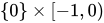
  3. The subspace of the real line is locally path connected but not connected.
  4. The topologist's sine curve is a subspace of the Euclidean plane that is connected, but not locally connected.[12]
  5. The space of rational numbers endowed with the standard Euclidean topology, is neither connected nor locally connected.
  6. The comb space is path connected but not locally path connected, and not even locally connected.
  7. A countably infinite set endowed with the cofinite topology is locally connected (indeed, hyperconnected) but not locally path connected.[13]
  8. The lexicographic order topology on the unit square is connected and locally connected, but not path connected, nor locally path connected.[14]
  9. The Kirch space is connected and locally connected, but not path connected, and not path connected im kleinen at any point. It is in fact totally path disconnected.

A first-countable Hausdorff space is locally path-connected if and only if is equal to the final topology on induced by the set of all continuous paths

Properties

[edit]

TheoremA space is locally connected if and only if it is weakly locally connected.[10]

  1. Local connectedness is, by definition, a local property of topological spaces, i.e., a topological property P such that a space X possesses property P if and only if each point x in X admits a neighborhood base of sets that have property P. Accordingly, all the "metaproperties" held by a local property hold for local connectedness. In particular:
  2. A space is locally connected if and only if it admits a base of (open) connected subsets.
  3. The disjoint union of a family of spaces is locally connected if and only if each is locally connected. In particular, since a single point is certainly locally connected, it follows that any discrete space is locally connected. On the other hand, a discrete space is totally disconnected, so is connected only if it has at most one point.
  4. Conversely, a totally disconnected space is locally connected if and only if it is discrete. This can be used to explain the aforementioned fact that the rational numbers are not locally connected.
  5. A nonempty product space is locally connected if and only if each is locally connected and all but finitely many of the are connected.[15]
  6. Every hyperconnected space is locally connected, and connected.

Components and path components

[edit]

The following result follows almost immediately from the definitions but will be quite useful:

Lemma: Let X be a space, and a family of subsets of X. Suppose that is nonempty. Then, if each is connected (respectively, path connected) then the union is connected (respectively, path connected).[16]

Now consider two relations on a topological space X: for write:

if there is a connected subset of X containing both x and y; and
if there is a path connected subset of X containing both x and y.

Evidently both relations are reflexive and symmetric. Moreover, if x and y are contained in a connected (respectively, path connected) subset A and y and z are connected in a connected (respectively, path connected) subset B, then the Lemma implies that is a connected (respectively, path connected) subset containing x, y and z. Thus each relation is an equivalence relation, and defines a partition of X into equivalence classes. We consider these two partitions in turn.

For x in X, the set of all points y such that is called the connected component of x.[17] The Lemma implies that is the unique maximal connected subset of X containing x.[18] Since the closure of is also a connected subset containing x,[19][20] it follows that is closed.[21]

If X has only finitely many connected components, then each component is the complement of a finite union of closed sets and therefore open. In general, the connected components need not be open, since, e.g., there exist totally disconnected spaces (i.e., for all points x) that are not discrete, like Cantor space. However, the connected components of a locally connected space are also open, and thus are clopen sets.[22] It follows that a locally connected space X is a topological disjoint union of its distinct connected components. Conversely, if for every open subset U of X, the connected components of U are open, then X admits a base of connected sets and is therefore locally connected.[23]

Similarly x in X, the set of all points y such that is called the path component of x.[24] As above, is also the union of all path connected subsets of X that contain x, so by the Lemma is itself path connected. Because path connected sets are connected, we have for all

However the closure of a path connected set need not be path connected: for instance, the topologist's sine curve is the closure of the open subset U consisting of all points (x,sin(x)) with x > 0, and U, being homeomorphic to an interval on the real line, is certainly path connected. Moreover, the path components of the topologist's sine curve C are U, which is open but not closed, and which is closed but not open.

A space is locally path connected if and only if for all open subsets U, the path components of U are open.[24] Therefore the path components of a locally path connected space give a partition of X into pairwise disjoint open sets. It follows that an open connected subspace of a locally path connected space is necessarily path connected.[25] Moreover, if a space is locally path connected, then it is also locally connected, so for all is connected and open, hence path connected, that is, That is, for a locally path connected space the components and path components coincide.

Examples

[edit]
  1. The set (where ) in the dictionary order topology has exactly one component (because it is connected) but has uncountably many path components. Indeed, any set of the form is a path component for each a belonging to I.
  2. Let be a continuous map from to (which is in the lower limit topology). Since is connected, and the image of a connected space under a continuous map must be connected, the image of under must be connected. Therefore, the image of under must be a subset of a component of Since this image is nonempty, the only continuous maps from ' to are the constant maps. In fact, any continuous map from a connected space to a totally disconnected space must be constant.

Quasicomponents

[edit]

Let X be a topological space. We define a third relation on X: if there is no separation of X into open sets A and B such that x is an element of A and y is an element of B. This is an equivalence relation on X and the equivalence class containing x is called the quasicomponent of x.[18]

can also be characterized as the intersection of all clopen subsets of X that contain x.[18] Accordingly is closed; in general it need not be open.

Evidently for all [18] Overall we have the following containments among path components, components and quasicomponents at x:


If X is locally connected, then, as above, is a clopen set containing x, so and thus Since local path connectedness implies local connectedness, it follows that at all points x of a locally path connected space we have

Another class of spaces for which the quasicomponents agree with the components is the class of compact Hausdorff spaces.[26]

Examples

[edit]
  1. An example of a space whose quasicomponents are not equal to its components is a sequence with a double limit point. This space is totally disconnected, but both limit points lie in the same quasicomponent, because any clopen set containing one of them must contain a tail of the sequence, and thus the other point too.
  2. The space is locally compact and Hausdorff but the sets and are two different components which lie in the same quasicomponent.
  3. The Arens–Fort space is not locally connected, but nevertheless the components and the quasicomponents coincide: indeed for all points x.[27]

See also

[edit]

Notes

[edit]

References

[edit]

Further reading

[edit]
Revisions and contributorsEdit on WikipediaRead on Wikipedia
from Grokipedia
In , a locally connected space is a in which every point has a neighborhood basis consisting of connected open sets, or equivalently, for every point xx and every neighborhood UU of xx, there exists a connected open neighborhood VV of xx such that VUV \subseteq U. This local property ensures that connectedness behaves well in small regions of the , contrasting with global connectedness, which does not imply local connectedness and vice versa. A key characterization is that a is locally connected the connected components of every open subset are open in the . Locally connected s are preserved under open subspaces, and continuous closed surjections from locally connected s onto others yield locally connected images. The product of locally connected s is locally connected if each factor is locally connected and all but finitely many factors are connected. Prominent examples include Euclidean spaces [R](/page/R)n\mathbb{[R](/page/R)}^n, which possess connected open balls as a basis, and more generally, topological manifolds. However, the rational numbers Q\mathbb{Q} as a subspace of R\mathbb{R} are not locally connected, as they are totally disconnected and lack nontrivial connected open sets. Counterexamples to the converse include the , defined as the set {(x,sin(1/x))0<x1}{(0,y)1y1}\{(x, \sin(1/x)) \mid 0 < x \leq 1\} \cup \{(0, y) \mid -1 \leq y \leq 1\} with the subspace topology from R2\mathbb{R}^2; it is connected but not locally connected at points on the vertical segment due to neighborhoods containing disconnected components. Conversely, the union of two disjoint open intervals, such as (0,1)(2,3)(0,1) \cup (2,3), is locally connected but disconnected.

Fundamentals

Definition

A topological space XX is locally connected if every point has a neighborhood basis consisting of connected open sets. In a topological space XX, the quasi-component of a point xXx \in X is defined as the intersection of all clopen subsets of XX that contain xx; that is, Q(x)={CXC is clopen in X and xC}.Q(x) = \bigcap \{ C \subseteq X \mid C \text{ is clopen in } X \text{ and } x \in C \}. This quasi-component Q(x)Q(x) is always a closed subset of XX, but it is not necessarily open or connected. The relation defined by xyx \sim y if and only if yQ(x)y \in Q(x) (equivalently, xQ(y)x \in Q(y)) is an equivalence relation on XX that is coarser than the equivalence relation induced by connectedness, meaning quasi-components refine the partition into connected components. The quasi-components of XX form a partition of XX into closed sets. In a connected space XX, there is exactly one quasi-component, namely XX itself. In a totally disconnected space, the quasi-components coincide with the singletons, which are also the connected components. A key theorem states that if XX is locally connected, then the quasi-components of XX coincide with its connected components.

Equivalent formulations

A topological space XX is locally connected if and only if it has a basis consisting of connected open sets. This formulation emphasizes the existence of sufficiently many connected neighborhoods to form a basis at every point. An equivalent characterization is that for every open set UXU \subseteq X, each connected component of UU (considered as a subspace) is open in XX. To see the equivalence between these two formulations, first suppose XX has a basis of connected open sets. Let UU be open in XX, and let CC be a connected component of UU. For any xCx \in C, there exists a basis element BB such that xBUx \in B \subseteq U and BB is connected. Since CC is the union of all connected subsets of UU containing xx, and BCB \subseteq C, it follows that CC is a union of such basis elements contained in UU, hence CC is open in XX. Conversely, suppose that connected components of open sets are open in XX. For any open UU containing a point xx, the connected component of xx in UU is open in XX and contains xx, providing a connected open neighborhood. The collection of all such components for varying UU forms a basis of connected open sets. Another equivalent formulation involves quasi-components: a space XX is locally connected if and only if, for every open subset UXU \subseteq X, every quasi-component of UU is open in XX. Here, the quasi-component of a point yUy \in U is the intersection of all clopen subsets of UU containing yy. To prove this equivalence, note first that in any space, quasi-components are contained in connected components, and both are closed in the subspace. If XX is locally connected, then connected components of open sets are open, so quasi-components coincide with them and are thus open. Conversely, if quasi-components of open sets are open, then for any open UU and point xUx \in U, the quasi-component QQ of xx in UU is open and connected (as it cannot be separated), hence it is the connected component, which is therefore open. This implies the connected components formulation, and thus local connectedness via the basis characterization. The two assertions (for components and quasi-components) are equivalent because, in this context, they align under the openness condition.

Historical context

Origins of the concept

The concept of local connectedness emerged in the early 20th century within the burgeoning field of general topology in Europe, particularly as mathematicians sought to refine notions of continuity and cohesion in abstract spaces beyond Euclidean geometry. Felix Hausdorff, in his seminal 1914 work Grundzüge der Mengenlehre, introduced the German term "Zusammenhängend im Kleinen" (connectedness in the small) to describe spaces where points have arbitrarily small connected neighborhoods, distinguishing it from global connectedness. This formulation arose amid efforts to axiomatize topological structures, building on earlier ideas of continua from Cantor and Jordan, and provided a foundational tool for analyzing local properties in metric and non-metric spaces. In parallel, the Polish school of topology, centered in Warsaw during the 1920s, advanced these ideas through rigorous set-theoretic approaches. Kazimierz Kuratowski, a key figure in this school alongside Sierpiński and Mazurkiewicz, employed the Polish term "lokalnie spójna" (locally connected) in his early papers to explore local cohesion in continua and its implications for dimension theory. This work was deeply intertwined with pre-World War II European topology, where local connectedness facilitated studies of continua—compact connected metric spaces—and low-dimensional embeddings, complementing global connectedness in understanding spatial invariance. Kuratowski's 1933 monograph Topologie, published in French as part of the Polish Mathematical Society's efforts to internationalize , marked the first systematic formalization of local connectedness. In this text, he defined it precisely within the closure operator framework he co-developed, integrating it into broader axiomatic and highlighting its role in separating components of open sets. This publication solidified the concept's place in the discipline, influencing subsequent developments in continuum theory and geometric before the disruptions of World War II.

Key developments

In the mid-20th century, local connectedness became a central concept in dimension theory following its integration into general topology texts during the 1940s and 1950s. Witold Hurewicz and Henry Wallman's influential monograph Dimension Theory (1941) established that, in the class of , the small inductive dimension coincides with the covering dimension, providing a foundational equivalence that simplified the study of topological dimension for such spaces. This work highlighted local connectedness as essential for aligning classical dimension invariants, influencing subsequent treatments in books like Ryszard Engelking's Dimension Theory (1978), which expanded on these results for separable metric spaces. Its role was further emphasized in standard texts such as John L. Kelley's General Topology (1955), which provided equivalent characterizations of local connectedness in axiomatic terms. Advancements in continuum theory during the 1950s further emphasized the role of local connectedness in Peano continua, defined as compact, connected, locally connected metric spaces. Gordon T. Whyburn's contributions, building on his earlier analytic topology, included key results on the decomposition and cyclic structure of Peano continua, such as characterizations of their subcontinua and endpoints using local connectedness properties. For instance, Whyburn's 1955 work on free arcs demonstrated how local connectedness enables structural theorems distinguishing tree-like continua from more complex Peano spaces. These developments solidified Peano continua as a cornerstone for understanding hereditarily locally connected spaces in plane topology. The 1960s onward saw local connectedness influence shape theory, pioneered by Karol Borsuk and his school, where it acts as a prerequisite for homotopy equivalences in non-ANR compacta. Borsuk's foundational papers, such as "Concerning the homotopical theory of shape" (1968), showed that locally connected compact metric spaces admit shape approximations via polyhedra, enabling extensions of classical homotopy to irregular spaces. Theorems from this era, like those relating shape dimension to local connectedness in dimension zero, underscored its utility in preserving homotopy types under embeddings.

Examples

Positive examples

Euclidean spaces Rn\mathbb{R}^n for any n1n \geq 1 are locally connected, as every point has a basis of open neighborhoods consisting of open balls, which are connected. All smooth manifolds are locally connected because they are locally homeomorphic to Rn\mathbb{R}^n, and thus every point admits a neighborhood basis of connected open sets via the chart maps. Discrete topological spaces are locally connected, since the singleton sets are open and connected, forming a neighborhood basis at each point. Connected length spaces, such as geodesic metric spaces where the distance realizes the infimum of path lengths, are locally connected because small balls around each point contain connected geodesic segments.

Counterexamples

A classic counterexample of a connected topological space that is not locally connected is the topologist's sine curve, defined as the subspace S={(x,sin(1/x))0<x1}{(0,y)1y1}S = \{(x, \sin(1/x)) \mid 0 < x \leq 1\} \cup \{(0, y) \mid -1 \leq y \leq 1\} of R2\mathbb{R}^2 with the standard topology. This space is connected because the vertical line segment at x=0x=0 serves as a limit set for the oscillating graph of sin(1/x)\sin(1/x), preventing any separation into disjoint non-empty open sets. However, it is not locally connected at points on the vertical segment, such as the origin (0,0)(0,0), since any neighborhood of (0,0)(0,0) in SS contains points from the sine curve whose connected components in the relative topology are disconnected arcs that do not connect through the origin without including the entire oscillating tail. The Warsaw circle provides another illustration of a connected space that fails local connectedness, constructed by taking the topologist's sine curve and adjoining an arc from (0,1)(0,1) to (0,1)(0,-1) that lies outside the oscillations, forming a closed loop avoiding the sine curve's dense limit points. This space is even path-connected, as paths can travel along the adjoining arc to bypass the oscillations, ensuring global connectivity. Yet, it is not locally connected at points on the adjoining arc near the vertical segment, where neighborhoods split into the arc component and infinitely many disconnected sine curve segments, with no connected open neighborhood containing only connected pieces around those points. The Knaster-Kuratowski fan, also known as the punctured Cantor fan, is a connected subset of R2\mathbb{R}^2 formed by line segments from an apex point p=(1/2,1/2)p = (1/2, 1/2) to points on the Cantor set in [0,1]×{0}[0,1] \times \{0\}, but with the topology modified such that rational-height points on "endpoint" rays are "dispersed." Specifically, the space consists of rays to the dense Cantor endpoints with rational y-coordinates kept intact, while rays to non-endpoint Cantor points have only irrational y-coordinates included. This construction ensures connectivity through the apex, as any separation would require isolating rays that are intertwined via the Cantor set's density. Nevertheless, it fails local connectedness at the apex pp, because every neighborhood of pp minus pp becomes totally disconnected into uncountably many separate rays, with no basis of connected open sets around pp.

Properties

Basic topological properties

A locally connected topological space has the property that every open subspace is also locally connected. This hereditary nature follows from the fact that the subspace topology on an open set inherits the local basis of connected open sets from the ambient space. In a locally connected space, the collection of all connected open sets forms a basis for the topology. Equivalently, for every open set UU in the space, each connected component of UU is open in the space. Local connectedness is preserved under arbitrary unions of open sets. If {Ui}iI\{U_i\}_{i \in I} is a collection of open locally connected subsets of a space XX, then their union U=iIUiU = \bigcup_{i \in I} U_i is open and locally connected, since for any point xUx \in U, which lies in some UjU_j, a connected open neighborhood of xx in UjU_j serves as one in UU. The property of local connectedness is not preserved under arbitrary continuous images. However, it is preserved under open continuous surjections: if f:XYf: X \to Y is a continuous open map from a locally connected space XX onto YY, then YY is locally connected. In a compact locally connected space, there are only finitely many connected components. Since the components are both open and closed, and a compact space cannot be written as an infinite disjoint union of nonempty open sets, the number of components must be finite.

Relations to other connectedness types

A space is locally path-connected if every point has a neighborhood basis consisting of path-connected open sets; since path-connected sets are connected, local path-connectedness implies local connectedness. The converse does not hold, as there exist locally connected spaces that are not locally path-connected, such as the comb space. Locally connected spaces need not be connected globally, as the property concerns only local neighborhoods; a space is connected only if it cannot be partitioned into two nonempty disjoint open sets. Thus, achieving full connectedness requires both local connectedness and the absence of such a partition. Uniform local connectedness strengthens the notion by requiring that the "scale" of connected neighborhoods be uniform across the space, particularly in metric contexts; for instance, every compact locally connected metric space is uniformly locally connected, meaning for any ϵ>0\epsilon > 0, there exists δ>0\delta > 0 such that any two points within distance δ\delta lie in a connected set of diameter at most ϵ\epsilon. In a locally path-connected , the path components coincide with the connected components: each path component is open (hence clopen in its connected component), and since every open connected subset is path-connected, the maximal connected sets are precisely the path components. The follows from the fact that local path-connectedness ensures open sets decompose into open path components, aligning the two partitions.

Components

Connected components

In a XX, the connected components are the maximal connected subsets, which form a partition of XX into disjoint connected subsets. Each connected component is closed in XX. In a locally connected space, the connected components are both open and closed (clopen), providing a disconnection of XX into clopen sets if XX is disconnected. These components are uniquely determined by the where two points are equivalent if they lie in a common connected subspace. A space XX is locally connected if and only if the connected components of every open subset of XX are open in XX. This characterization ensures that open subsets decompose into disjoint unions of their open connected components. In non-locally connected continua, the connected components of open subsets need not be open, highlighting the role of local connectedness in maintaining this openness property.

Path components in locally connected spaces

In a topological space XX, the path component of a point xXx \in X is the union of all path-connected subsets of XX containing xx, and these path components partition XX into disjoint path-connected subsets. In any space, each path component is contained within some connected component, but the two may differ unless additional conditions hold. For a locally connected space XX, where every point has a basis of connected open neighborhoods, the connected components of XX are open (and hence also locally connected). However, the path components need not coincide with the connected components, nor are they necessarily open. Path components in such spaces are always closed, as the path component of xx is the intersection of all closed sets containing it that are path-connected, but openness requires local path-connectedness. Specifically, if XX is locally connected but not locally path-connected, the path components may be proper closed subsets of the connected components. A canonical example is the unit square [0,1]×[0,1][0,1] \times [0,1] equipped with the topology, where basis elements are order intervals ((a,b)×[0,1])({c}×(d,e))( (a,b) \times [0,1] ) \cup ( \{c\} \times (d,e) ) for appropriate points. This space is connected and locally connected, as every basis element is connected. However, it is not path-connected, and its path components are precisely the vertical line segments {t}×[0,1]\{t\} \times [0,1] for each t[0,1]t \in [0,1], each of which is homeomorphic to [0,1][0,1] and closed but not open. No continuous path can connect points with distinct first coordinates, as any such path would require traversing uncountably many disjoint open sets in the parameter interval, violating continuity. In summary, while locally connectedness ensures that connected components are well-behaved (open and path-accessible within themselves under further assumptions), path components in these spaces highlight the gap between connectedness and path-connectedness, remaining closed subsets that may fragment larger components.

Quasicomponents

Definition

In a XX, the quasi-component of a point xXx \in X is defined as the of all clopen subsets of XX that contain xx; that is, Q(x)={CXC is clopen in X and xC}.Q(x) = \bigcap \{ C \subseteq X \mid C \text{ is clopen in } X \text{ and } x \in C \}. This quasi-component Q(x)Q(x) is always a closed subset of XX, but it is not necessarily open or connected. The relation defined by xyx \sim y if and only if yQ(x)y \in Q(x) (equivalently, xQ(y)x \in Q(y)) is an on XX that is coarser than the equivalence relation induced by connectedness, meaning that the partition into quasi-components is coarser than the partition into connected components (each quasi-component contains one or more connected components). The quasi-components of XX form a partition of XX into closed sets. In a XX, there is exactly one quasi-component, namely XX itself. In a , the quasi-components coincide with the singletons, which are also the connected components. A key theorem states that if XX is locally connected, then the quasi-components of XX coincide with its connected components.

Behavior in locally connected spaces

In a locally connected , the quasicomponents coincide with the connected components. This equivalence arises because every connected component in such a space is open, and since connected components are always closed, they are clopen subsets. The quasicomponent of a point xx, defined as the intersection of all containing xx, is therefore precisely the connected component of xx, as the latter serves as the smallest such clopen set. This coincidence implies that quasicomponents in spaces are both open and connected. For any open UU, its quasicomponents (equivalently, connected components) form a partition of UU into clopen subsets relative to UU, ensuring that the space decomposes neatly into these pieces without finer quasi-separations. Consequently, properties like local path-connectedness further align path components with these quasicomponents, simplifying the analysis of connectedness. An illustrative example is the real line R\mathbb{R} with the standard topology, which is locally connected. Here, the connected component is R\mathbb{R} itself (an unbounded open interval), and the quasicomponents match exactly, as there are no non-trivial clopen sets beyond the whole space. In contrast, spaces like the rational numbers Q\mathbb{Q} are not locally connected but totally disconnected, so their quasicomponents coincide with the connected components, both being singletons; this shows that local connectedness is sufficient but not necessary for the coincidence.

References

Add your contribution
Related Hubs
User Avatar
No comments yet.