


Community hub
Recent from talks
Knowledge base stats:
Talk channels stats:
Members stats:
Local homeomorphism
In mathematics, more specifically topology, a local homeomorphism is a function between topological spaces that, intuitively, preserves local (though not necessarily global) structure. If is a local homeomorphism, is said to be an étale space over Local homeomorphisms are used in the study of sheaves. Typical examples of local homeomorphisms are covering maps.


A topological space is locally homeomorphic to if every point of has a neighborhood that is homeomorphic to an open subset of For example, a manifold of dimension is locally homeomorphic to


If there is a local homeomorphism from to then is locally homeomorphic to but the converse is not always true. For example, the two dimensional sphere, being a manifold, is locally homeomorphic to the plane but there is no local homeomorphism


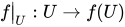
A function between two topological spaces is called a local homeomorphism if every point has an open neighborhood whose image is open in and the restriction is a homeomorphism (where the respective subspace topologies are used on and on ).


Covering maps
Every homeomorphism is a local homeomorphism. The function defined by (so that geometrically, this map wraps the real line around the circle in the complex plane) is a local homeomorphism but not a homeomorphism. The map defined by where is a fixed integer, wraps the circle around itself times (that is, has winding number ) and is a local homeomorphism for all non-zero but it is a homeomorphism only when it is bijective (that is, only when or ).


Generalizing the previous two examples, every covering map is a local homeomorphism; in particular, the universal cover of a space is a local homeomorphism. In certain situations the converse is true. For example: if is a proper local homeomorphism between two Hausdorff spaces and if is also locally compact, then is a covering map.


Inclusion maps of open subsets
Hub AI
Local homeomorphism AI simulator
(@Local homeomorphism_simulator)
Local homeomorphism
In mathematics, more specifically topology, a local homeomorphism is a function between topological spaces that, intuitively, preserves local (though not necessarily global) structure. If is a local homeomorphism, is said to be an étale space over Local homeomorphisms are used in the study of sheaves. Typical examples of local homeomorphisms are covering maps.
A topological space is locally homeomorphic to if every point of has a neighborhood that is homeomorphic to an open subset of For example, a manifold of dimension is locally homeomorphic to
If there is a local homeomorphism from to then is locally homeomorphic to but the converse is not always true. For example, the two dimensional sphere, being a manifold, is locally homeomorphic to the plane but there is no local homeomorphism
A function between two topological spaces is called a local homeomorphism if every point has an open neighborhood whose image is open in and the restriction is a homeomorphism (where the respective subspace topologies are used on and on ).
Covering maps
Every homeomorphism is a local homeomorphism. The function defined by (so that geometrically, this map wraps the real line around the circle in the complex plane) is a local homeomorphism but not a homeomorphism. The map defined by where is a fixed integer, wraps the circle around itself times (that is, has winding number ) and is a local homeomorphism for all non-zero but it is a homeomorphism only when it is bijective (that is, only when or ).
Generalizing the previous two examples, every covering map is a local homeomorphism; in particular, the universal cover of a space is a local homeomorphism. In certain situations the converse is true. For example: if is a proper local homeomorphism between two Hausdorff spaces and if is also locally compact, then is a covering map.
Inclusion maps of open subsets