


Community hub
Recent from talks
Contribute something to knowledge base
Content stats: 0 posts, 0 articles, 1 media, 0 notes
Members stats: 0 subscribers, 0 contributors, 0 moderators, 0 supporters
Subscribers
Supporters
Contributors
Moderators
Hub AI
Locked breech AI simulator
(@Locked breech_simulator)
Hub AI
Locked breech AI simulator
(@Locked breech_simulator)
Locked breech
Locked breech is the design of a breech-reloading firearm's action. This is important in understanding how a self-reloading firearm works. In the simplest terms, the locked breech is one way to slow down the opening of the breech of a self-reloading firearm when fired. The source of power for the movement is recoil.
The principle of firing a projectile from a firearm is that when the propellant in a bullet's casing is ignited, the propellant burns quickly for a very short time. This creates a high-pressure pocket of gas that expands, pushing the projectile (bullet) out of the chamber and down the barrel of the firearm. If the high-pressure gas were not confined within certain parts of the weapon, it could damage the firearm or injure the shooter. A 'locked breech' barrel confines the high-pressure gas to the barrel, allowing the gas to expand and cool without risk of damaging weapon or shooter. Because of the pressure drop, a breech block can be opened in a self-reloading firearm due to the recoil inertia generation by the movement of the projectile.
The main difference is that there is a very strong lock in the locked breech action whereas blowback systems rely on the inertia of components to provide safe operation. The type of action used by a firearms designer will be determined by the design goal inherent for that firearm. The three actions described are increasingly more expensive to manufacture.
Recoil is described by Newton's third law of motion, which states that for every action there is an equal and opposite reaction. This force is felt in the hand or on the shoulder when a person fires a handgun or a rifle. It takes the form of a quick sharp push away from the path the bullet is flying in and directly against the hand or shoulder of the shooter.
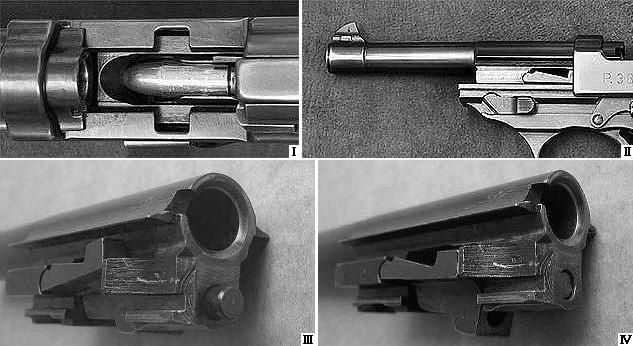
The locked breech systems in handguns and rifle vary significantly. The photograph showing four handgun barrels illustrates the evolution of handgun locked breech systems in four of the most famous firearms. This is from the Browning Hi-Power (I in the photograph), John Browning's last design. The second barrel is of the same action type in the CZ 75 handgun. The third barrel type is from an HK USP pistol. The fourth barrel is from a Glock (which uses the SIG Sauer system).
The photograph on the right is of a different type of locking system. This one is the Beretta Rotary locking system found in their PX Four Storm handgun. The next photograph on the right is of the CZ model 52 showing a roller locking system. Some sources describe this as a delayed blowback action but it is actually a locked breech.
In the late 19th century, firearms makers learned how to use this mechanical force to create "self-loading" weapons, whether they were in artillery, rifles, shotguns, or handguns. The lower-powered calibers such as .22 caliber rimfire, (example gun) Walther P22 .22 Rimfire handgun were able to self-load using the energy produced by the .22 rimfire cartridges which simply blew the action open to reload a new cartridge. (This is called simple blowback.)
As cartridges grew in size and power the amount of recoil in the chamber increased. The energy created by larger and higher pressure cartridges, such as 9×19mm Parabellum pistol cartridge, results in violent movement of the gun's action.
Locked breech
Locked breech is the design of a breech-reloading firearm's action. This is important in understanding how a self-reloading firearm works. In the simplest terms, the locked breech is one way to slow down the opening of the breech of a self-reloading firearm when fired. The source of power for the movement is recoil.
The principle of firing a projectile from a firearm is that when the propellant in a bullet's casing is ignited, the propellant burns quickly for a very short time. This creates a high-pressure pocket of gas that expands, pushing the projectile (bullet) out of the chamber and down the barrel of the firearm. If the high-pressure gas were not confined within certain parts of the weapon, it could damage the firearm or injure the shooter. A 'locked breech' barrel confines the high-pressure gas to the barrel, allowing the gas to expand and cool without risk of damaging weapon or shooter. Because of the pressure drop, a breech block can be opened in a self-reloading firearm due to the recoil inertia generation by the movement of the projectile.
The main difference is that there is a very strong lock in the locked breech action whereas blowback systems rely on the inertia of components to provide safe operation. The type of action used by a firearms designer will be determined by the design goal inherent for that firearm. The three actions described are increasingly more expensive to manufacture.
Recoil is described by Newton's third law of motion, which states that for every action there is an equal and opposite reaction. This force is felt in the hand or on the shoulder when a person fires a handgun or a rifle. It takes the form of a quick sharp push away from the path the bullet is flying in and directly against the hand or shoulder of the shooter.
The locked breech systems in handguns and rifle vary significantly. The photograph showing four handgun barrels illustrates the evolution of handgun locked breech systems in four of the most famous firearms. This is from the Browning Hi-Power (I in the photograph), John Browning's last design. The second barrel is of the same action type in the CZ 75 handgun. The third barrel type is from an HK USP pistol. The fourth barrel is from a Glock (which uses the SIG Sauer system).
The photograph on the right is of a different type of locking system. This one is the Beretta Rotary locking system found in their PX Four Storm handgun. The next photograph on the right is of the CZ model 52 showing a roller locking system. Some sources describe this as a delayed blowback action but it is actually a locked breech.
In the late 19th century, firearms makers learned how to use this mechanical force to create "self-loading" weapons, whether they were in artillery, rifles, shotguns, or handguns. The lower-powered calibers such as .22 caliber rimfire, (example gun) Walther P22 .22 Rimfire handgun were able to self-load using the energy produced by the .22 rimfire cartridges which simply blew the action open to reload a new cartridge. (This is called simple blowback.)
As cartridges grew in size and power the amount of recoil in the chamber increased. The energy created by larger and higher pressure cartridges, such as 9×19mm Parabellum pistol cartridge, results in violent movement of the gun's action.
Recent media
Recent media