



Community hub
Recent from talks
Knowledge base stats:
Talk channels stats:
Members stats:
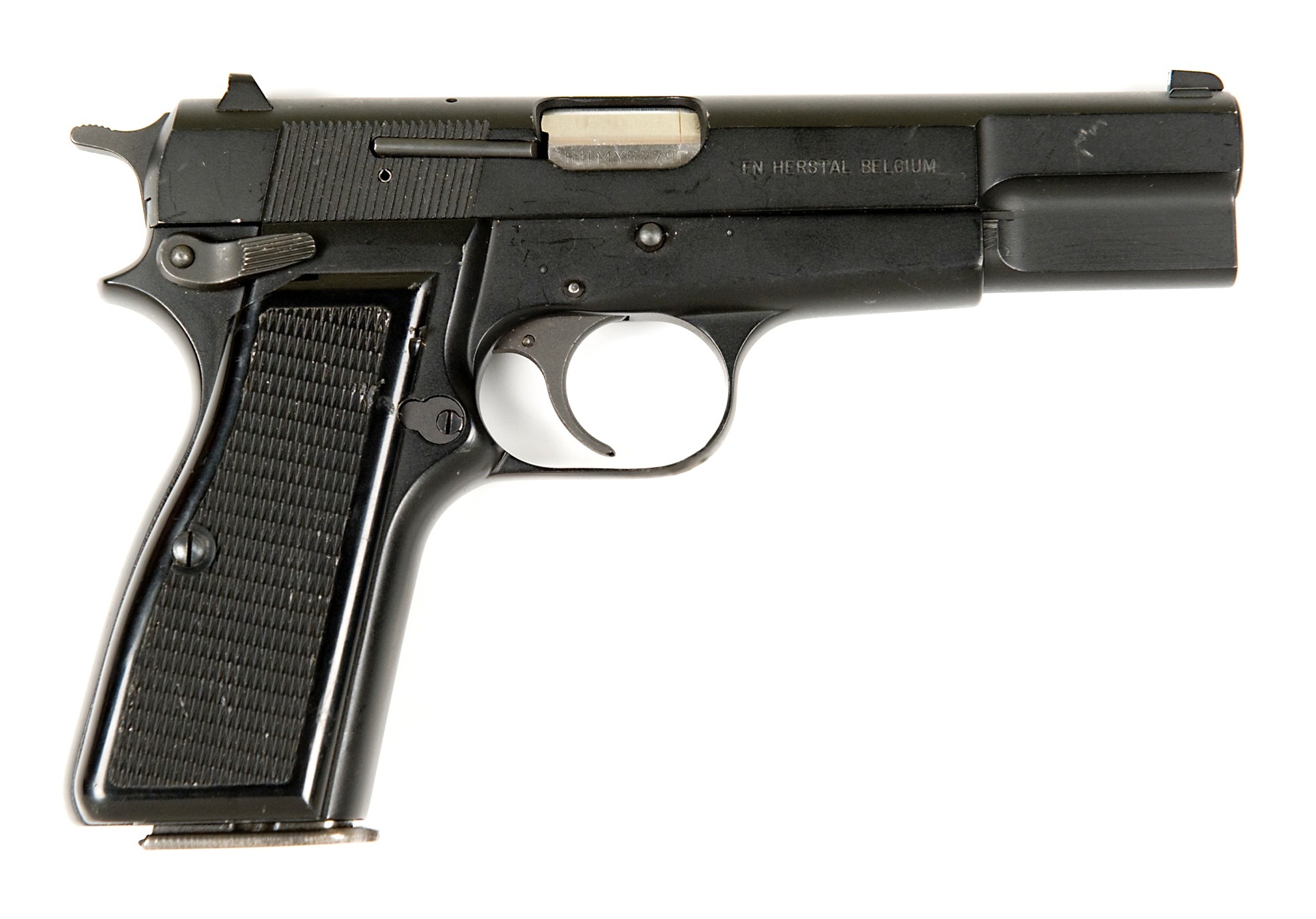
Browning Hi-Power
The Browning Hi-Power is a single-action, semi-automatic pistol available in the 9×19mm Parabellum and .40 S&W calibers. It was based on a design by American firearms inventor John Browning, and completed by Dieudonné Saive at FN Herstal. Browning died in 1926, several years before the design was finalized. FN Herstal named it the "High Power" in allusion to the 13-round magazine capacity, almost twice that of other designs at the time, such as the Walther P38 or Colt M1911.
During World War II, Belgium was occupied by Nazi Germany and the FN factory was used by the Wehrmacht to build the pistols for their military, under the designation "9mm Pistole 640(b)". FN Herstal continued to build guns for the Allied forces by moving their production line to a John Inglis and Company plant in Canada, where the name was changed to "Hi Power". The name change was kept even after production returned to Belgium. The pistol is often referred to as an HP or BHP, and the terms P-35 and HP-35 are also used, based on the introduction of the pistol in 1935. Other names include GP (after the French term grande puissance) or BAP (Browning Automatic Pistol). The Hi-Power is one of the most widely used military pistols in history, having been used by the armed forces of over 50 countries. Although most pistols were built in Belgium by FN Herstal, licensed and unlicensed copies were built around the world, in countries such as Argentina, Hungary, India, Bulgaria, and Israel.
After 82 years of continuous production, FN Herstal announced that the production of the Hi-Power would end, and it was discontinued in early 2018 by Browning Arms. From 2019 to 2022, with new Belgian Hi-Powers no longer being built, new clones were designed by various firearm companies to fill the void, including GİRSAN, TİSAŞ, and Springfield Armory, Inc. These new Hi-Power clones began competing with each other by offering new finishes, enhanced sights, redesigned hammers, bevelled magazine wells, improved trigger, and increased magazine capacity.
In 2022, FN announced they would resume production of the Browning Hi-Power. The 2022 "FN High Power" incorporated a number of entirely new features such as a fully ambidextrous slide lock, simplified takedown method, enlarged ejection port, reversible magazine release, wider slide serrations, different colored finish offerings, and 17-round magazines. In contrast to popular belief, the new FN High Power might resemble a modern Hi-Power, but it is, in fact, a different design. One of the noticeable details is the lack of Browning-style locking lugs.
The Browning Hi-Power was designed in response to a French military requirement for a new service pistol, the "Grand Rendement" (French for "high efficiency"), or alternatively Grande Puissance (literally "high power"). The French military required that:
This last criterion was seen to demand a caliber of 9 mm (0.35 in) or larger, a bullet mass of around 8 g (120 gr), and a muzzle velocity of 350 m/s (1,100 ft/s). It was to accomplish all of this at a weight not exceeding 1 kg (2.2 lb).
FN commissioned John Browning to design a new military sidearm conforming to this specification. Browning had previously sold the rights to his successful M1911 U.S. Army automatic pistol to Colt's Patent Firearms, and was therefore forced to design an entirely new pistol while working around the M1911 patents. Browning built two different prototypes for the project in Utah and filed the patent for this pistol in the United States on 28 June 1923, granted on 22 February 1927. One was a simple blowback design, while the other was operated with a locked-breech recoil system. Both prototypes utilised the new staggered magazine design (by designer Dieudonné Saive) to increase capacity without unduly increasing the pistol's grip size or magazine length.
The locked breech design was selected for further development and testing. This model was striker-fired, and featured a double-stack magazine that held 16 rounds. The design was refined through several trials held by the Versailles Trial Commission.
Hub AI
Browning Hi-Power AI simulator
(@Browning Hi-Power_simulator)
Browning Hi-Power
The Browning Hi-Power is a single-action, semi-automatic pistol available in the 9×19mm Parabellum and .40 S&W calibers. It was based on a design by American firearms inventor John Browning, and completed by Dieudonné Saive at FN Herstal. Browning died in 1926, several years before the design was finalized. FN Herstal named it the "High Power" in allusion to the 13-round magazine capacity, almost twice that of other designs at the time, such as the Walther P38 or Colt M1911.
During World War II, Belgium was occupied by Nazi Germany and the FN factory was used by the Wehrmacht to build the pistols for their military, under the designation "9mm Pistole 640(b)". FN Herstal continued to build guns for the Allied forces by moving their production line to a John Inglis and Company plant in Canada, where the name was changed to "Hi Power". The name change was kept even after production returned to Belgium. The pistol is often referred to as an HP or BHP, and the terms P-35 and HP-35 are also used, based on the introduction of the pistol in 1935. Other names include GP (after the French term grande puissance) or BAP (Browning Automatic Pistol). The Hi-Power is one of the most widely used military pistols in history, having been used by the armed forces of over 50 countries. Although most pistols were built in Belgium by FN Herstal, licensed and unlicensed copies were built around the world, in countries such as Argentina, Hungary, India, Bulgaria, and Israel.
After 82 years of continuous production, FN Herstal announced that the production of the Hi-Power would end, and it was discontinued in early 2018 by Browning Arms. From 2019 to 2022, with new Belgian Hi-Powers no longer being built, new clones were designed by various firearm companies to fill the void, including GİRSAN, TİSAŞ, and Springfield Armory, Inc. These new Hi-Power clones began competing with each other by offering new finishes, enhanced sights, redesigned hammers, bevelled magazine wells, improved trigger, and increased magazine capacity.
In 2022, FN announced they would resume production of the Browning Hi-Power. The 2022 "FN High Power" incorporated a number of entirely new features such as a fully ambidextrous slide lock, simplified takedown method, enlarged ejection port, reversible magazine release, wider slide serrations, different colored finish offerings, and 17-round magazines. In contrast to popular belief, the new FN High Power might resemble a modern Hi-Power, but it is, in fact, a different design. One of the noticeable details is the lack of Browning-style locking lugs.
The Browning Hi-Power was designed in response to a French military requirement for a new service pistol, the "Grand Rendement" (French for "high efficiency"), or alternatively Grande Puissance (literally "high power"). The French military required that:
This last criterion was seen to demand a caliber of 9 mm (0.35 in) or larger, a bullet mass of around 8 g (120 gr), and a muzzle velocity of 350 m/s (1,100 ft/s). It was to accomplish all of this at a weight not exceeding 1 kg (2.2 lb).
FN commissioned John Browning to design a new military sidearm conforming to this specification. Browning had previously sold the rights to his successful M1911 U.S. Army automatic pistol to Colt's Patent Firearms, and was therefore forced to design an entirely new pistol while working around the M1911 patents. Browning built two different prototypes for the project in Utah and filed the patent for this pistol in the United States on 28 June 1923, granted on 22 February 1927. One was a simple blowback design, while the other was operated with a locked-breech recoil system. Both prototypes utilised the new staggered magazine design (by designer Dieudonné Saive) to increase capacity without unduly increasing the pistol's grip size or magazine length.
The locked breech design was selected for further development and testing. This model was striker-fired, and featured a double-stack magazine that held 16 rounds. The design was refined through several trials held by the Versailles Trial Commission.