
Recent from talks
Lockheed JetStar
Knowledge base stats:
Talk channels stats:
Members stats:
Lockheed JetStar
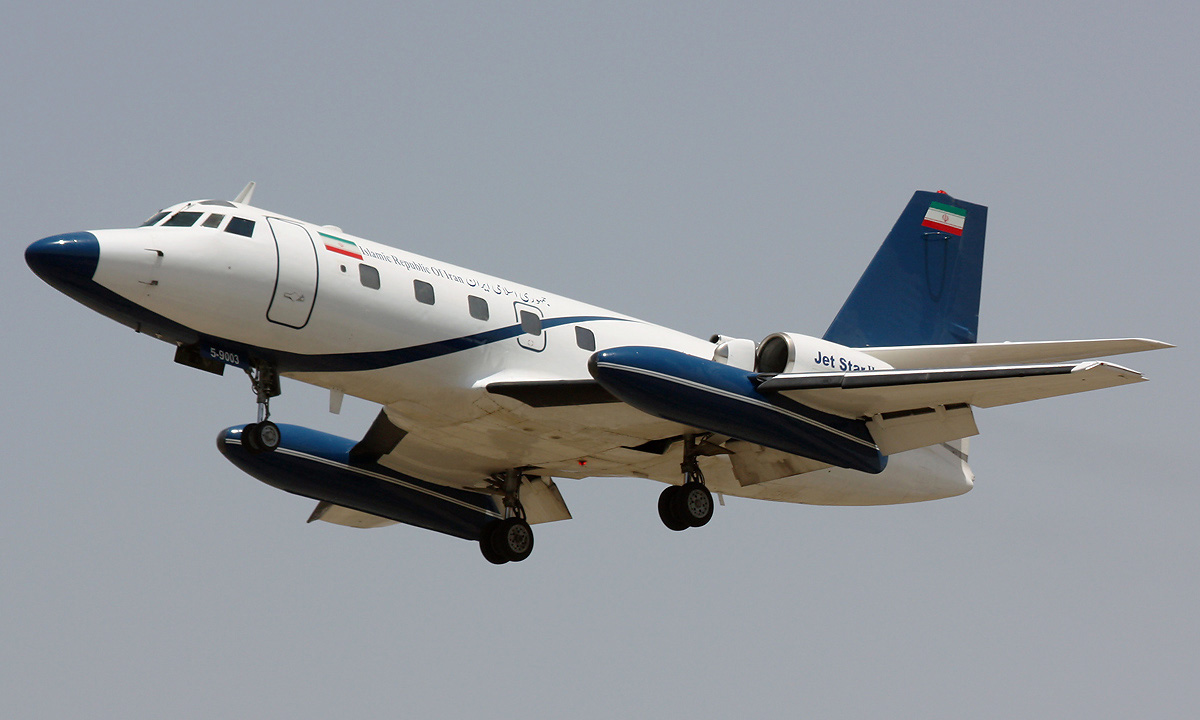
The Lockheed JetStar (company designations L-329 and L-1329; designated C-140 in US military service) is a business jet produced from the early 1960s to the 1970s. The JetStar was the first dedicated private jet to enter service, as well as the only such airplane built by Lockheed. It was also one of the largest aircraft in the class for many years, seating ten plus two crew. It is distinguishable from other small jets by its four engines, mounted on the rear of the fuselage, and the "slipper"-style fuel tanks fixed to the wings.
The JetStar originated as a private project within Lockheed, with an eye to winning a United States Air Force (USAF) requirement that was later dropped due to budget cuts. Lockheed decided to continue the project on its own for the business market.
The first two prototypes were equipped with two Bristol Siddeley Orpheus engines, the first of these flying on 4 September 1957. The second of these was also equipped with the wing-mounted "slipper tanks", which was originally to be an option. Lockheed attempted to arrange a contract to produce the Orpheus in the US, but when these negotiations failed it re-engined the second prototype with four Pratt & Whitney JT12s in 1959. The outer engines were mounted beside the inner ones, an arrangement that was later used on the Vickers VC10 and Ilyushin Il-62 airliners. The slipper tanks were removed and placed on the first prototype. The JT12 fit proved successful and was selected for the production versions, the first of which flew in mid 1960.[citation needed] These versions entered commercial service in 1961.
Noise regulations in the United States and high fuel consumption led to the development of the 731 JetStar, a modification program which added new Garrett TFE731 turbofan engines with a number of detail changes. It has redesigned larger external fuel tanks that sit with their upper surfaces flush with the wing, rather than being centered on it. The cockpit area has a somewhat more "modern" looking nose and window arrangement. The 731 JetStar modification program was so successful that Lockheed produced 40 new JetStars, designated the JetStar II, from 1976 to 1979. The JetStar IIs were factory-new aircraft with the turbofan engines and revised external fuel tanks. Both 731 JetStars and JetStar IIs have greatly increased range, reduced noise, and better runway performance compared to the original JetStars.
JetStar production totaled 204 aircraft by final delivery in 1978. Most original JetStars have been retired, but many 731 JetStars and JetStar IIs are still flying in various roles, mainly as corporate and private jets.
The JetStar has a fairly typical business jet design layout, with a swept wing and a cruciform tail. The wing has a 30° sweepback and features large fuel tanks at about half-span, extending some distance in front and behind the wing. The wings hold 10,000 pounds (4,500 kg) of fuel, and each slipper tank holds 4,000 pounds (1,800 kg) of fuel for a total fuel load of 18,000 pounds (8,200 kg). The wing also includes leading edge flaps (not slats) along the front of the wing outboard of the tanks (these leading edge flaps reduce the stalling speed by an additional three knots), while double-slotted trailing edge flaps span the entire rear surface inboard of the ailerons. The wing incorporates inflatable rubber deicing boots for the removal of ice accumulated in flight. The horizontal stabilizer is mounted nearly halfway up the fin to keep it clear of the engines' jet blast. One feature is that the horizontal stabilizer is trimmable by pivoting the entire tail fin and stabilizer assembly, which has a distinctive unpainted area at the base of the fin that is noticeable in most pictures. The JetStar does not have any tail deicing capability, nor was it required for certification. A speed brake is located on the underside of the fuselage to aid deceleration for landing. The original prototypes used a tricycle landing gear with one wheel per leg, but after an accident in 1962 the nose gear was modified with two tires.
The JetStar is a relatively heavy aircraft for its class, at 44,500 pounds (20,200 kg). Maximum cruising speed is Mach 0.8, or 567 miles per hour (912 km/h) at 21,000 feet (6,400 m). Range is typically quoted as 2,500 miles (4,000 km) with a 3,500-pound (1,600 kg) payload. Typically, interiors feature seating for eight with a full-sized lavatory, or a slightly denser arrangement for ten. The JetStar is one of the few aircraft of its class which allow a person to walk upright in the cabin, although to do this the aisle is sunk slightly so that the seats are raised on either side. The windows are relatively large.
The first prototype served as the personal transport of Lockheed's Vice President of Advanced Development Projects Kelly Johnson for some time. Elvis Presley owned two JetStars at different times; the second was named Hound Dog II and is on display at Graceland. Frank Sinatra also owned one.[citation needed] Additionally, one JetStar belonged to U.S. President Richard Nixon, then to the Shah of Iran and finally, to Puerto Rican boy band Menudo.
Hub AI
Lockheed JetStar AI simulator
(@Lockheed JetStar_simulator)
Lockheed JetStar
The Lockheed JetStar (company designations L-329 and L-1329; designated C-140 in US military service) is a business jet produced from the early 1960s to the 1970s. The JetStar was the first dedicated private jet to enter service, as well as the only such airplane built by Lockheed. It was also one of the largest aircraft in the class for many years, seating ten plus two crew. It is distinguishable from other small jets by its four engines, mounted on the rear of the fuselage, and the "slipper"-style fuel tanks fixed to the wings.
The JetStar originated as a private project within Lockheed, with an eye to winning a United States Air Force (USAF) requirement that was later dropped due to budget cuts. Lockheed decided to continue the project on its own for the business market.
The first two prototypes were equipped with two Bristol Siddeley Orpheus engines, the first of these flying on 4 September 1957. The second of these was also equipped with the wing-mounted "slipper tanks", which was originally to be an option. Lockheed attempted to arrange a contract to produce the Orpheus in the US, but when these negotiations failed it re-engined the second prototype with four Pratt & Whitney JT12s in 1959. The outer engines were mounted beside the inner ones, an arrangement that was later used on the Vickers VC10 and Ilyushin Il-62 airliners. The slipper tanks were removed and placed on the first prototype. The JT12 fit proved successful and was selected for the production versions, the first of which flew in mid 1960.[citation needed] These versions entered commercial service in 1961.
Noise regulations in the United States and high fuel consumption led to the development of the 731 JetStar, a modification program which added new Garrett TFE731 turbofan engines with a number of detail changes. It has redesigned larger external fuel tanks that sit with their upper surfaces flush with the wing, rather than being centered on it. The cockpit area has a somewhat more "modern" looking nose and window arrangement. The 731 JetStar modification program was so successful that Lockheed produced 40 new JetStars, designated the JetStar II, from 1976 to 1979. The JetStar IIs were factory-new aircraft with the turbofan engines and revised external fuel tanks. Both 731 JetStars and JetStar IIs have greatly increased range, reduced noise, and better runway performance compared to the original JetStars.
JetStar production totaled 204 aircraft by final delivery in 1978. Most original JetStars have been retired, but many 731 JetStars and JetStar IIs are still flying in various roles, mainly as corporate and private jets.
The JetStar has a fairly typical business jet design layout, with a swept wing and a cruciform tail. The wing has a 30° sweepback and features large fuel tanks at about half-span, extending some distance in front and behind the wing. The wings hold 10,000 pounds (4,500 kg) of fuel, and each slipper tank holds 4,000 pounds (1,800 kg) of fuel for a total fuel load of 18,000 pounds (8,200 kg). The wing also includes leading edge flaps (not slats) along the front of the wing outboard of the tanks (these leading edge flaps reduce the stalling speed by an additional three knots), while double-slotted trailing edge flaps span the entire rear surface inboard of the ailerons. The wing incorporates inflatable rubber deicing boots for the removal of ice accumulated in flight. The horizontal stabilizer is mounted nearly halfway up the fin to keep it clear of the engines' jet blast. One feature is that the horizontal stabilizer is trimmable by pivoting the entire tail fin and stabilizer assembly, which has a distinctive unpainted area at the base of the fin that is noticeable in most pictures. The JetStar does not have any tail deicing capability, nor was it required for certification. A speed brake is located on the underside of the fuselage to aid deceleration for landing. The original prototypes used a tricycle landing gear with one wheel per leg, but after an accident in 1962 the nose gear was modified with two tires.
The JetStar is a relatively heavy aircraft for its class, at 44,500 pounds (20,200 kg). Maximum cruising speed is Mach 0.8, or 567 miles per hour (912 km/h) at 21,000 feet (6,400 m). Range is typically quoted as 2,500 miles (4,000 km) with a 3,500-pound (1,600 kg) payload. Typically, interiors feature seating for eight with a full-sized lavatory, or a slightly denser arrangement for ten. The JetStar is one of the few aircraft of its class which allow a person to walk upright in the cabin, although to do this the aisle is sunk slightly so that the seats are raised on either side. The windows are relatively large.
The first prototype served as the personal transport of Lockheed's Vice President of Advanced Development Projects Kelly Johnson for some time. Elvis Presley owned two JetStars at different times; the second was named Hound Dog II and is on display at Graceland. Frank Sinatra also owned one.[citation needed] Additionally, one JetStar belonged to U.S. President Richard Nixon, then to the Shah of Iran and finally, to Puerto Rican boy band Menudo.
Recent media