
Recent from talks
Loa loa filariasis
Knowledge base stats:
Talk channels stats:
Members stats:
Loa loa filariasis
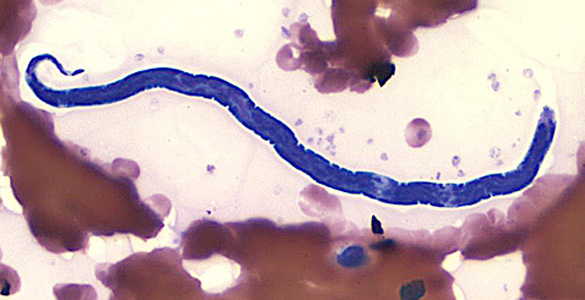
Loa loa filariasis, (Loiasis) is a skin and eye disease caused by the nematode worm Loa loa. Humans contract this disease through the bite of a deer fly (Chrysops spp.) or mango fly, the vectors for Loa loa. The adult Loa loa filarial worm can reach from three to seven centimetres long and migrates throughout the subcutaneous tissues of humans, occasionally crossing into subconjunctival tissues of the eye where it can be easily observed. Loa loa does not normally affect vision but can be painful when moving about the eyeball or across the bridge of the nose. Loiasis can cause red itchy swellings below the skin called "Calabar swellings". The disease is treated with the drug diethylcarbamazine (DEC), and when appropriate, surgical methods may be employed to remove adult worms from the conjunctiva. Loiasis belongs to the group of neglected tropical diseases, and there is a call for it to be included in the high-priority listing.
A filariasis such as loiasis most often consists of asymptomatic microfilaremia. Some patients can develop lymphatic dysfunction causing lymphedema. Episodic angioedema (Calabar swellings) in the arms and legs, caused by immune reactions, are common. Calabar swellings are 3–10 cm (1.2–3.9 in) in surface area, sometimes erythematous, and not pitting. When chronic, they can form cyst-like enlargements of the connective tissue around the sheaths of muscle tendons, becoming very painful when moved. The swellings may last for one to three days and may be accompanied by localized urticaria (skin eruptions) and pruritus (itching). They reappear at referent locations at irregular time intervals. Subconjunctival migration of an adult worm to the eyes can also occur frequently, and this is the reason Loa loa is also called the "African eye worm". The passage over the eyeball can be sensed, but it usually takes less than 15 minutes. Eyeworms affect men and women equally, but advanced age is a risk factor. Eosinophilia is often prominent in filarial infections. Dead worms may cause chronic abscesses, which may lead to the formation of granulomatous reactions and fibrosis.[citation needed]
In the human host, Loa loa larvae migrate to the subcutaneous tissue, where they mature into adult worms in approximately one year, but sometimes up to four years. Adult worms migrate in the subcutaneous tissues at a speed of less than 1 cm/min, mating and producing more microfilariae. The adult worms can live up to 17 years in the human host.
Loa loa infective larvae (L3) are transmitted to humans by the deer fly vectors of the tabanid genus Chrysops—C. dimidiata and C. silacea. These carriers are blood-sucking and day-biting, and they are found in rainforest-like environments in western and central Africa. Infective larvae (L3) mature to adults (L5) in the subcutaneous tissues of the human host, after which the adult worms—assuming the presence of a male and female worm—mate and produce microfilariae. The cycle of infection continues when a non-infected mango or deer fly takes a blood meal from a microfilaremic human host, and this stage of the transmission is possible because of the combination of the diurnal periodicity of microfilariae and the day-biting tendencies of the Chrysops spp.
Humans are the primary reservoir for Loa loa. Other minor potential reservoirs have been indicated in various fly-biting habit studies, such as hippopotamuses, wild ruminants (e.g. buffalo), rodents, and lizards. A simian type of loiasis exists in monkeys and apes which is transmitted by the deer fly vector Chrysops langi. There is no crossover between the human and simian types of the disease.
Loa loa is transmitted by several species of tabanid flies. Although horseflies of the genus Tabanus are often mentioned as vectors, the two most prominent vectors are from the tabanid genus Chrysops—C. dimidiata and C. silacea. These species exist only in Africa and are popularly known as deer flies or mango flies.
Chrysops spp. are small (5–20 mm, 0.20–0.79 in long) with a large head and downward-pointing mouthparts. Their wings are clear or speckled brown. They are hematophagous and typically live in forested and muddy habitats like swamps, streams, reservoirs, and rotting vegetation. Female mango and deer flies require a blood meal for the production of a second batch of eggs. This batch is deposited near water, where the eggs hatch in 5–7 days. The larvae mature in water or soil, where they feed on organic material such as decaying animal and vegetable products. Fly larvae are 1–6 cm (0.39–2.36 in) long and take 1–3 years to mature from egg to adult. When fully mature, C. dimidiata and C. silacea assume the day-biting tendencies of all tabanids.
The bite of the mango fly can be very painful, possibly because of the laceration style employed; rather than puncturing the skin as a mosquito does, the mango fly (and deer fly) makes a laceration in the skin and subsequently laps up the blood. Female flies require a fair amount of blood for their aforementioned reproductive purposes and thus may take multiple blood meals from the same host if disturbed during the first one.
Hub AI
Loa loa filariasis AI simulator
(@Loa loa filariasis_simulator)
Loa loa filariasis
Loa loa filariasis, (Loiasis) is a skin and eye disease caused by the nematode worm Loa loa. Humans contract this disease through the bite of a deer fly (Chrysops spp.) or mango fly, the vectors for Loa loa. The adult Loa loa filarial worm can reach from three to seven centimetres long and migrates throughout the subcutaneous tissues of humans, occasionally crossing into subconjunctival tissues of the eye where it can be easily observed. Loa loa does not normally affect vision but can be painful when moving about the eyeball or across the bridge of the nose. Loiasis can cause red itchy swellings below the skin called "Calabar swellings". The disease is treated with the drug diethylcarbamazine (DEC), and when appropriate, surgical methods may be employed to remove adult worms from the conjunctiva. Loiasis belongs to the group of neglected tropical diseases, and there is a call for it to be included in the high-priority listing.
A filariasis such as loiasis most often consists of asymptomatic microfilaremia. Some patients can develop lymphatic dysfunction causing lymphedema. Episodic angioedema (Calabar swellings) in the arms and legs, caused by immune reactions, are common. Calabar swellings are 3–10 cm (1.2–3.9 in) in surface area, sometimes erythematous, and not pitting. When chronic, they can form cyst-like enlargements of the connective tissue around the sheaths of muscle tendons, becoming very painful when moved. The swellings may last for one to three days and may be accompanied by localized urticaria (skin eruptions) and pruritus (itching). They reappear at referent locations at irregular time intervals. Subconjunctival migration of an adult worm to the eyes can also occur frequently, and this is the reason Loa loa is also called the "African eye worm". The passage over the eyeball can be sensed, but it usually takes less than 15 minutes. Eyeworms affect men and women equally, but advanced age is a risk factor. Eosinophilia is often prominent in filarial infections. Dead worms may cause chronic abscesses, which may lead to the formation of granulomatous reactions and fibrosis.[citation needed]
In the human host, Loa loa larvae migrate to the subcutaneous tissue, where they mature into adult worms in approximately one year, but sometimes up to four years. Adult worms migrate in the subcutaneous tissues at a speed of less than 1 cm/min, mating and producing more microfilariae. The adult worms can live up to 17 years in the human host.
Loa loa infective larvae (L3) are transmitted to humans by the deer fly vectors of the tabanid genus Chrysops—C. dimidiata and C. silacea. These carriers are blood-sucking and day-biting, and they are found in rainforest-like environments in western and central Africa. Infective larvae (L3) mature to adults (L5) in the subcutaneous tissues of the human host, after which the adult worms—assuming the presence of a male and female worm—mate and produce microfilariae. The cycle of infection continues when a non-infected mango or deer fly takes a blood meal from a microfilaremic human host, and this stage of the transmission is possible because of the combination of the diurnal periodicity of microfilariae and the day-biting tendencies of the Chrysops spp.
Humans are the primary reservoir for Loa loa. Other minor potential reservoirs have been indicated in various fly-biting habit studies, such as hippopotamuses, wild ruminants (e.g. buffalo), rodents, and lizards. A simian type of loiasis exists in monkeys and apes which is transmitted by the deer fly vector Chrysops langi. There is no crossover between the human and simian types of the disease.
Loa loa is transmitted by several species of tabanid flies. Although horseflies of the genus Tabanus are often mentioned as vectors, the two most prominent vectors are from the tabanid genus Chrysops—C. dimidiata and C. silacea. These species exist only in Africa and are popularly known as deer flies or mango flies.
Chrysops spp. are small (5–20 mm, 0.20–0.79 in long) with a large head and downward-pointing mouthparts. Their wings are clear or speckled brown. They are hematophagous and typically live in forested and muddy habitats like swamps, streams, reservoirs, and rotting vegetation. Female mango and deer flies require a blood meal for the production of a second batch of eggs. This batch is deposited near water, where the eggs hatch in 5–7 days. The larvae mature in water or soil, where they feed on organic material such as decaying animal and vegetable products. Fly larvae are 1–6 cm (0.39–2.36 in) long and take 1–3 years to mature from egg to adult. When fully mature, C. dimidiata and C. silacea assume the day-biting tendencies of all tabanids.
The bite of the mango fly can be very painful, possibly because of the laceration style employed; rather than puncturing the skin as a mosquito does, the mango fly (and deer fly) makes a laceration in the skin and subsequently laps up the blood. Female flies require a fair amount of blood for their aforementioned reproductive purposes and thus may take multiple blood meals from the same host if disturbed during the first one.
Recent media