Hubbry Logo
Cordylobia anthropophagaCordylobia anthropophagaMain
Open search
Cordylobia anthropophaga
Community hub
Cordylobia anthropophaga
logo
8 pages, 0 posts
0 subscribers
Be the first to start a discussion here.
Cordylobia anthropophaga
from Wikipedia

Cordylobia anthropophaga
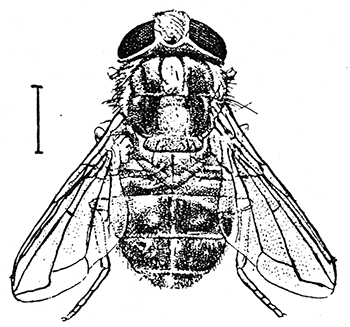
Adult
Larva
Scientific classification Edit this classification
Kingdom: Animalia
Phylum: Arthropoda
Class: Insecta
Order: Diptera
Family: Calliphoridae
Genus: Cordylobia
Species:
C. anthropophaga
Binomial name
Cordylobia anthropophaga
Synonyms[1]
  • Ochromyia anthropophaga Blanchard & Bérenger-Féraud, 1872
  • Cordylobia gruenbergi Dönitz, 1906
  • Cordylobia murium Döntitz, 1906
  • Cordylobia sarcophaga Scheben, 1910
  • Oestrus livingstonii Cobbold, 1879

Cordylobia anthropophaga, the mango fly, tumbu fly, tumba fly, putzi fly, or skin maggot fly, is a species of blow-fly common in East and Central Africa and Southern Africa. It is a parasite of large mammals (including humans) during its larval stage.[2] C. anthropophaga is found in the tropics of Africa and is a common cause of myiasis in humans in the region.[3]

Its specific epithet anthropophaga derives from the Greek word anthropophagos, "human eater".

The mode of infection by the Cayor Worm. Doctors Rodhain and Bequaert conclude, from their observations in the Congo Free State, that Cordylobia anthropophaga lays its eggs on the ground. The larvae, known generally as Cayor Worms, crawl over the soil until they come in contact with a mammal, penetrate the skin and lie in the subcutaneous tissue, causing the formation of tumors. On reaching full growth, the larvae leave the host, fall to the ground, bury themselves and then pupate. This fly is said to be the most common cause of human or animal myiasis in tropical Africa, from Senegal to Natal. In the region of Lower Katanga where these investigations were made, dogs appeared to be the principal hosts, although Cordylobia larvae were found also in guinea-pigs, a monkey, and two humans. The larvae are always localized on those parts of the hosts which come in immediate contact with the soil."

Ann. Soc. Entom. de Belgique, Iv, pp. 192–197, 1911) summary translation in Entomological News. 1911 Vol. xxii:467.

History of discovery

[edit]

The larvae of the tumbu fly, Cordylobia anthropophaga, were first described in Senegal in 1862, and Émile Blanchard first described the adult and gave it its name in 1872. In 1903, Grünberg placed the tumbu fly in a new genus, Cordylobia.[4]

Life cycle

[edit]

Female tumbu flies deposit around 300 eggs in sandy soil, often contaminated with feces. The hatched larvae can remain viable in the soil for 9–15 days, when they need to find a host to continue developing.[5] If a larva finds a host, it penetrates the skin and takes 8–12 days developing through three larval stages before it reaches the prepupal stage. It then leaves the host, drops to the ground, buries itself, and pupates. It then becomes an adult fly able to reproduce and begin the cycle all over again.[6]

Clinical presentation in humans

[edit]

Successful penetrations in humans results in furuncular (boil-like) myiasis, typically on the backs of arms or about the waist, lower back, or buttocks.[7]

C. anthropophaga rarely causes severe problems, and mainly causes cutaneous myiasis. Geary et al. describe the presentation of cutaneous myiasis caused by the tumbu fly: "At the site of penetration, a red papule forms and gradually enlarges. At first the host may experience only intermittent, slight itching, but pain develops and increases in frequency and intensity as the lesions develop into a furuncle. The furuncle's aperture opens, permitting fluids containing blood and waste products of the maggot to drain."[6]

Transmission

[edit]

Female tumbu flies lay their eggs in soil contaminated with feces or urine or on damp clothing or bed linens. Damp clothing hanging to dry makes for a perfect spot. The larvae hatch in 2–3 days and attach to unbroken skin and penetrate the skin, producing swelling and infection.[8] If the larvae hatch in soil, any disturbance of the soil causes them to wriggle to the surface to penetrate the skin of the host.[6]

Reservoir and vector

[edit]

A natural reservoir is defined as an organism that can harbor a pathogen indefinitely with no ill effects. Although C. anthropophaga larvae can cause ill effects for animal hosts, relative to myiasis in humans, animal hosts are reservoirs.

Many animals are hosts of C. anthropophaga. The dog is the most common domestic host and several species of wild rats are the preferred field hosts. Domestic fowl are dead-end hosts; the larvae cannot develop when they enter the tissue of a fowl.[4]

Humans are, in fact, accidental hosts; tumbu fly larvae do not usually infect humans.[3]

A vector is an organism that carries the parasites (the larvae) from one host to another. The tumbu fly itself is the vector in a loose sense, because the female deposits the eggs in soil or on damp cloth, where the larvae can hatch and attach to human or animal skin.[8]

Diagnostics

[edit]

Cutaneous myiasis caused by the tumbu fly should be suspected when a patient who has just spent time in sub-Saharan Africa presents with ulcers or boil-like sores. Definitive diagnosis is only possible when the larvae are found. They should be removed and allowed to develop into adult flies for identification and examination purposes.

Treatment

[edit]

When C. anthropophaga causes cutaneous myiasis, the larvae more often than not can be removed without any incision. Covering the punctum (the breathing hole) with petroleum jelly or similar substances cuts off the air supply and forces the maggot to the surface, where it is easy to capture with forceps. If this does not work, local anesthetic can be administered and an incision made to widen the punctum and remove the maggot.[6] Another treatment discussed in the March 2014 Journal of the American Medical Association is to inject a combination of anaesthetic and epinephrine into the insect's chamber. Less drastically, because larvae of C. anthropophaga have smaller hooked bristles on the cuticle than those of Dermatobia hominis, it often is practical just to push on each side of the hole to squeeze the maggot out, especially after first enlarging the punctum. It is important not to burst the larva to prevent the risk of granulomatous or serious inflammatory reaction.[9]

Patients should be monitored for additional and subsequent lesions, as development does not occur in unison and some larvae may take longer to reach the prepupal stage. Antiseptics or antibiotics may be useful to prevent bacterial infection after removal of the larvae, but in practice are not often necessary; the secretions of the larva tend to discourage bacterial growth. As a rule, the wound may be expected to heal readily.[10]

Epidemiology

[edit]

The tumbu fly is endemic to the tropical regions of Africa, south of the Sahara. Myiasis caused by C. anthropophaga is the most common cause of myiasis in Africa, but can be seen worldwide because of air travel, as human movements carry infestation outside endemic areas.[8]

Public health and prevention strategies

[edit]

The fly commonly infects humans by laying its eggs on wet clothes, left out to dry.[11] The eggs hatch in one to three days and the larvae (which can survive without a host for up to 15 days) then burrow into the skin when the clothes are worn.[2] A prevention method is to iron all clothes, including underwear, which kills the eggs/larvae.[12][13]

References

[edit]
Revisions and contributorsEdit on WikipediaRead on Wikipedia
from Grokipedia
Cordylobia anthropophaga, commonly known as the tumbu fly or mango fly, is a parasitic of blow fly belonging to the family and the genus Cordylobia, native to the tropical and subtropical regions of . This fly is the most prevalent cause of cutaneous in its endemic areas, infesting the skin of humans and large mammals during its larval stage, leading to painful boil-like lesions. The life cycle of C. anthropophaga begins when females lay 100–300 eggs on damp , leaf litter, or contaminated , often in areas with animal feces. The eggs hatch into first-instar larvae within 2–4 days, which remain viable in the or on fabrics for up to 15 days until they contact a suitable host, at which point they penetrate the skin to form subcutaneous cavities where they feed and develop over 8–12 days. Mature third-instar larvae then exit the host, drop to the ground, pupate in the for about 2–3 weeks, and emerge as s, completing the cycle in 3–4 weeks under optimal conditions. Infestations typically manifest as furuncular , presenting as itchy, red papules that evolve into furuncle-like nodules with a central punctum, often accompanied by seropurulent discharge and secondary bacterial infections if untreated. While generally self-limiting as larvae eventually emerge, complications can arise in vulnerable populations, and prevention involves ironing clothes after drying outdoors and avoiding direct skin contact with potentially contaminated . Although rare outside , imported cases highlight its potential as an emerging travel-related health concern.

Taxonomy and description

Taxonomy

Cordylobia anthropophaga belongs to the kingdom Animalia, phylum Arthropoda, class Insecta, order Diptera, family , genus Cordylobia, and species anthropophaga. The species was originally described by Émile Blanchard in 1872 as Ochromyia anthropophaga, based on adult specimens, and later transferred to the newly established genus Cordylobia by Karl Grünberg in 1903. No major reclassifications have occurred since, though the Ochromyia anthropophaga remains recognized in taxonomic databases. The specific epithet "anthropophaga" derives from the Greek words anthropos (human) and phagein (to eat), alluding to the fly's larvae parasitizing human skin. The genus Cordylobia, established in 1903, encompasses a small group of African calliphorids, with C. anthropophaga being the most notorious for human infestations compared to congeners like C. rodhaini (Gedoelst, 1910) and C. ruandae (Fain, 1953), which primarily affect nonhuman mammals.

Morphology

Cordylobia anthropophaga adults are robust flies measuring 6–12 mm in length, comparable to the size of a but stockier in build. The body is yellow-brown in color, featuring two broad, variable dorsal thoracic stripes that are typically dark. Antennae are aristate, characteristic of the family, and wings are clear with prominent dark veins. Eggs of C. anthropophaga are small (approximately 0.8 mm) and elongated, typically laid in batches of 100–300 on substrates such as damp or . They are sticky, facilitating adhesion to these surfaces for protection and dispersal. Larvae undergo three instars, each with distinct morphological features adapted for . First-instar larvae are 1–2 mm long and translucent, enabling initial penetration into host tissue. Second-instar larvae grow to 5–8 mm, developing spines along their body segments for anchorage. Third-instar larvae reach 13–15 mm in length, exhibiting a barrel-shaped form with a cylindrical body divided into 12 visible segments covered in posteriorly directed spines; they possess prominent posterior spiracles featuring three sinuous slits for respiration. Pupae are barrel-shaped, measuring 10–15 mm, and form within a brown, hardened casing in the , providing during . Unique larval adaptations include paired spade-like mouth hooks used for skin penetration and movement within the host, as well as elongated posterior spiracles functioning as tubes to access air from the skin surface.

Biology and life cycle

Life cycle stages

The life cycle of Cordylobia anthropophaga, commonly known as the tumbu fly, consists of four distinct stages: egg, , , and . This completes its development in warm, humid environments typical of , with the entire cycle spanning approximately 3-4 weeks under optimal conditions such as temperatures of 25-30°C and adequate moisture. Adult females, which live for 2-3 weeks, lay batches of 100-300 eggs directly onto damp substrates like contaminated with or , or on damp clothing left in shaded areas. Oviposition is triggered by environmental cues including warmth and , with females capable of depositing up to 500 eggs over their lifespan in multiple batches. The eggs, which are elongated and white, hatch in 2-4 days due to these moisture and temperature stimuli, releasing first-instar larvae ready to seek a host. Upon , the mobile first- larvae penetrate the unbroken of a suitable host within hours, often after crawling onto or in contact with the infested substrate. They then undergo three larval over a total duration of 8-12 days, during which they feed on host tissue fluids within a subcutaneous cavity, molting progressively and growing to about 1.5 cm in length by the third . The mature third- eventually exits the host, drops to the ground, and burrows into the soil to pupate. The pupal stage occurs within a protective puparium in the soil and lasts 7-9 days in tropical conditions, though it can extend longer at cooler temperatures; emergence into the adult form is influenced by soil temperature and humidity. Adult flies emerge, mate shortly thereafter, and females begin oviposition soon after, perpetuating the cycle. Unlike the related human botfly Dermatobia hominis, which requires an intermediate arthropod vector to transport eggs to the host, C. anthropophaga larvae actively seek and penetrate hosts without such a vector. Factors like humidity and temperature variations can modulate developmental rates across all stages, with drier or cooler conditions prolonging the cycle.

Hosts and ecology

_Cordylobia anthropophaga primarily inhabits sub-Saharan African savannas and rural areas characterized by sandy soils and , where adult flies are most active during the warmer months. The species thrives in environments with access to damp, organic-rich substrates, favoring regions with seasonal rainfall that supports larval development. Breeding occurs in contaminated with animal or , as well as in damp leaf litter or earth, providing the moist conditions necessary for egg hatching and larval survival. The fly's preferred hosts include a range of mammals, with dogs, , , and monkeys serving as primary reservoirs for larval . In domestic dogs, infestation rates can reach up to 45% in endemic areas such as parts of , while like rattus exhibit lower prevalence around 6.4% in regions like . such as and small antelopes also act as common hosts, contributing to the parasite's persistence in wild and semi-domesticated populations. Ecologically, C. anthropophaga occupies a parasitic niche, with its larvae obligately mammalian hosts to complete development, thereby playing a role in regulating host populations in tropical ecosystems. are closely tied to environmental conditions, peaking during rainy seasons when increased moisture enhances egg-laying and larval viability, often leading to higher levels from June to October in affected regions. Adult flies contribute to by feeding on floral , indirectly supporting plant reproduction in habitats. Infestations in non-human hosts result in significant veterinary impacts, including skin lesions that reduce animal productivity and cause economic losses through decreased and milk yield in . In dogs and , chronic can lead to secondary infections, exacerbating morbidity in rural animal populations. The employs direct oviposition strategies, with females laying eggs on suitable substrates without relying on intermediary vectors, facilitating efficient transmission within its host communities.

Transmission and epidemiology

Transmission

Cordylobia anthropophaga, commonly known as the tumbu fly, transmits its larvae to humans through direct contact with hatched eggs rather than via adult fly bites, distinguishing it from vector-mediated myiases. Adult females oviposit clusters of 100–300 eggs on damp substrates such as clothing, bedding, or soil contaminated with urine or feces, often in shaded areas. The eggs hatch within 1–3 days into first-instar larvae, which remain viable in the environment for up to 15 days until contacting a suitable host, at which point, stimulated by body heat and moisture, the larvae actively penetrate the unbroken skin within 5–10 minutes, allowing them to burrow subcutaneously and initiate furuncular myiasis. Human infestations are primarily accidental, as the fly exhibits a zoophilic for animal hosts like dogs, , and antelopes, but occur frequently in endemic regions due to close human-animal proximity and shared environments. Key risk factors include sun-drying laundry or bedding on the ground in rural settings, walking barefoot on contaminated , and poor personal , which facilitate contact between and hatched larvae. Low exacerbates these risks by limiting access to indoor drying methods and . In contrast to Dermatobia hominis (the human ), which relies on an vector like a to transport eggs to the host, C. anthropophaga transmission depends entirely on direct environmental contact with oviposition sites, making preventive behaviors like clothes critical in affected areas.

Geographic distribution and prevalence

Cordylobia anthropophaga, commonly known as the tumbu fly, is endemic to , with its primary distribution spanning tropical and subtropical regions south of the Sahara Desert. The species is most prevalent in West and Central African countries, including , , the , and , where environmental conditions favor its life cycle. Sporadic occurrences have been documented in , such as in , though these are less common compared to western regions. Human infestations are particularly common in rural areas, affecting children at rates of approximately 5-6% in surveyed populations in , with higher incidence among boys and older children (7-20 years). Prevalence can reach up to 40% in vulnerable groups, such as neonates in wetland areas of the , and is elevated during the rainy season due to increased humidity and suitable breeding sites. The condition remains underreported across , with recent systematic reviews (post-2020) indicating stable incidence primarily in , where C. anthropophaga accounts for over 66% of documented cases. Risk is highest among rural dwellers and tourists visiting endemic zones, with limited data suggesting underdiagnosis contributes to incomplete prevalence estimates. In livestock and domestic animals, infestation rates are notable, reaching up to 45% in dogs in urban and rural settings in Nigeria, often linked to poor hygiene and proximity to breeding sites. Veterinary cases underscore the fly's broad host range, with similar patterns in rodents and cavies in Cameroon showing prevalences of 2-6%. No established populations exist outside Africa, though imported cases occur sporadically in Europe and other continents via infested clothing or travelers from endemic areas, such as documented instances in France and the United Kingdom. The fly thrives in warm, humid environments with high rainfall, limiting its natural range but highlighting potential risks from global travel.

Clinical aspects in humans

Symptoms and presentation

Infestation with Cordylobia anthropophaga, known as tumbu fly , typically begins with a painless larval penetration of the skin, often unnoticed by the host, occurring shortly after eggs hatch on contaminated or soil in contact with the body. Within 2-3 days, an initial sign emerges as a small, erythematous resembling a bite, which evolves into a painless, boil-like furuncular measuring 1-2 cm in diameter, commonly on covered areas such as the trunk, , or thighs. As the develops subcutaneously over 8-12 days, the progresses with increasing itching and a characteristic sensation of movement or "creeping" beneath the skin due to larval activity, accompanied by serous or purulent discharge from a central pore where the larva's spiracle is visible as a small black dot. Multiple are common in a single , with up to 10 furuncles reported, potentially mimicking a creeping eruption if larvae migrate slightly. If untreated, the mature third-stage emerges from the after 7-14 days, leaving a small opening. Complications primarily involve secondary bacterial infections, such as formation from scratching or poor , leading to increased , swelling, and potential scarring upon resolution. In immunocompromised individuals, rare systemic effects like fever or may occur, though the infestation is generally self-limiting and localized. Key distinguishing features include the palpable subcutaneous movement and the central spiracle, aiding in clinical recognition.

Diagnosis

Diagnosis of Cordylobia anthropophaga primarily relies on clinical evaluation, supported by laboratory confirmation when necessary. Clinically, the condition is suspected based on the presence of characteristic furuncular lesions—painless, boil-like nodules with a central punctum through which serous or purulent fluid may exude, often accompanied by itching or a sensation of movement beneath the skin. A history of recent travel to or residence in endemic regions of is a key diagnostic clue, as these lesions typically develop 1–3 days after larval infestation. Laboratory confirmation involves careful extraction of the , often achieved by applying occlusion (e.g., ) to induce hypoxia and prompt emergence, followed by gentle removal using to avoid fragmentation. Partial or complete larval extraction allows for microscopic examination, where species identification is based on distinctive morphological features: the third-instar measures approximately 12–19 mm in length, with a cylindrical body covered in transverse rows of brownish cuticular spines on all segments, and posterior spiracles featuring three sinuous slits without a defined peritreme. These traits distinguish C. anthropophaga from other -causing flies. Imaging modalities, particularly , aid in when larvae are not immediately visible or accessible. High-frequency reveals a hypoechoic, subcutaneous mass with internal motion, corresponding to the breathing spiracles of the , typically located 1–2 cm beneath the skin surface. Color Doppler may highlight vascular changes around the but is not essential for routine cases. Molecular methods, such as (PCR) targeting mitochondrial subunit I (cox1) or 28S rRNA genes, are reserved for ambiguous cases or when morphological identification is inconclusive, such as with damaged specimens; these techniques confirm C. anthropophaga DNA with high specificity but are not standard due to their cost and availability. Serological tests are not routinely used, as they lack specificity for this parasite. Diagnostic challenges include frequent misidentification as bacterial furunculosis, , or staphylococcal boils, leading to inappropriate use; clinicians must inquire about travel history and examine for the telltale central punctum or larval movement to differentiate. Squeezing the should be avoided, as it risks larval rupture, secondary bacterial , or from released antigens.

Treatment

The primary treatment for infestations caused by Cordylobia anthropophaga, known as tumbu fly myiasis, involves the mechanical removal of the larvae to prevent complications such as secondary bacterial infections or inflammatory reactions. Surgical excision under local anesthesia, often using lidocaine with epinephrine, is a standard approach, where the lesion is incised and the larva is extracted intact using forceps; this method ensures complete removal and minimizes the risk of larval rupture, which could lead to anaphylaxis or severe local inflammation. An alternative non-surgical method is occlusion therapy, in which or a similar viscous substance is applied over the breathing hole of the lesion to induce hypoxia, prompting the third-instar to emerge for air; this technique is particularly useful for superficial lesions and has demonstrated high efficacy in forcing larval expulsion without incision. For cases with multiple lesions or when mechanical methods are impractical, oral at a dose of 200 mcg/kg as a single administration serves as an effective adjunct, paralyzing the larvae to facilitate their expulsion or death, though it may provoke an initial inflammatory response if the larva remains . Secondary bacterial infections, which occur in a minority of cases due to skin disruption, are managed with systemic antibiotics such as oral amoxicillin or broader-spectrum agents like piperacillin-tazobactam if warranted by culture results; these are prescribed judiciously to cover common pathogens like Staphylococcus species. Following larval removal, post-treatment care emphasizes thorough wound cleansing with antiseptics, application of topical antibiotics or dressings to promote healing, and monitoring to avert scarring or detect any residual larvae; patients are advised to seek follow-up if new symptoms arise within the first week. With appropriate intervention, complete resolution typically occurs within 1-2 weeks, restoring normal skin integrity without long-term sequelae in most instances.

History and prevention

Discovery and research history

The larvae of Cordylobia anthropophaga, known as the tumbu fly, were first described in 1862 by French physicians Henri Coquerel and Henri Mondière based on specimens extracted from human and canine hosts in , marking the initial recognition of furuncular caused by this in . The adult fly was formally described in 1872 by Émile Blanchard and Louis Joseph Bérenger-Féraud as Ochromyia anthropophaga, a name reflecting its observed infestations in humans during 19th-century colonial medical reports from the region. In 1903, German entomologist Paul Grünberg established the Cordylobia and transferred the to it, distinguishing it taxonomically from other calliphorids based on morphological traits such as wing venation and thoracic structure. Early 20th-century research advanced understanding of the species' , with French entomologist Maurice Surcouf contributing detailed observations on its morphology and distribution in colonial during the 1910s, helping to clarify its role in endemic . By the 1950s, epidemiological surveys in , including those conducted by British and French colonial health services, documented prevalence patterns and host preferences, revealing C. anthropophaga as a significant cause of cutaneous infestations in both humans and domestic animals across sub-Saharan regions. These studies, often published in journals like the Bulletin of Entomological Research, emphasized seasonal variations in larval activity tied to and conditions. Modern research since the 2000s has employed molecular techniques to confirm species boundaries within the genus Cordylobia, particularly distinguishing C. anthropophaga from the morphologically similar C. rodhaini using markers like subunit I (COI), resolving earlier taxonomic ambiguities that arose from overlapping larval features in historical collections. Recent studies as of 2025 have further applied COI sequencing to confirm identifications in imported traveler cases from to and , while prevalence surveys in reported furuncular in 6.4% of peridomestic dogs, underscoring ongoing zoonotic risks. Notable early reports of in , such as those referenced by F.W. Hope in 1840, highlighted the condition's recognition prior to formal descriptions, while assessments in the late 20th century have considered from C. anthropophaga a neglected condition with implications. Early confusion between C. anthropophaga and other myiasis-causing flies, such as Dermatobia hominis in misattributed cases or C. rodhaini due to similar furuncular lesions, was largely resolved through comparative morphological analyses of larval spines and adult genitalia in mid-20th-century taxonomic revisions.

Prevention and public health measures

Personal protective measures against Cordylobia anthropophaga infestation primarily focus on preventing larval penetration through clothing and skin contact with contaminated surfaces. Individuals in endemic areas should iron all clothing, bedding, and linens after outdoor drying, as the heat effectively kills eggs deposited by female flies on damp fabrics. Drying clothes indoors or in direct sunlight can also reduce egg viability by desiccating them before hatching. Additionally, covering exposed skin with long-sleeved clothing and avoiding contact with potentially contaminated soil or sand minimizes risk, particularly since larvae penetrate intact skin upon contact. At the household level, maintaining proper is essential to disrupt fly breeding sites. Removing decaying , such as , urine-soiled sand, or damp refuse, around homes limits adult fly populations and egg-laying opportunities. Applying insecticides to soil or infested areas can further suppress larval development, while using fly traps or screens on windows prevents fly entry into living spaces. Public health initiatives in rural emphasize community education to promote these practices. Programs, often aligned with broader neglected tropical disease (NTD) efforts, deliver awareness campaigns through local health workers, teaching residents about safe habits and environmental to curb transmission. strategies include targeted applications in high-risk villages and integration into national NTD frameworks. Challenges in prevention include low awareness among tourists and short-term visitors to endemic regions, who may overlook local risks despite pre-travel advisories. Integrating myiasis control into existing NTD programs remains difficult due to limited surveillance data and resource constraints in remote areas. Adherence to ironing and indoor drying has proven effective in reducing infestation rates, with studies in equatorial Africa reporting substantial declines in cases among compliant communities, though quantitative impacts vary by setting. Emerging research explores permethrin-treated fabrics as an adjunct, but traditional methods remain the cornerstone due to their accessibility and reliability.

References

Add your contribution
Related Hubs
User Avatar
No comments yet.