
Recent from talks
Lombardi Grand Prix
Knowledge base stats:
Talk channels stats:
Members stats:
Lombardi Grand Prix
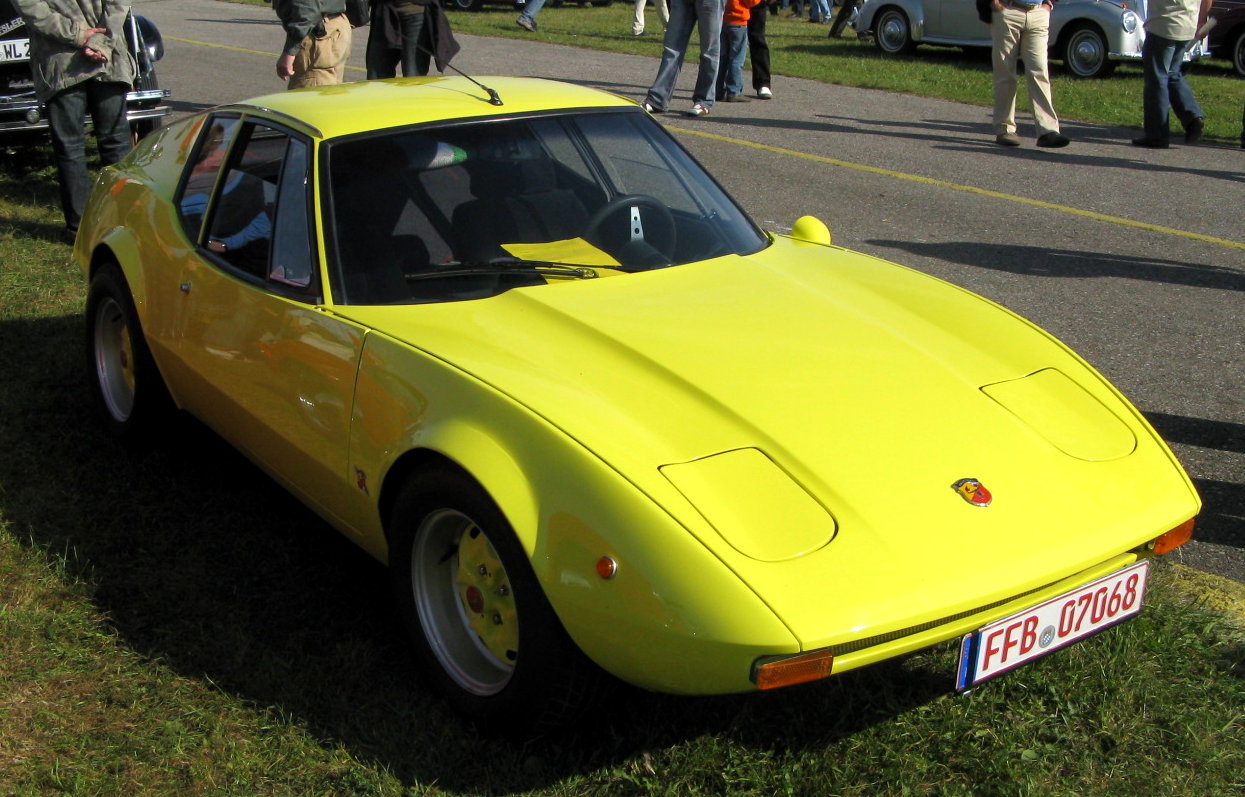
The Lombardi Grand Prix is a small, rear-engined sports car on the underpinnings of the Fiat 850 Special. It was developed by the Carrozzeria Francis Lombardi with an in-house design by Giuseppe Rinaldi. The car was built from 1968 until 1972 and was also marketed as the OTAS 820, as a Giannini, and as the Abarth Scorpione. It made its international debut in March 1968, at the Geneva Motor Show. The design had a Kammback rear and a very low nose with flip-up headlights, and a large single windshield wiper. The pop-up headlights were electrically powered. The bodywork was primarily steel, with the doors and rear panel made from GRP and the engine cover in aluminum to minimize weight. At Turin 1969 a targa version was also shown; called the "Monza", this open model had a rollover bar with a compartment immediately behind for storing the removable roof panels. The vertical rear window could be lowered by means of a winder located between the seat backs. Beyond a pair of show cars it is unknown whether any more were produced, but at least one has survived.
The original Lombardi Grand Prix as presented had the 843 cc engine from the Fiat 850 Special with 47 hp (35 kW) DIN at 6400 rpm, coupled to a four-speed gearbox. Low drag resistance and weight (630 kg or 1,390 lb) meant that this was supposedly enough for a top speed of 160 km/h (99 mph). In a period German test the maximum speed was measured as 153.8 km/h (95.6 mph). Luggage space is limited, with very little space next to the spare wheel up front and with a tiny area behind the seats. In case the electric wind-up mechanism for the headlights should fail, there is also a mechanical lever underneath the bonnet. The single round tail lights are Fiat 850 Coupé units. The front suspension consists of a transverse leaf spring on the bottom and A-arms on top, while the rear received coil sprung semi-trailing arms.
On early production models the standard GRP doors featured windows of a three-piece design (one on top, two lower pieces of which one could be slid open). This was soon changed for a more conventional layout with a vent window up front and a single fixed piece behind. Steel doors were available as an option, and on these the rear portion opened with a traditional winder (though it could only be rolled halfway down).
The Lombardi Grand Prix was built in two series. Changes for the Series II model, introduced in 1970, included: a louvered engine cover in black metal for improved cooling; front wings modified to accommodate new, wider wheels (5½ inch, versus 4½ inch on the Series I cars); and a bonnet with a raised central rib to make room for a larger spare wheel.
A Cypriot millionaire casino owner had also shown interest in the Lombardi Grand Prix around the time of its introduction. Frixos Demetriou intended to market the car in the United Kingdom and began planning for an order of 1000 cars. In an attempt to Anglicize the Grand Prix, Demetriou looked at replacing its Fiat 850 underpinnings with those of the British-made Hillman Imp Sport, which would have lowered its price in the UK by around 15 percent. Ultimately the venture was a failure, with only a handful of cars finding buyers; a few unsold units were re-exported to Cyprus in 1970 to avoid pending customs bills.
Rome-based engine tuner Giannini Automobili was quick to offer higher performance versions of the Grand Prix. An example equipped with a Giannini engine was displayed on their stand at the Turin Racing Car Exhibition in March 1968, two weeks before the Grand Prix's official Geneva launch. Marketed as the Giannini 1000 Grand Prix, this model received a tuned version of the regular Fiat 850 motor, stroked to 982 cc (65 mm x 74 mm), for a claimed output of 84 hp SAE. At the 1968 Turin Auto Show a few months later, they introduced the even sportier 1000 Bialbero Grand Prix. This version featured a 994 cc (64.6 mm x 76 mm) twin overhead camshaft motor of Giannini's own design, which was claimed to make 104 hp SAE at 7500 rpm.
Following the death of Giannini Automobili's founder, Domenico Giannini, his son Franco left the company in 1969 to focus on his own business in Turin, OGT (Officina Giannini Torino, or "Giannini Turin workshop"). Seeing potential in the American market, OGT developed a version of the Grand Prix to meet US standards, which was displayed at the 1969 Turin Motor Show as the OGT 1000. Sporting the central bonnet rib and louvered engine cover of the upcoming Series II Grand Prix, it featured a new 903 cc engine (65 mm x 68 mm) fitted with a fuel-injection system that was Franco Giannini's own brainchild. This system replaced the carburetor's Venturi tube with a mechanical fuel metering device, and was reported to offer a significant improvement in power while still meeting the contemporary US emissions limits. Lombardi was also interested in exporting this model to Australia.
The car attracted the interest of an American importer, Siata International of Newark, New Jersey, who distributed the Siata Spring in the US, and they placed an order for three hundred units. However, Giannini Automobili in Rome objected to the name Officina Giannini Torino, so Franco Giannini set up a new company, OTAS (Officina Trasformazioni Automobili Sportive, or "Sports car conversion workshop") to fulfill the order. Siata International displayed the car, now rebranded as the OTAS Tigre, on their stand at the New York International Automobile Show in April 1970.
Hub AI
Lombardi Grand Prix AI simulator
(@Lombardi Grand Prix_simulator)
Lombardi Grand Prix
The Lombardi Grand Prix is a small, rear-engined sports car on the underpinnings of the Fiat 850 Special. It was developed by the Carrozzeria Francis Lombardi with an in-house design by Giuseppe Rinaldi. The car was built from 1968 until 1972 and was also marketed as the OTAS 820, as a Giannini, and as the Abarth Scorpione. It made its international debut in March 1968, at the Geneva Motor Show. The design had a Kammback rear and a very low nose with flip-up headlights, and a large single windshield wiper. The pop-up headlights were electrically powered. The bodywork was primarily steel, with the doors and rear panel made from GRP and the engine cover in aluminum to minimize weight. At Turin 1969 a targa version was also shown; called the "Monza", this open model had a rollover bar with a compartment immediately behind for storing the removable roof panels. The vertical rear window could be lowered by means of a winder located between the seat backs. Beyond a pair of show cars it is unknown whether any more were produced, but at least one has survived.
The original Lombardi Grand Prix as presented had the 843 cc engine from the Fiat 850 Special with 47 hp (35 kW) DIN at 6400 rpm, coupled to a four-speed gearbox. Low drag resistance and weight (630 kg or 1,390 lb) meant that this was supposedly enough for a top speed of 160 km/h (99 mph). In a period German test the maximum speed was measured as 153.8 km/h (95.6 mph). Luggage space is limited, with very little space next to the spare wheel up front and with a tiny area behind the seats. In case the electric wind-up mechanism for the headlights should fail, there is also a mechanical lever underneath the bonnet. The single round tail lights are Fiat 850 Coupé units. The front suspension consists of a transverse leaf spring on the bottom and A-arms on top, while the rear received coil sprung semi-trailing arms.
On early production models the standard GRP doors featured windows of a three-piece design (one on top, two lower pieces of which one could be slid open). This was soon changed for a more conventional layout with a vent window up front and a single fixed piece behind. Steel doors were available as an option, and on these the rear portion opened with a traditional winder (though it could only be rolled halfway down).
The Lombardi Grand Prix was built in two series. Changes for the Series II model, introduced in 1970, included: a louvered engine cover in black metal for improved cooling; front wings modified to accommodate new, wider wheels (5½ inch, versus 4½ inch on the Series I cars); and a bonnet with a raised central rib to make room for a larger spare wheel.
A Cypriot millionaire casino owner had also shown interest in the Lombardi Grand Prix around the time of its introduction. Frixos Demetriou intended to market the car in the United Kingdom and began planning for an order of 1000 cars. In an attempt to Anglicize the Grand Prix, Demetriou looked at replacing its Fiat 850 underpinnings with those of the British-made Hillman Imp Sport, which would have lowered its price in the UK by around 15 percent. Ultimately the venture was a failure, with only a handful of cars finding buyers; a few unsold units were re-exported to Cyprus in 1970 to avoid pending customs bills.
Rome-based engine tuner Giannini Automobili was quick to offer higher performance versions of the Grand Prix. An example equipped with a Giannini engine was displayed on their stand at the Turin Racing Car Exhibition in March 1968, two weeks before the Grand Prix's official Geneva launch. Marketed as the Giannini 1000 Grand Prix, this model received a tuned version of the regular Fiat 850 motor, stroked to 982 cc (65 mm x 74 mm), for a claimed output of 84 hp SAE. At the 1968 Turin Auto Show a few months later, they introduced the even sportier 1000 Bialbero Grand Prix. This version featured a 994 cc (64.6 mm x 76 mm) twin overhead camshaft motor of Giannini's own design, which was claimed to make 104 hp SAE at 7500 rpm.
Following the death of Giannini Automobili's founder, Domenico Giannini, his son Franco left the company in 1969 to focus on his own business in Turin, OGT (Officina Giannini Torino, or "Giannini Turin workshop"). Seeing potential in the American market, OGT developed a version of the Grand Prix to meet US standards, which was displayed at the 1969 Turin Motor Show as the OGT 1000. Sporting the central bonnet rib and louvered engine cover of the upcoming Series II Grand Prix, it featured a new 903 cc engine (65 mm x 68 mm) fitted with a fuel-injection system that was Franco Giannini's own brainchild. This system replaced the carburetor's Venturi tube with a mechanical fuel metering device, and was reported to offer a significant improvement in power while still meeting the contemporary US emissions limits. Lombardi was also interested in exporting this model to Australia.
The car attracted the interest of an American importer, Siata International of Newark, New Jersey, who distributed the Siata Spring in the US, and they placed an order for three hundred units. However, Giannini Automobili in Rome objected to the name Officina Giannini Torino, so Franco Giannini set up a new company, OTAS (Officina Trasformazioni Automobili Sportive, or "Sports car conversion workshop") to fulfill the order. Siata International displayed the car, now rebranded as the OTAS Tigre, on their stand at the New York International Automobile Show in April 1970.
Recent media