
Recent from talks
Longleaf pine
Knowledge base stats:
Talk channels stats:
Members stats:
Longleaf pine
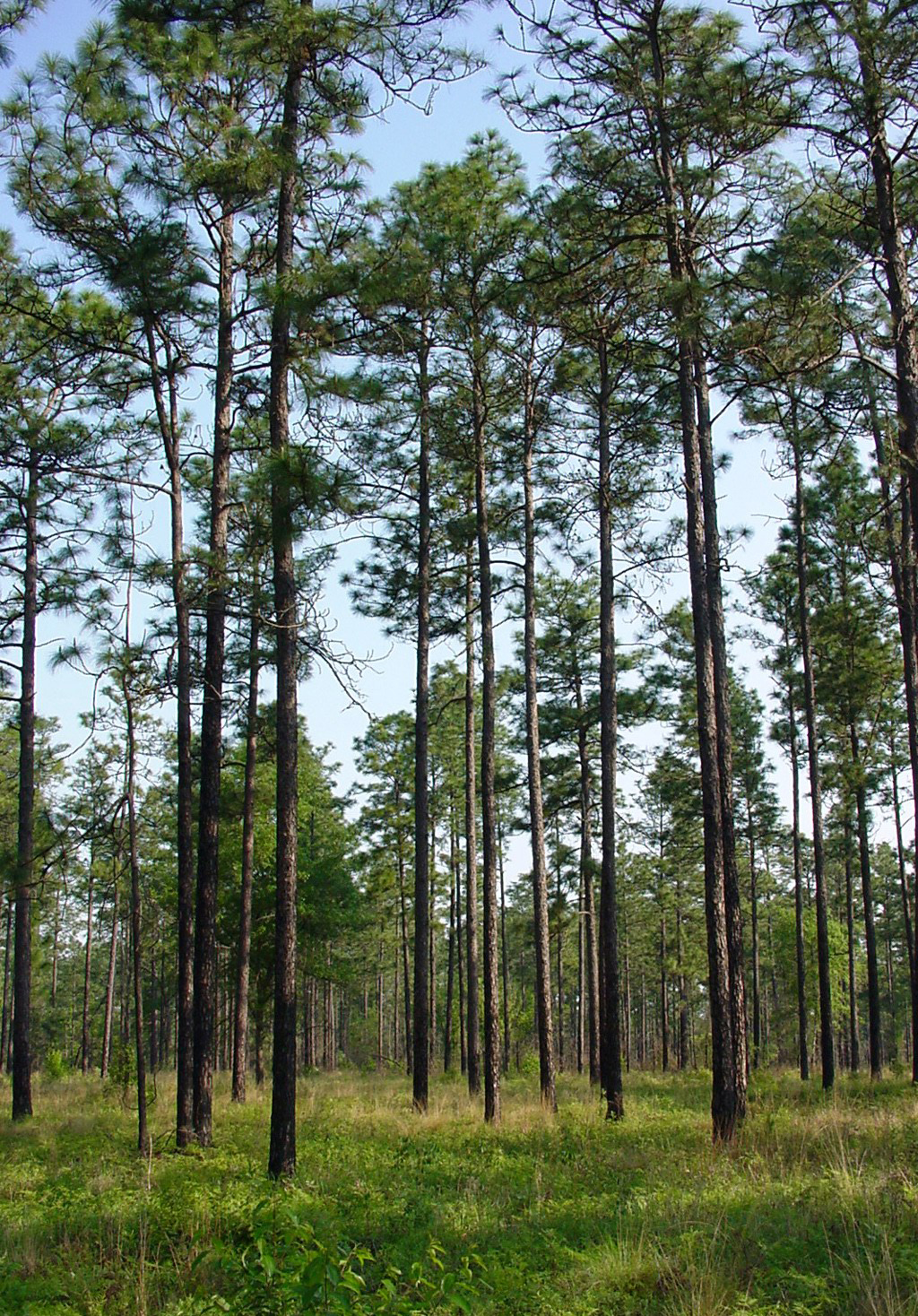
The longleaf pine (Pinus palustris) is a pine species native to the Southeastern United States, found along the coastal plain from East Texas to southern Virginia, extending into northern and central Florida. In this area it is also known as "yellow pine" or "long leaf yellow pine", although it is properly just one out of a number of species termed yellow pine. It reaches a height of 30–35 m (98–115 ft) and a diameter of 0.7 m (28 in). In the past, before extensive logging, they reportedly grew to 47 m (154 ft) with a diameter of 1.2 m (47 in). The tree is a cultural symbol of the Southern United States, being the official state tree of Alabama. This particular species is one of the eight pine tree species that falls under the "Pine" designation as the state tree of North Carolina.
The bark is thick, reddish-brown, and scaly. The leaves are dark green and needle-like, and occur in bundles of mainly three, sometimes two or four, especially in seedlings. They often are twisted and 20–45 centimetres (7+3⁄4–17+3⁄4 inches) in length. A local race of P. palustris in a cove near Rockingham, North Carolina, have needles up to 24 inches (61 centimeters ) in length. It is one of the two Southeastern U.S. pines with long needles, the other being slash pine.
The cones, both female seed cones (ovulate strobili) and male pollen cones (staminate strobili), are initiated during the growing season before buds emerge. Pollen cones begin forming in their buds in July, while seed conelets are formed during a relatively short period of time in August. Pollination occurs early the following spring, with the pollen cones 3–8 cm (1+1⁄4–3+1⁄4 in) long. The seed cones mature in about 20 months from pollination; when mature, they are yellow-brown in color, 15–25 cm (6–9+3⁄4 in) long, and 5–7 cm (2–2+3⁄4 in) broad, opening to 12 cm (4+3⁄4 in), and have a small, but sharp, downward-pointing spine on the middle of each scale. The seeds are 7–9 millimetres (1⁄4–3⁄8 in) long, with a 25–40 mm (1–1+5⁄8 in) wing.
Longleaf pine takes 100 to 150 years to become full size and may live to be 500 years old. When young, they grow a long taproot, which usually is 2–3 metres (6+1⁄2–10 feet) long; by maturity, they have a wide spreading lateral root system with several deep 'sinker' roots. They grow on well-drained, usually sandy soil, characteristically in pure stands. Longleaf pine also is known as being one of several species grouped as a southern yellow pine or longleaf yellow pine, and in the past as pitch pine (a name dropped as it caused confusion with pitch pine, Pinus rigida).
The species epithet palustris is Latin for "of the marsh" and indicates its common habitat. The scientific name meaning "of marshes" is a misunderstanding on the part of Philip Miller, who described the species, after seeing longleaf pine forests with temporary winter flooding.
Longleaf pine is highly pyrophytic (resistant to wildfire) and dependent on fire. Their thick bark and growth habits help to provide a tolerance to fire. Periodic natural wildfire and anthropogenic fires select for this species by removing competition and exposing bare soil for successful germination of seeds. The lack of medium-tall trees (called a midstory canopy) leads to open longleaf pine forests or savannas. New seedlings do not appear at all tree-like and resemble a dark-green fountain of needles. This form is called the grass stage. During this stage, which lasts for 5–12 years, vertical growth is very slow, and the tree may take a number of years simply to grow ankle high. After that, it has a growth spurt, especially if it is in a gap or no tree canopy is above it. In the grass stage, it is very resistant to low intensity fires because the terminal bud is protected from lethal heating by the tightly packed needles. While relatively immune to fire at this stage, the plant is quite appealing to feral pigs; the early settlers' habit of releasing swine into the woodlands to feed may have been partly responsible for the decline of the species.
Longleaf pine forests are rich in biodiversity. They are well-documented for their high levels of plant diversity, in groups including sedges, grasses, carnivorous plants, and orchids. These forests also provide habitat for gopher tortoises, which as keystone species, dig burrows that provide habitat for hundreds of other species of animals. The red-cockaded woodpecker is dependent on mature pine forests and is now endangered as a result of this decline. Longleaf pine seeds are large and nutritious, forming a significant food source for birds (notably the brown-headed nuthatch) and other wildlife. Nine salamander species and 26 frog species are characteristic of pine savannas, along with 56 species of reptiles, 13 of which could be considered specialists on this habitat.
The Red Hills Region of Florida and Georgia is home to some of the best-preserved stands of longleaf pines. These forests have been burned regularly for many decades to encourage bobwhite quail habitat in private hunting plantations.
Hub AI
Longleaf pine AI simulator
(@Longleaf pine_simulator)
Longleaf pine
The longleaf pine (Pinus palustris) is a pine species native to the Southeastern United States, found along the coastal plain from East Texas to southern Virginia, extending into northern and central Florida. In this area it is also known as "yellow pine" or "long leaf yellow pine", although it is properly just one out of a number of species termed yellow pine. It reaches a height of 30–35 m (98–115 ft) and a diameter of 0.7 m (28 in). In the past, before extensive logging, they reportedly grew to 47 m (154 ft) with a diameter of 1.2 m (47 in). The tree is a cultural symbol of the Southern United States, being the official state tree of Alabama. This particular species is one of the eight pine tree species that falls under the "Pine" designation as the state tree of North Carolina.
The bark is thick, reddish-brown, and scaly. The leaves are dark green and needle-like, and occur in bundles of mainly three, sometimes two or four, especially in seedlings. They often are twisted and 20–45 centimetres (7+3⁄4–17+3⁄4 inches) in length. A local race of P. palustris in a cove near Rockingham, North Carolina, have needles up to 24 inches (61 centimeters ) in length. It is one of the two Southeastern U.S. pines with long needles, the other being slash pine.
The cones, both female seed cones (ovulate strobili) and male pollen cones (staminate strobili), are initiated during the growing season before buds emerge. Pollen cones begin forming in their buds in July, while seed conelets are formed during a relatively short period of time in August. Pollination occurs early the following spring, with the pollen cones 3–8 cm (1+1⁄4–3+1⁄4 in) long. The seed cones mature in about 20 months from pollination; when mature, they are yellow-brown in color, 15–25 cm (6–9+3⁄4 in) long, and 5–7 cm (2–2+3⁄4 in) broad, opening to 12 cm (4+3⁄4 in), and have a small, but sharp, downward-pointing spine on the middle of each scale. The seeds are 7–9 millimetres (1⁄4–3⁄8 in) long, with a 25–40 mm (1–1+5⁄8 in) wing.
Longleaf pine takes 100 to 150 years to become full size and may live to be 500 years old. When young, they grow a long taproot, which usually is 2–3 metres (6+1⁄2–10 feet) long; by maturity, they have a wide spreading lateral root system with several deep 'sinker' roots. They grow on well-drained, usually sandy soil, characteristically in pure stands. Longleaf pine also is known as being one of several species grouped as a southern yellow pine or longleaf yellow pine, and in the past as pitch pine (a name dropped as it caused confusion with pitch pine, Pinus rigida).
The species epithet palustris is Latin for "of the marsh" and indicates its common habitat. The scientific name meaning "of marshes" is a misunderstanding on the part of Philip Miller, who described the species, after seeing longleaf pine forests with temporary winter flooding.
Longleaf pine is highly pyrophytic (resistant to wildfire) and dependent on fire. Their thick bark and growth habits help to provide a tolerance to fire. Periodic natural wildfire and anthropogenic fires select for this species by removing competition and exposing bare soil for successful germination of seeds. The lack of medium-tall trees (called a midstory canopy) leads to open longleaf pine forests or savannas. New seedlings do not appear at all tree-like and resemble a dark-green fountain of needles. This form is called the grass stage. During this stage, which lasts for 5–12 years, vertical growth is very slow, and the tree may take a number of years simply to grow ankle high. After that, it has a growth spurt, especially if it is in a gap or no tree canopy is above it. In the grass stage, it is very resistant to low intensity fires because the terminal bud is protected from lethal heating by the tightly packed needles. While relatively immune to fire at this stage, the plant is quite appealing to feral pigs; the early settlers' habit of releasing swine into the woodlands to feed may have been partly responsible for the decline of the species.
Longleaf pine forests are rich in biodiversity. They are well-documented for their high levels of plant diversity, in groups including sedges, grasses, carnivorous plants, and orchids. These forests also provide habitat for gopher tortoises, which as keystone species, dig burrows that provide habitat for hundreds of other species of animals. The red-cockaded woodpecker is dependent on mature pine forests and is now endangered as a result of this decline. Longleaf pine seeds are large and nutritious, forming a significant food source for birds (notably the brown-headed nuthatch) and other wildlife. Nine salamander species and 26 frog species are characteristic of pine savannas, along with 56 species of reptiles, 13 of which could be considered specialists on this habitat.
The Red Hills Region of Florida and Georgia is home to some of the best-preserved stands of longleaf pines. These forests have been burned regularly for many decades to encourage bobwhite quail habitat in private hunting plantations.
Recent media