Hubbry Logo
search
logo

Loop de Loop

logo
Community Hub0 Subscribers
Read side by side
from Wikipedia
"Loop de Loop"
Single by Johnny Thunder
from the album Loop de Loop
B-side"Don't Be Ashamed"
ReleasedDecember 1962 (1962-12)
GenreR&B
Length2:12
LabelDiamond
SongwritersTeddy Vann, Joe Dong
ProducerTeddy Vann
Johnny Thunder singles chronology
"Tell Her"
(1962)
"Loop de Loop"
(1962)
"Rock-A-Bye My Darling"
(1963)

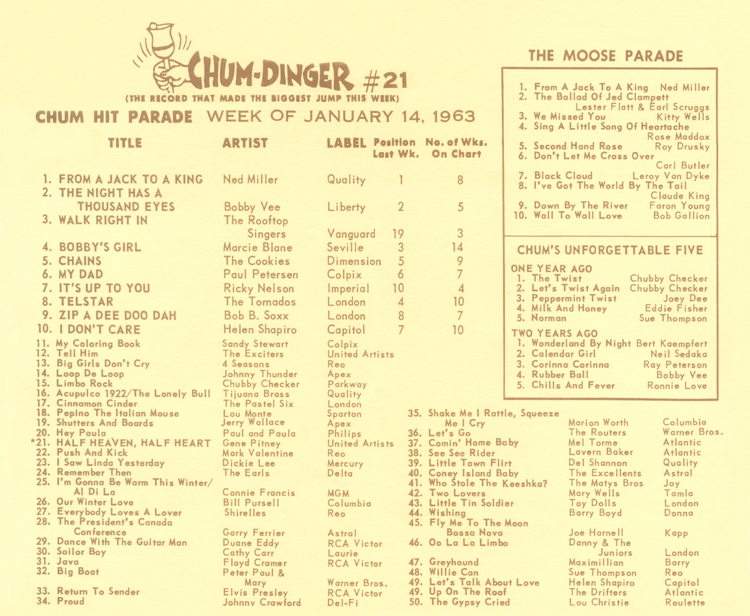
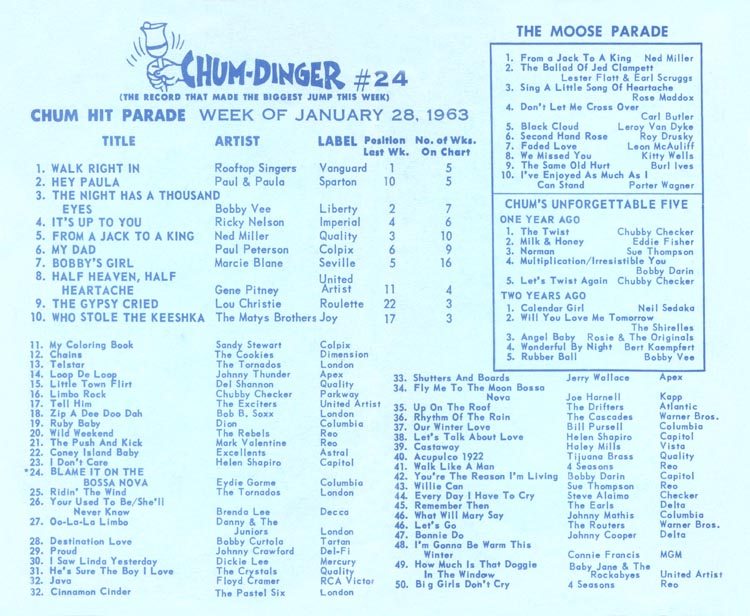
"Loop de Loop" is a song written by Teddy Vann and Joe Dong and performed by Johnny Thunder featuring The Bobbettes. It reached No. 4 on the U.S. pop chart and No. 6 on the U.S. R&B chart in 1963.[1] It was featured on his 1963 album Loop De Loop.[2] In Canada it reached No. 14 in 2 separate weeks.[3][4]

The recording was produced by Teddy Vann, and it was Thunder's only Top 40 hit.[5] The chorus is taken almost in whole from the popular folk song or children's song, known by various names, including "Here we go Loop de Loop."

Other charting versions

[edit]

Other versions

[edit]

References

[edit]
Revisions and contributorsEdit on WikipediaRead on Wikipedia
from Grokipedia
"Loop de Loop" is a rhythm and blues song written by Teddy Vann and Joe Dong, first recorded and released by Johnny Thunder (real name Gil Hamilton) featuring The Bobbettes in 1962.[1][2] The track, which adapts the traditional children's folk song "Looby Loo," became Thunder's only major hit, reaching number 4 on the Billboard Hot 100 chart in February 1963 and spending 11 weeks on the chart.[2][1] The song's playful lyrics and upbeat melody, centered around a dance-like routine, captured the early 1960s pop-soul vibe, contributing to its commercial success on Diamond Records.[2] Johnny Thunder, a Florida native who had previously sung with The Drifters under the pseudonym "Little Johnny," transitioned to solo work with this release, marking a pivotal moment in his career. He continued performing until his death on September 6, 2024.[2][3] Its influence extended to later covers, highlighting its enduring appeal in the doo-wop and rock 'n' roll era.[1]

Background

Songwriting and development

"Loop de Loop" was written by Teddy Vann and Joe Dong, with Vann serving as the primary producer and co-writer.[4][5] Vann, a Brooklyn-born singer-songwriter and producer active in the New York music scene, collaborated with Dong, his brother-in-law, to create the track.[4][6] The song originated from the traditional children's folk song and dance game "Looby Loo," which involves circular arm movements and Vann adapted into a complete song in approximately 30 minutes.[4][1] This quick composition transformed the playful nursery rhyme-inspired activity into a lighthearted novelty number.[4] Developed in the vibrant 1962 New York R&B scene, amid the post-Twist dance craze featuring artists like Dionne Warwick and The Exciters, Vann aimed to craft an upbeat hit for emerging talents.[4] The result was a doo-wop style track tailored for the early 1960s market, emphasizing fun and accessibility.[4] Johnny Thunder was selected as the lead vocalist for the project.[4]

Original recording

The original recording of "Loop de Loop" occurred in late 1962 at Bell Sound Studios in New York City.[7][8] Lead vocals were provided by Johnny Thunder, whose real name was Gil Hamilton, with backing vocals by the female R&B group The Bobbettes, best known for their 1957 hit "Mr. Lee."[9][2][10] The session was produced by Teddy Vann, who emphasized doo-wop harmonies and an upbeat rhythm to capture the song's playful, party-like energy, derived from the traditional children's folk song "Looby Loo."[9][2][1] The arrangement featured simple instrumentation, including drums, bass, and piano, creating a lively atmosphere suitable for the track's novelty style.[11] It was released as a single on Diamond Records under catalog number D-129 in December 1962.[12][13]

Musical composition

Lyrics and theme

The lyrics of "Loop de Loop" are structured around a simple, highly repetitive chorus that captures the essence of the song's energetic dance: "Here we go loop de loop / Here we go loop de li / Here we go loop de loop / On a Saturday night."[14] This refrain repeats throughout, reinforcing the looping motion through rhythmic, chant-like phrasing that invites audience participation.[14] The verses paint a vivid picture of a carefree social gathering, with lines such as "We're having a party / Ev'rybody's havin' a great time / All the gang's here and a-dancin' / Yeah I'm loopin' with a baby of mine," evoking excitement and communal joy without delving into complex storytelling.[14] A later verse introduces a romantic element, inviting a partner to join the dance: "Darling are you ready / To loop a loop loop with me / Start right there / Wait just a minute until I count to three / (one, two, three)."[14] This narrative focuses on youthful exuberance and the thrill of dancing, emphasizing escapist entertainment centered on a Saturday night bash. Adapted from the traditional children's song "Looby Loo," the lyrics employ onomatopoeic and playful repetition to mimic spinning and twirling movements, enhancing its suitability as a sing-along for group dances and parties. The straightforward, lighthearted theme of fun and flirtation aligns with the song's doo-wop style, prioritizing rhythmic engagement over deeper emotional or social commentary.

Musical structure

"Loop de Loop" is composed in the key of G major, which imparts a bright and energetic quality to the track, aligning with its party-themed vibe. The song employs a straightforward chord progression featuring the chords G, C, D, and Em—corresponding to the I, IV, V, and vi degrees in G major—a hallmark of doo-wop and early rock 'n' roll that emphasizes rhythmic groove and accessibility over harmonic complexity.[15] The arrangement is built around a 4/4 time signature, with an upbeat tempo of 125 beats per minute that drives the song's lively feel.[16] Structurally, it follows a classic pop format: a vocal intro leading into a repeating chorus, interspersed with two verses that build the narrative, and fading out with a final chorus repetition, creating a sense of ongoing festivity. Call-and-response elements are evident in the interplay between lead vocalist Johnny Thunder and the backing vocals provided by The Bobbettes, a group renowned for their tight harmonies in the doo-wop style.[15]

Release and commercial performance

Single release

"Loop de Loop" by Johnny Thunder was released as a 7-inch 45 RPM single on Diamond Records in late 1962, catalog number D-129, with "Don't Be Ashamed" as the B-side on standard pressings.[17] Distributed primarily through independent channels by the New York-based label, the single targeted regional markets in the Northeast United States.[12] Promotion efforts centered on securing radio airplay in the Northeast, leveraging Diamond Records' local connections to build early buzz among R&B and pop stations. A key boost came from Thunder's live performance of the song on the nationally televised American Bandstand on January 4, 1963, which increased visibility and encouraged further regional play.[2] This appearance helped propel the single's chart trajectory beginning in early 1963.[2] Marketed as a lighthearted, danceable novelty track, "Loop de Loop" appealed to teenagers amid the ongoing twist and party dance craze of the early 1960s, drawing from its playful nursery rhyme origins reimagined for youthful energy.[18] Producer Teddy Vann emphasized this fun, accessible vibe to attract a young audience, positioning the song as an easy-to-follow party anthem.[18]

Chart success

"Loop de Loop" by Johnny Thunder peaked at number 4 on the Billboard Hot 100 in February 1963, following its debut on December 22, 1962. The single spent 11 weeks on the chart overall. It also reached number 6 on the Billboard Hot R&B Sides chart.[19] The song achieved commercial success in the United States. International performance was more modest. As a novelty track released during the winter season, "Loop de Loop" emerged as a breakout hit comparable to contemporaries like The Chiffons' "He's So Fine," which topped the Hot 100 later that year. Its chart rise was bolstered by promotional appearances, including a performance on American Bandstand.[2]

Reception and legacy

Critical reception

Upon its release in 1963, "Loop de Loop" received praise from contemporary reviewers for its catchy simplicity and danceability, positioning it as an engaging novelty track suited for jukeboxes and parties. Cash Box highlighted the song as a "terrific teen refitting of an old kiddie favorite," emphasizing its playful adaptation of a children's rhyme into an upbeat R&B number.[20] Similarly, music commentators noted its infectious rhythm and lighthearted appeal, describing it as a "very catchy quasi-novelty song" that effectively blended fun with rhythmic drive.[21] Retrospective analyses have positioned "Loop de Loop" as a quintessential one-hit wonder within the doo-wop novelty genre, often critiqued for its superficial lyrics and lack of emotional depth but celebrated for its boundless, infectious energy that captured the era's exuberant pop spirit. AllMusic's overview of Johnny Thunder's career identifies the track as his defining 1963 hit.[22] Critics have frequently referenced it as a classic example of playful, rhythm-driven pop that prioritized fun over complexity, influencing later compilations of one-hit wonders.[23] Johnny Thunder's vocal delivery on the song has been commended for its inherent charm and enthusiastic phrasing, lending a boyish exuberance to the nursery-rhyme lyrics. The prominent backing vocals provided by The Bobbettes contributed to the track's distinctive appeal in reviews. Its commercial peak at number four on the Billboard Hot 100 further underscored the song's widespread popularity among audiences.

Cultural impact

The release of "Loop de Loop" in late 1962 sparked a minor dance trend in early 1963, aligning with the era's proliferation of novelty step dances popularized through television and records, much like the Twist had done a year earlier.[24] The song's upbeat, repetitive lyrics encouraged simple, playful movements at teen parties, contributing to the broader 1960s dance craze that emphasized accessible, fun routines over complex choreography. Its performance on American Bandstand on January 4, 1963, further amplified this, as the show routinely demonstrated steps for hit songs to a national audience.[25] The track's whimsical, childlike quality led to appearances on other period television programs, including Shivaree in 1965, where Thunder performed it in color, reinforcing its role in mid-1960s variety entertainment.[26] While not as prominently featured in films, the song has appeared in retro-themed media compilations since the 1990s, often selected to evoke the innocent exuberance of 1960s youth culture and sock-hop nostalgia. This enduring appeal stems from its lighthearted nursery-rhyme structure, which resonated with critics for its unpretentious charm and helped cement its place in compilations of one-hit wonders. As Johnny Thunder's defining recording—his only Billboard Top 40 entry—"Loop de Loop" solidified his legacy as a quintessential one-hit wonder of the early rock 'n' roll era. Johnny Thunder (real name Gilbert Hamilton) died on September 6, 2024, at the age of 93.[3] The 1963 album of the same name, released by Diamond Records, extended the song's brand with 12 tracks including the hit single, but failed to produce further successes and quickly faded from commercial view.[27] Its positive reception among reviewers for blending R&B energy with novelty appeal amplified its cultural footprint, influencing the playful tone of later 1960s pop confections.

Cover versions

Charting covers

Several cover versions of "Loop de Loop" achieved commercial success on international charts, paralleling the original recording by Johnny Thunder, which peaked at No. 4 on the Billboard Hot 100 in early 1963.[28] Frankie Vaughan's 1963 cover, released on Philips Records, marked a notable adaptation in the UK market, reaching No. 5 on the UK Singles Chart and spending 12 weeks on the chart.[29] Vaughan's rendition, characterized by his signature easy-listening and traditional pop style, targeted a broader adult audience compared to the original's youthful energy. In the U.S., Bobby Rydell's February 1963 version on Cameo Records embodied the teen idol aesthetic prevalent in early 1960s pop, though it did not secure a position on the Billboard Hot 100.[30] Dalida's French-language adaptation, released in 1963 as part of her Barclay EP, integrated into her expansive international discography and supported her ongoing popularity across France and Europe during that era.[31]

Other notable covers

The Liverbirds, an all-female beat group from Liverpool active in the 1960s, delivered a high-energy rendition of "Loop de Loop" characterized by their raw garage rock style, capturing the vibrant Liverpool sound during their residencies in Hamburg.[32] Recorded amid their performances at the Star-Club between 1964 and 1966, the track appeared as the A-side of a 1966 single on the Star-Club Records label, paired with "Bo Diddley Is a Lover," and showcased the band's driving rhythm section and enthusiastic vocals that aligned with the era's Merseybeat influences.[33] This version was later remastered and reissued in 2024 as part of the compilation Complete Recordings (Remastered 2024), preserving its lively, unpolished appeal for contemporary audiences.[34] In a collaborative acoustic blues interpretation, Taj Mahal joined forces with Eric Bibb and Linda Tillery on the 1997 album Shakin' a Tailfeather, infusing "Loop de Loop" with folk and roots elements through harmonica-driven arrangements and communal harmonies.[35] Released on Verve Music Group as a family-oriented project blending R&B classics with educational rhythms, the track highlighted Mahal's signature multi-instrumental approach, transforming the original's upbeat swing into a warm, narrative-driven performance that emphasized storytelling and cultural heritage.[36] This rendition stood out for its gentle pacing and layered vocal interplay, diverging from more rock-oriented covers by prioritizing acoustic intimacy and rhythmic playfulness suitable for intergenerational listening. The Walkmen offered an indie rock reworking of "Loop de Loop" on their 2006 tribute album Pussy Cats Starring the Walkmen, a full recreation of Harry Nilsson's 1974 John Lennon-produced record, where the band amplified the song's communal spirit with a lively studio gathering of friends.[37] Recorded for Record Collection, their version retained the original's playful chaos but infused it with post-punk edges through Hamilton Leithauser's emotive delivery and the group's signature reverb-heavy guitars, creating a raucous, party-like atmosphere that echoed the tribute's experimental ethos.[38] This cover exemplified the band's ability to blend reverence with irreverence, turning the track into a jubilant ensemble shout-along that contrasted the more subdued charting versions by emphasizing raw, collective energy over polished production.

References

User Avatar
No comments yet.