


Community hub
Recent from talks
Contribute something
Nothing was collected or created yet.
The Bobbettes
View on Wikipedia
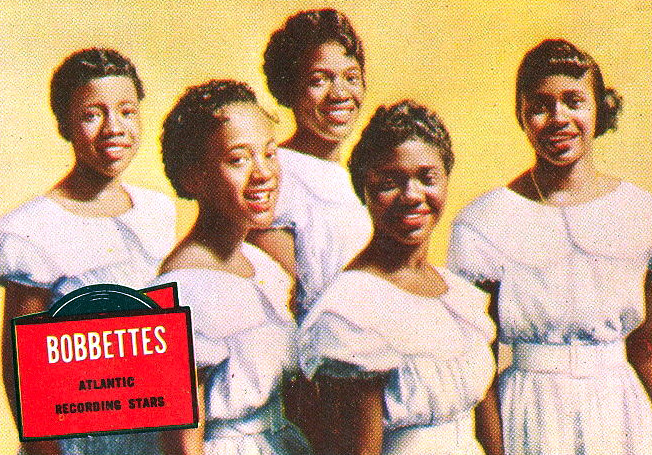
The Bobbettes were an American R&B girl group who had a 1957 top 10 hit song called "Mr. Lee".[1] The group initially existed from 1955 to 1974 and included Jannie Pought (1945–1980), Emma Pought (born 1942), Reather Dixon (1944–2014), Laura Webb (1941–2001), and Helen Gathers (1942–2011).
Key Information


History
[edit]The group, which originally formed in East Harlem, New York, in 1955, was first known as "The Harlem Queens".[1][2] The girls first met while singing at the Glee Club at P.S. 109 in Spanish Harlem.[2] They were soon discovered by James Dailey, a record producer, who also became their manager, while playing a concert at the Apollo Theater's amateur night, and were signed to a recording contract on the Atlantic label.[1] The girls lived in the housing projects of 1905 Second Ave and 99th Street and sang in the hallways of the building and downstairs in the playground.
In 1957, the girls released their first hit single, "Mr. Lee", an uptempo song in which the narrator proclaims her devotion to her crush—her school teacher.[1] The girls actually disliked the real-life Mr. Lee and the original lyrics to the song were something of a put-down, but Atlantic insisted the group revise the lyrics before recording the song.[1] The single, backed by "Look at the Stars", became their biggest hit recording, peaking at #6 on the Billboard Pop singles chart and spending four weeks at #1 on the R&B chart.[1] This made the Bobbettes the first girl group to release a #1 R&B hit that also made the pop top 10. The song would later be covered by Diana Ross on the European version of her 1987 album Red Hot Rhythm & Blues. The personnel on "Mr. Lee" included Jesse Powell on tenor sax, Allan Hanlon and Al Caiola on guitar, Ray Ellis on piano, Milt Hinton on bass, and Joe Marshall on drums. Billboard named the song #79 on their list of 100 Greatest Girl Group Songs of All Time.[3]
After a series of novelty songs for Atlantic that were unsuccessful,[2] they recorded the original recording of "I Shot Mr. Lee".[1] Atlantic refused the song and the group left the label and signed with Teddy Vann and a new version was issued on the small Triple-X label.[1] It started to climb the charts rapidly, eventually reaching #52 on the Billboard Hot 100, whereupon Atlantic released their own version of the song.
Over the next few years they followed up that single with such other recordings as "Have Mercy Baby", "You Are My Sweetheart", "You Belong to Me", and "Dance with Me Georgie". They then signed with End Records and released the songs "Teach Me Tonight" and "I Don't Like It Like That" (answer to Chris Kenner's "I Like It Like That"). Although the recording of "I Don't Like It Like That" was the girls' last chart record, they continued to record for a series of record labels, including Diamond, RCA Victor and Mayhew, before disbanding in 1974.[1][2] They also toured the oldies circuits for many years having reformed after their initial breakup.[1] Other recordings by the Bobbettes include, "Oh My Pa-Pa", "Speedy", "Zoomy", and "Rock and Ree-ah-Zole (The Teenage Talk)". Their single of "I've Gotta Face The World" on RCA Victor is a Northern soul single.
In 1980, Jannie Pought was stabbed to death at age 34 by a stranger in New Jersey.[4][5]
Reather Dixon (born on May 1, 1944, in Bamberg, South Carolina) died on January 8, 2014, at age 69.[6]
The Bobbettes were nominated for induction in the Vocal Group Hall of Fame.[when?]
Discography
[edit]Singles
[edit]| Year | Title (A-Side, B-Side)[7] | Chart positions | |||
|---|---|---|---|---|---|
| US [8] |
US R&B [8] | ||||
| 1957 | "Mr. Lee" b/w "Look at the Stars" |
6 | 1 | ||
| "Speedy" b/w "Come-A Come-A" |
— | — | |||
| 1958 | "Zoomy" b/w "Rock and Ree-Ah-Zole" |
— | — | ||
| "The Dream" b/w "Um Bow Bow" |
— | — | |||
| 1959 | "Don't Say Goodnight" b/w "You Are My Sweetheart" |
— | — | ||
| 1960 | "I Shot Mr. Lee" b/w "Untrue Love" |
52 | — | ||
| "Have Mercy Baby" b/w "Dance with Me Georgie" |
66 95 |
— | |||
| "Oh My Papa" b/w "I Cried" |
— | — | |||
| 1961 | "Teach Me Tonight" b/w "Mr Johnny Q" |
— | — | ||
| "I Don't Like It Like That, Part 1" b/w "Part 2" |
72 | — | |||
| "Looking for a Lover" b/w "Are You Satisfied" |
— | — | |||
| 1962 | "My Dearest" b/w "I'm Stepping Out Tonight" |
— | — | ||
| "Over There" b/w "Loneliness" |
— | — | |||
| "The Broken Heart" b/w "Mama Papa" |
— | — | |||
| "Teddy" b/w "Row, Row, Row" |
— | — | |||
| 1963 | "Close Your Eyes" b/w "Somebody Bad Stole De Wedding Bell" |
— | — | ||
| 1964 | "My Mama Said" b/w "Sandman" |
— | — | ||
| "In Paradise" b/w "I'm Climbing a Mountain" |
— | — | |||
| 1965 | "You Ain't Seen Nothing Yet" b/w "I'm Climbing a Mountain" |
— | — | ||
| 1966 | "Having Fun" b/w "I've Gotta Face the World" |
— | — | ||
| "It's All Over" b/w "Happy Go Lucky Me" |
— | — | |||
| 1971 | "That's a Bad Thing to Know" b/w "All in Your Mind" |
— | — | ||
| 1972 | "Tighten Up Your Own" b/w "Looking for a New Love" |
— | — | ||
| 1974 | "It Won't Work Out" b/w "Good Man" |
— | — | ||
| "—" denotes releases that did not chart. | |||||
References
[edit]- ^ a b c d e f g h i j Colin Larkin, ed. (2002). The Virgin Encyclopedia of Fifties Music (Third ed.). Virgin Books. p. 45. ISBN 1-85227-937-0.
- ^ a b c d Ankeny, Jason. "Biography". AllMusic. Retrieved April 16, 2022.
- ^ "100 Greatest Girl Group Songs of All Time: Critics' Picks". Billboard.com. Retrieved July 11, 2017.
- ^ "Marv Goldberg's R&B Notebooks - BOBBETTES". Uncamarvy.com. Retrieved December 7, 2012.
- ^ "The Bobbettes". Rockabilly.nl. February 28, 1957. Archived from the original on October 11, 2006. Retrieved December 7, 2012.
- ^ "Obituary Reather Turner May 1, 1944 – January 8, 1014". dignitymemorial.com. Retrieved May 1, 2021.
- ^ Clemente, John (2013). Girl Groups: Fabulous Females Who Rocked the World. Authorhouse. p. 68. ISBN 9781477276334. Retrieved August 6, 2017.
- ^ a b "The Bobbettes - Awards". AllMusic. Archived from the original on December 8, 2013. Retrieved April 16, 2022.
External links
[edit]
The Bobbettes
View on GrokipediaFormation and Early Career
Origins in East Harlem
The Bobbettes formed in 1955 in East Harlem, New York, when a group of eight schoolgirls, aged 11 to 15, came together through the glee club at P.S. 109, an elementary school located at 99th Street and Second Avenue in Manhattan.[3] Initially calling themselves the Harlem Queens, they drew from the vibrant African American community of the neighborhood, where music served as a key outlet for young people amid the social and economic challenges of 1950s urban life.[3][4] The young singers, including the core founding members Reather Dixon, sisters Emma and Jannie Pought, Laura Webb, and Helen Gathers (with three others in the initial octet rotating early on), began rehearsing informally after school and in local settings, honing their harmonies on original songs and covers.[3][5] Inspired by the rising doo-wop and R&B scene, they emulated styles from groups like the Spaniels, whose emotive ballads influenced their blend of youthful energy and vocal interplay.[5] These grassroots efforts led to initial performances at neighborhood talent shows and amateur nights, building confidence and a local following before their eventual appearance at the Apollo Theater.[1][3] By late 1956, the group had streamlined to a core quintet still performing as the Harlem Queens, reflecting their evolving aspirations within East Harlem's tight-knit music culture, where street-savvy creativity shaped their path from schoolyard singers to emerging performers.[6]Discovery and Signing with Atlantic Records
In 1957, the all-female vocal group performing as the Harlem Queens caught the attention of talent scout and producer James Dailey during their appearance at the Apollo Theater's amateur night in Harlem.[1] Dailey, who managed several local acts, recognized their potential and immediately took on the role of their manager, guiding the young performers—aged between 11 and 15—from their informal beginnings into professional opportunities.[7] Soon after, Dailey facilitated a name change to the Bobbettes, a playful moniker suggested by member Laura Webb after her niece Chanel Bobbette, aiming for a more endearing and marketable identity. Under Dailey's guidance, the group underwent an audition process that led to their signing with Atlantic Records, marking one of the label's earliest contracts with an all-girl R&B ensemble.[3][5] This deal was notable in an era dominated by male vocal groups, as Atlantic, a leading independent label known for its R&B roster, provided the Bobbettes with access to professional production and distribution.[8][1] The group's initial recording sessions took place in New York City at the end of February 1957, where they cut four original compositions under the supervision of Atlantic's team, including arranger Reggie Obrecht.[8] These sessions highlighted the Bobbettes' songwriting talents, with the teenagers contributing lyrics and melodies drawn from their everyday experiences; early releases from this period included tracks like "Speedy," showcasing their harmonious doo-wop style.[3] As one of the first such groups on a major label, their entry into the studio represented a breakthrough for young female artists in R&B.[7] Navigating their early career as teenagers presented significant challenges, including strict parental oversight required by their ages and the need to balance school obligations with burgeoning professional demands.[1] Parents accompanied the group on initial tours, such as one-night theater stands along the Eastern circuit, ensuring compliance with child labor laws and curfews, while the girls were temporarily enrolled in a professional children's school to accommodate travel.[7] These constraints limited nightclub performances but allowed focus on safer venue bookings, underscoring the logistical hurdles of youth in the music industry at the time.[3]Musical Career and Achievements
Breakthrough Hit "Mr. Lee"
"Mr. Lee" originated as a song written by the members of the Bobbettes in 1955, when the girls—ranging in age from 9 to 11—were part of the glee club at P.S. 109, an elementary school in Spanish Harlem, New York. The track was initially a playful taunt directed at their disliked teacher, Mr. Lee, whom they described as the "ugliest" in the school; the original lyrics were derogatory, but Atlantic Records insisted on revisions to make them complimentary, changing the focus to the "handsomest" teacher to avoid potential legal issues.[4] The song was recorded in early 1957 at Atlantic Studios in New York City, produced by Ahmet Ertegun, with arrangement by Reggie Obrecht. Featuring the group's signature doo-wop harmonies layered over an upbeat R&B rhythm, the recording captured the youthful energy of the performers through shrill vocals, exuberant shrieks, and tight ensemble singing that highlighted their raw talent.[9][4] Released by Atlantic Records in June 1957, "Mr. Lee" quickly became a breakthrough success, entering the Billboard charts in late July and peaking at number 6 on the Pop chart while reaching number 1 on the R&B chart, where it held the top spot for four weeks. The single sold over one million copies, marking a commercial milestone for the era.[3][7][10] This achievement positioned the Bobbettes as the first all-girl R&B group to secure a top 10 Pop hit and a number 1 R&B single, paving the way for future acts and predating the Chantels' success by several months.[11][7]Subsequent Releases and Label Changes
Following the success of their debut hit "Mr. Lee," the Bobbettes faced tensions with Atlantic Records when the label declined to release their 1959 recording of "I Shot Mr. Lee," a sequel with more candid lyrics about their former teacher, leading to the end of their contract in 1959.[3] The group then signed with George Goldner's Triple-X Records (affiliated with End and Gone labels), and re-recorded "I Shot Mr. Lee" for release in June 1960, where it peaked at #52 on the Billboard Hot 100.[1] This track, along with the B-side "Untrue Love," marked their return to the charts but also prompted Atlantic to issue its own version of the song in July 1960, diluting its momentum.[3] In September 1960, still on the affiliated Triple-X label, the Bobbettes released "Have Mercy Baby," a cover of the 1952 R&B hit by Billy Ward and His Dominoes, which reached #66 on the pop chart and #95 on the R&B chart, showcasing their energetic doo-wop harmonies.[12] By 1961, they issued "Teach Me Tonight," a standard originally popularized by The DeCastro Sisters, as the B-side to "Mr. Johnny Q" on End Records, highlighting their versatility in interpreting pop ballads.[13] That same year, on Gone Records, they recorded "I Don’t Like It Like That," an answer song to Chris Kenner's "I Like It Like That," which climbed to #72 on the pop chart and demonstrated their continued engagement with contemporary trends.[1] The group continued recording through the mid-1960s, switching to Diamond Records in late 1962, where they released several singles including "Heaven Knows" in 1963, though none matched their earlier chart success.[3] By 1966, they moved to RCA Victor for tracks like "Close Your Eyes," before brief stints with labels such as Josie in 1969 and Mayhew Records from 1971 to 1974, their final active recording period.[3] Throughout the late 1950s and 1960s, the Bobbettes toured extensively on the Eastern theatre circuit, making television appearances such as on American Bandstand and navigating the era's racial segregation, which posed logistical and safety challenges for Black artists traveling through the South.[14][15]Group Members and Lineup Changes
Original Members
The original members of The Bobbettes were five young women from working-class families in East Harlem, New York, who formed the group in 1955 while attending P.S. 109 elementary school.[11] They shared a passion for singing doo-wop harmonies inspired by the street corner traditions of their neighborhood, with each contributing distinct vocal roles that blended seamlessly in their early performances at local talent shows.[3] All five co-wrote their breakthrough hit "Mr. Lee," drawing from personal experiences with their music teacher at P.S. 109, which helped establish their songwriting credibility from the outset.[3] Emma Pought, born April 28, 1942, in New York City, served as the first lead singer and alto, providing the rich bass harmonies that anchored the group's sound during their formative years.[11][16] As the older sister of fellow member Jannie, she helped initiate the group alongside Reather Dixon, organizing rehearsals in school hallways and apartment stoops amid their modest family circumstances. Pought's steady, resonant voice was essential to the layered vocal arrangements on early tracks like "Mr. Lee," where she shared lead duties and contributed to the song's infectious energy.[17] Emma Pought is the sole surviving original member as of 2025.[18] Jannie Pought, born November 8, 1945, in New York City, was the soprano, delivering bright, soaring melodies and high harmonies that defined the group's youthful appeal in their initial recordings.[11][19] Growing up in the same working-class household as her sister Emma in East Harlem, she brought playful energy to rehearsals and performances.[1] Her contributions extended to co-writing "Mr. Lee," reflecting the group's collective creativity during their school days, though her life was tragically cut short in September 1980 at age 34, when she was stabbed to death by a stranger while walking in Jersey City, New Jersey.[20][21] Reather Dixon, born May 1, 1944, in Bamberg, South Carolina, but raised in New York City's East Harlem after her family relocated for better opportunities, functioned as the baritone/alto and co-lead, offering key harmony support and shared leads that added depth to the quintet's blend.[11][22] Coming from a working-class background with parents Wilber and Elouise Dixon, she co-founded the group with Emma Pought and provided the rhythmic pulse in early harmonies, notably on "Mr. Lee," where her voice grounded the higher vocals and shared lead duties.[23] Later known as Reather Turner, she maintained close family ties, living with her mother in her final years, and passed away on January 8, 2014, at age 69 in East Harlem, survived by her mother, a brother, and two sisters.[24] Laura Webb, born November 8, 1941, in New York City, held the role of tenor, responsible for mid-range notes that elevated the group's hits and gave their sound a distinctive sparkle in amateur contests during the mid-1950s.[11][25] From a working-class East Harlem family, she suggested the name "The Bobbettes" to replace their initial "Harlem Queens," symbolizing their aspirations beyond the neighborhood, and her tenor lines were crucial to the harmonic interplay on early singles.[3] Webb, later known as Laura Childress, died of cancer on January 8, 2001, at age 59 in New York.[26] Helen Gathers, born March 18, 1942, in New York City, performed as the alto/baritone, contributing smooth lower harmonies that complemented the leads and enriched the group's tight-knit vocal texture from their schoolyard beginnings.[11][27] Raised in a working-class East Harlem family, she focused on family life after the group's early successes, balancing performances with personal responsibilities as the members navigated young adulthood.[28] Gathers passed away on February 13, 2011, in the Bronx, New York, at age 68.[27][29]Later Additions and Departures
Following the success of their early recordings, the Bobbettes underwent significant lineup changes starting in the early 1960s. Helen Gathers departed the group in 1960 due to travel fatigue from constant touring, reducing the ensemble to a quartet comprising Reather Dixon, Emma Pought, Jannie Pought, and Laura Webb.[3][2] This shift maintained the group's core harmony but emphasized the remaining members' vocal interplay, enabling them to continue as a more streamlined unit for subsequent releases on labels like RCA Victor.[3][2] The quartet configuration persisted through the 1960s, with the members adapting to evolving R&B styles while preserving their doo-wop roots. In the early 1970s, Jannie Pought left the group, further altering the dynamics as the remaining trio—Reather Dixon, Emma Pought, and Laura Webb—focused on occasional recordings and performances. Pought's exit was followed by her tragic death in 1980 from a random stabbing attack in Jersey City, New Jersey. The group briefly recruited Gloria Glynn as a replacement for Pought during this period before operating primarily as a trio.[18][3][30] The Bobbettes officially disbanded in 1974 amid waning commercial opportunities in the evolving music industry.[31] Despite this, the original members participated in sporadic reunions on the oldies revival circuit. In the 1980s, the group reformed for performances with Reather Dixon and Emma Pought joined by newcomers Debra Thompson and Pamela Tate, introducing fresher vocal textures that sustained their live appeal into the 2000s.[31][2][32] These later additions helped the ensemble adapt to contemporary audiences while honoring their foundational sound, though the group eventually retired following Dixon's death in 2014.[2]Legacy and Influence
Cultural Impact
The Bobbettes played a pivotal role as pioneers of the girl group genre in the late 1950s, introducing a youthful, harmony-driven R&B style that emphasized self-written songs and exuberant vocal interplay, which directly influenced subsequent acts such as The Shirelles and The Supremes.[33][4] Their breakthrough hit "Mr. Lee" exemplified this approach, blending doo-wop harmonies with playful energy that captured the autonomy of young female performers in a male-dominated industry.[31] This innovation helped establish the commercial viability of all-female ensembles, paving the way for the genre's expansion in the 1960s.[3] A subversive undercurrent in their music, particularly "Mr. Lee," reflected post-war youth culture's teen rebellion against authority figures; originally penned as an insult to a disliked teacher, the song was reworked into a seemingly innocuous tribute at the behest of their label, masking its coded critique of oppressive adults.[34] This duality highlighted the group's clever navigation of societal constraints, allowing subtle resistance within mainstream pop.[4] As one of the earliest all-Black, all-female groups to achieve major-label success on Atlantic Records, The Bobbettes broke significant barriers in the segregated music industry of the 1950s, representing working-class Black youth and broadening the genre's demographic scope.[2][3] Their achievements underscored the potential for racial and gender integration in R&B, influencing broader cultural narratives around female empowerment and diversity.[33] The enduring impact of "Mr. Lee" is evident in its later covers, such as Diana Ross's 1987 version on her album Red Hot Rhythm & Blues, which peaked at #58 on the UK Singles Chart in 1988, and its inclusion at #79 on Billboard's list of the 100 Greatest Girl Group Songs of All Time.[35][36]Recognition and Later Performances
In the 2000s, The Bobbettes received recognition for their pioneering role in doo-wop and girl group music, including a nomination for induction into the Vocal Group Hall of Fame in 2002.[11] This acknowledgment highlighted their status as the first all-female group to achieve a number-one R&B hit and a top-ten pop single with "Mr. Lee" in 1957.[1] Following the group's initial disbandment in 1974, surviving members revived performances during the 1970s oldies revival, touring the United States and England to enthusiastic audiences nostalgic for early rock and roll harmony groups.[1] This resurgence continued into the 1980s and 1990s, culminating in the release of the compilation album Mr. Lee and Other Big Hits in 1989 on Revival Records, featuring an updated lineup including original members Reather Dixon and Emma Pought alongside Debra Thompson and Pamela Tate.[37] The album re-recorded and compiled their classic tracks, reinforcing their enduring appeal on the oldies circuit through the 2000s. Tributes to individual members underscored the group's lasting legacy after several deaths in later years. Reather "Dimples" Dixon Turner, a co-founder and key vocalist, passed away on January 8, 2014, at age 69; her memorial service in Woodside, New York, celebrated her contributions to The Bobbettes and the broader doo-wop genre, drawing reflections on the group's trailblazing influence.[38] Similarly, original member Jannie Pought had been fatally stabbed in 1980 at age 34, and Laura Webb died in 2001, with obituaries often noting their roles in shaping female vocal harmony traditions.[1] The Bobbettes maintained a presence in modern revivals through occasional performances at nostalgia events, such as their 2011 appearance at the Rhythm Riot festival in the UK, where they performed "Mr. Lee" and "I Shot Mr. Lee" to mark one of their rare international outings since the 1950s.[39] Their music also influenced nostalgia media, with "Mr. Lee" featured prominently in the 1986 film Stand by Me, helping to introduce their sound to new generations via the movie's acclaimed soundtrack.[40]Discography
Singles
The Bobbettes issued around 20 singles between 1957 and 1981, primarily on independent R&B labels, with their initial output on Atlantic achieving crossover appeal but highlighting the typical disparities between Pop and R&B chart performance for girl groups of the era. Early releases emphasized doo-wop harmonies and teen-themed lyrics, while later efforts incorporated answer songs and covers, often peaking higher on R&B charts than Pop due to limited mainstream radio play.[3][30] Key singles are listed chronologically below, focusing on notable releases with available chart data from Billboard; b-sides and rarities like "Zoomy" (a 1958 Atlantic upbeat novelty track backed by "Rock and Ree-ah-zole") exemplify their lighter, experimental sides that did not chart prominently.[3][41]| Year | A-Side / B-Side | Label | Chart Positions |
|---|---|---|---|
| 1957 | Mr. Lee / Look at the Stars | Atlantic | #6 Pop, #1 R&B (4 weeks) |
| 1958 | Zoomy / Rock and Ree-ah-zole | Atlantic | — |
| 1960 | I Shot Mr. Lee / Untrue Love | End | #52 Pop |
| 1961 | Teach Me Tonight / Mr. Johnny Q | End | — |