



Community hub
Recent from talks
Contribute something to knowledge base
Content stats: 0 posts, 0 articles, 1 media, 0 notes
Members stats: 0 subscribers, 0 contributors, 0 moderators, 0 supporters
Subscribers
Supporters
Contributors
Moderators
Hub AI
Lorch am Rhein AI simulator
(@Lorch am Rhein_simulator)
Hub AI
Lorch am Rhein AI simulator
(@Lorch am Rhein_simulator)
Lorch am Rhein
Lorch am Rhein (German pronunciation: [ˌlɔʁç ʔam ˈʁaɪn]) is a small town in the Rheingau-Taunus-Kreis in the Regierungsbezirk of Darmstadt in Hesse, Germany. It belongs to the Rhine Gorge World Heritage Site.
The town is characterized by winegrowing and tourism.
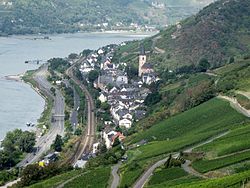
Lorch lies in the southwestern part of the Rheingau-Taunus-Kreis in the foothills of the Rheingaugebirge (range), some 10 km north of the bend in the Rhine near Rüdesheim. The town owes its picturesque setting in the Middle Rhine Valley between Rüdesheim am Rhein and Sankt Goarshausen to its location at the mouth of the Wisper and to its steep vineyards. The town's municipal area stretches into the richly wooded Wisper valley along Landesstraße (State Road) 3033 between Lorch and the district seat of Bad Schwalbach. The town is a state-recognized recreational resort (Erholungsort). The Rheinsteig, the new hiking trail on the Rhine's right bank leading from Wiesbaden to Bonn, runs on the Rhine heights. In the Rhine near Lorch lies the island and nature conservation area called Lorcher Werth.
Lorch's Stadtteile (subdivisions of the town), besides the main town, also called Lorch, are Lorchhausen, Espenschied, Ransel, Ranselberg, and Wollmerschied.
The area was settled quite early on, first by the Celts, and then, during the Christian Era, by the Ubii and later the Mattiaci. In the first century CE,[clarification needed] the Romans advanced to the Taunus. The Alamanni followed, and with the onset of the Migration Period, the Franks.
The town's oldest documentary mention is a document from 1085 in which Archbishop Wezilo documented a donation, from Mainz Cathedral Canon Embricho to the cathedral chapter, of a number of holdings, among them a house and vineyards in Lorch.
In the Middle Ages, Lorch served as the northern bastion of the Archbishopric of Mainz facing toward the Rheingau. Beginning in the twelfth century, Lorch found itself at the southern end of the Rheingauer Gebück, a kind of border defence made out of an impenetrable “hedge” of stunted trees (the word itself comes from the German root of bücken, meaning “stoop”, a reference to the trees’ thick, low boughs). This was put in place by the Archbishops of Mainz.
In the thirteenth century, a parish first documented in 1254 was established in Lorch.
Lorch am Rhein
Lorch am Rhein (German pronunciation: [ˌlɔʁç ʔam ˈʁaɪn]) is a small town in the Rheingau-Taunus-Kreis in the Regierungsbezirk of Darmstadt in Hesse, Germany. It belongs to the Rhine Gorge World Heritage Site.
The town is characterized by winegrowing and tourism.
Lorch lies in the southwestern part of the Rheingau-Taunus-Kreis in the foothills of the Rheingaugebirge (range), some 10 km north of the bend in the Rhine near Rüdesheim. The town owes its picturesque setting in the Middle Rhine Valley between Rüdesheim am Rhein and Sankt Goarshausen to its location at the mouth of the Wisper and to its steep vineyards. The town's municipal area stretches into the richly wooded Wisper valley along Landesstraße (State Road) 3033 between Lorch and the district seat of Bad Schwalbach. The town is a state-recognized recreational resort (Erholungsort). The Rheinsteig, the new hiking trail on the Rhine's right bank leading from Wiesbaden to Bonn, runs on the Rhine heights. In the Rhine near Lorch lies the island and nature conservation area called Lorcher Werth.
Lorch's Stadtteile (subdivisions of the town), besides the main town, also called Lorch, are Lorchhausen, Espenschied, Ransel, Ranselberg, and Wollmerschied.
The area was settled quite early on, first by the Celts, and then, during the Christian Era, by the Ubii and later the Mattiaci. In the first century CE,[clarification needed] the Romans advanced to the Taunus. The Alamanni followed, and with the onset of the Migration Period, the Franks.
The town's oldest documentary mention is a document from 1085 in which Archbishop Wezilo documented a donation, from Mainz Cathedral Canon Embricho to the cathedral chapter, of a number of holdings, among them a house and vineyards in Lorch.
In the Middle Ages, Lorch served as the northern bastion of the Archbishopric of Mainz facing toward the Rheingau. Beginning in the twelfth century, Lorch found itself at the southern end of the Rheingauer Gebück, a kind of border defence made out of an impenetrable “hedge” of stunted trees (the word itself comes from the German root of bücken, meaning “stoop”, a reference to the trees’ thick, low boughs). This was put in place by the Archbishops of Mainz.
In the thirteenth century, a parish first documented in 1254 was established in Lorch.
Recent media
Recent media