Hubbry Logo
UbiiUbiiMain
Open search
Ubii
Community hub
Ubii
logo
8 pages, 0 posts
0 subscribers
Be the first to start a discussion here.
Contribute something
Ubii
Ubii
from Wikipedia

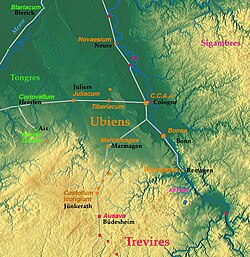
The Ubii around AD 30
Fannius, a member of the Ubii, corporis custos, the Germanic bodyguard of Nero, Museo Epigrafico, Terme di Diocleziano, Rome

The Ubii were a Germanic tribe[1][2] first encountered dwelling on the east bank of the Rhine in the time of Julius Caesar, who formed an alliance with them in 55 BC in order to launch attacks across the river. They were transported in 39 BC by Marcus Vipsanius Agrippa to the west bank, apparently at their own request, as they feared the incursions of their neighbors, the Chatti.[3]

A colony for Roman veterans was founded in 50 AD under the patronage of Agrippa's granddaughter, Agrippina the Younger,[4] who had been born at Ara Ubiorum, the capital of the Ubii. The colony derived its title from the names of Agrippina and her husband, the emperor Claudius, and received the name Colonia Claudia Ara Augusta Agrippinensium, which is the origin of the city's modern name, Cologne. Alongside the allotment of land to veterans, the existing town of Ara Ubiorum was elevated to the status of a colonia, which would have conferred many privileges on the inhabitants.[5] The Ubii were also at Bonna (Bonn) of the Eburones.

The Ubii remained loyal allies of Rome; they were instrumental in crushing the Batavian rebellion in 70 AD and, although some of them made part of the invasion of Pannonia in 166 AD, they become foederati supporting Roman troops in the Marcomannic Wars in 166–67 AD.

They seem to have been so thoroughly Romanized that they adopted the name Agrippinenses in honour of their "founder",[6] and their later history is submerged with other Franks in that of eastern Gaul as a whole.

Roman interactions

[edit]

In 55 BC, Julius Caesar was preparing for an invasion of Britain, when several Germanic tribes, including the Ubii,[7] crossed the Rhine river. This movement included the Usipetes and Tencteri tribes, who wished to relocate to avoid contact with the Suevi. Caesar, concerned that fighting might break out in the region and draw troops away from his planned invasion, marched toward the Rhine. He met with ambassadors from the Germanic tribe and offered them land with the Ubii and an alliance against the Suevi; however, Caesar soon became worried that the tribes were delaying until their cavalry could return.

Together with the Batavi, the Ubii furnished soldiers for the Germanic bodyguard, the personal bodyguard of the early Roman emperors.

See also

[edit]

Notes

[edit]
[edit]
Revisions and contributorsEdit on WikipediaRead on Wikipedia
from Grokipedia
The Ubii were a West Germanic tribe who settled along the east bank of the River by the , in the of modern-day Nordrhein-Westfalen, . First encountered by during his , they were described as a populous and prosperous people influenced by neighboring Gallic customs, though they faced subjugation and tribute demands from more powerful tribes like the . The Ubii quickly formed a strategic alliance with Rome, providing military support to Caesar against the Suebi in 55 BC and reaffirming their loyalty during his Rhine campaigns in 53 BC, in exchange for protection and potential resettlement. In 38 BC, under the direction of Marcus Vipsanius Agrippa, they were relocated to the west bank of the Rhine for greater security, where they established their chief settlement, Oppidum Ubiorum, which served as an administrative center in the Roman province of Germania Inferior. This town was later refounded as Colonia Claudia Ara Agrippinensium (Colonia Agrippina) around AD 50, becoming a key Roman colony and the precursor to the modern city of Cologne; the Ubii supplied troops to the Roman legions and maintained their status as loyal foederati until at least the 4th century AD. By the , the Ubii were gradually absorbed into the expanding Frankish kingdoms following the collapse of Roman authority in the region, with their territory incorporated into the Ripuarian Frankish domain after the capture of in 455. Their tribal name, derived from the Proto-Germanic uba/ubaraz meaning "up, over, or above," reflects their geographical position relative to the , and they are frequently mentioned in ancient sources such as Caesar's , ' and Histories, and Strabo's for their role in Roman frontier politics.

Name and origins

Etymology

The name Ubii derives from Proto-Germanic roots ūbaz and ūbaraz, signifying "up," "above," or "over," which scholars interpret as possibly alluding to the tribe's original settlement in elevated or upland regions east of the Rhine. This linguistic reconstruction aligns with the tribe's mention in ancient Roman sources, such as Julius Caesar's Commentarii de Bello Gallico (4.1, 4.16), where the Ubii are described as allies without etymological explanation, and Tacitus's Germania (28), which notes their proximity to the Rhine but provides no origin for the name. Ptolemy's Geographia (2.11.10) similarly lists the Ubii among Germanic peoples near the Rhine, reinforcing their geographical context without delving into nomenclature. Comparisons with neighboring Germanic tribal names reveal phonetic and semantic parallels; for instance, the , another Rhine-adjacent group displaced alongside the Ubii in the BCE, may stem from a or hybrid form uξsi-petes meaning "those who shine from above," suggesting shared motifs of elevation or prominence in tribal self-identification. These links highlight a broader pattern in early Germanic , where locational or topographical descriptors formed ethnic identifiers, as seen in reconstructions from ubiri ("upward"). Following Roman relocation of the Ubii across the under Agrippa in 38 BCE, their tribal name evolved in official usage to Agrippinenses, denoting inhabitants of the colony (modern ), though pre-Roman etymological roots remained tied to their Germanic heritage.

Pre-Roman history

The Ubii were a Germanic tribe first documented in historical records during the mid-1st century BC, with their earliest mention appearing in Julius Caesar's , composed around 55–50 BC. In this account, Caesar describes the Ubii as inhabiting the eastern bank of the River, positioning them as neighbors to and distinguishing them from more distant Germanic groups. Their territory was noted for its fertility and relative prosperity compared to other Germanic regions, attributed to ongoing commercial exchanges with Gallic traders across the , which had fostered a degree of cultural sophistication uncommon among their kin. Prior to direct Roman engagement, the Ubii faced persistent military pressures from neighboring Germanic tribes, particularly the Suebi, who conducted repeated incursions into Ubii lands. These conflicts had significantly weakened the Ubii, reducing them to a status under Suebi dominance and limiting their autonomy in the . The Suebi's aggressive expansion also displaced adjacent groups, such as the Tencteri and , who migrated westward under duress; the Ubii, sharing similar vulnerabilities to these pressures, were positioned geographically to potentially absorb or ally with such displaced peoples in their shared resistance against Suebic hegemony. Archaeological and linguistic evidence suggests the Ubii emerged as part of broader Germanic migrations during the pre-Roman (c. onward), likely originating from northern German lowlands with possible ancestral ties to southern Scandinavian populations, aligning them culturally with the western Germanic branch known later as the . This migratory context underscores their establishment along the as a semi-sedentary group engaged in and , though specific pre-55 BC events remain sparsely recorded due to the absence of indigenous written sources.

Territory and settlements

Original homeland

The Ubii, a Germanic tribe, originally occupied territory on the east bank of the Rhine River, situated between the Sieg River to the south and the Ruhr River to the north, encompassing parts of modern-day North Rhine-Westphalia in Germany. This location positioned them along a strategic stretch of the lower Rhine, where the river served as a natural boundary and trade corridor with neighboring Gallic tribes across the water, such as the Treviri. The landscape of this homeland consisted of fertile alluvial plains in the river valleys, interspersed with dense forests and low hills rising toward the interior, creating an environment well-suited for mixed , including grain cultivation and , while the elevated terrain offered defensive advantages against incursions. These features not only sustained a relatively prosperous tribal economy but also facilitated control over riverine routes vital for commerce and mobility in the pre-Roman era. Archaeological investigations in the reveal evidence of occupation in areas later settled by the Ubii, including settlements and fortified sites from the La Tène period (c. 450–50 BC), marked by imported artifacts such as gold coins and glass bracelets that reflect cultural exchanges and elite status displays. Hill forts and rural habitations in this area, uncovered through excavations and metal detector surveys, indicate organized communities with influences from broader Celtic-Germanic interactions during the late . This homeland faced increasing pressures from eastward migrations by the mid-1st century BC, contributing to regional instability.

Relocation and key sites

In 38–39 BCE, facilitated the relocation of the Ubii from the east bank of the to the , a move undertaken at the tribe's request to escape incursions from neighboring Germanic groups. This resettlement placed the Ubii in territory previously held by the , strengthening Roman influence along the frontier while providing the tribe with protection under Roman oversight. The primary settlement established following the relocation was Ara Ubiorum, an altar and sanctuary dedicated to the , which served as a religious and administrative center for the Ubii. Over time, this site evolved into the oppidum Ubiorum, a proto-urban center, and in 50 CE, it was elevated to a full Roman under Emperor , renamed Colonia Claudia Ara Augusta Agrippinensium in honor of , who was born there. The , modern-day , featured a planned Roman layout with a forum, temples, and aqueducts, reflecting the integration of Ubii traditions with imperial urban standards. Another significant site was , initially founded as a military outpost to support the resettled Ubii and secure the frontier. Constructed between 12 and 9 BCE under the campaigns of Drusus, it developed into one of the largest Roman fortresses, housing up to 5,000 troops with a rectilinear grid of streets, stone barracks, granaries, and defensive walls enclosing approximately 25 hectares. By the CE, Bonna supported a growing civilian adjacent to the castrum, incorporating baths, workshops, and trade facilities that facilitated both military logistics and Ubii economic activities.

Society and culture

Social structure

The Ubii society was organized around tribal exercised by , known as reges or magistrates, who were selected based on noble birth and personal valor, though influenced by neighboring Gallic customs that promoted more settled communities and oppida, as observed among by Roman authors. These leaders held authority primarily through influence and example rather than absolute power, guiding decisions in both . In wartime, appointed officers with significant authority, including the power over life and death, to command warriors effectively. Decision-making occurred through public assemblies of free men, where major issues were debated and resolved collectively, reflecting a consultative rather than hierarchical governance. These gatherings, often held on auspicious days such as the new or full moon, allowed all freemen to participate, with priests maintaining order and enforcing silence during deliberations. noted that such assemblies were venues for public declarations of leadership and praise for acts of valor, underscoring the communal basis of authority among , including tribes like the Ubii. Social cohesion was reinforced by kinship-based clans, or gentes, which formed the foundational units of Germanic tribal life and served as the primary basis for military organization. Within these clans, a warrior elite emerged through the comitatus system, a bond of lifelong loyalty between chieftains and their followers, where young men attached themselves to a leader for protection, honor, and opportunities in battle. Followers competed for proximity to the chieftain based on proven courage, while desertion brought severe shame; this structure emphasized mutual obligation, with the leader providing for his retinue in exchange for unwavering support. The of Ubii featured divisions among farmers, herders, and a limited number of craftsmen, aligned with the broader Germanic pastoral lifestyle but enhanced by Gallic influences and proximity to routes. dominated, supplying , cheese, and as staples, with held communally and reassigned annually by magistrates to prevent wealth accumulation and promote mobility. was practiced on a basic scale, focusing on crops tilled collectively, while craftsmanship involved simple ironworking for tools and weapons; was active, involving and early use of Roman silver coins for goods like from the Baltic and metals from regional networks, contributing to their prosperity. Archaeological evidence from burial sites in the Ubii homeland along the reveals status differentiation through , indicating social hierarchies despite the egalitarian ideals noted in Roman texts. Elite burials often included militaria such as spears and shields, symbolizing warrior status, alongside luxury imports like glass beads and bronze vessels, while common graves featured simpler and fewer items. For instance, at sites like Rheindorf, richer interments with Roman-influenced vessels and animal offerings highlight distinctions based on achieved or ascribed rank within clans. Post-relocation to the Roman side of the , these hierarchies began to incorporate elements of Roman civic organization, subtly altering traditional clan-based roles.

Religion and daily life

The Ubii practiced a polytheistic typical of pre-Roman Germanic tribes but with significant Gallic and later Roman influences, venerating multiple deities associated with natural forces and , including a thunder god equated by Romans with and later known in Germanic traditions as Donar. describes similar tribes along the as worshipping such gods without temples or images, instead consecrating sacred groves and open-air altars where divine presence was felt through reverence alone. These sites, often dense woodlands east of the , served as focal points for communal spiritual connection, reflecting the Ubii's integration of animistic beliefs with of ancestral and celestial powers. A prominent feature of Ubii was the of the Matronae, or mother goddesses, particularly after their relocation to the west bank of the . This , blending Germanic, Celtic, and Roman elements, is attested by hundreds of inscriptions and altars dedicated by the Ubii in the , especially around modern and , where the goddesses were invoked for , , and . The Matronae were often depicted in triads holding symbols of abundance, and their worship reinforced social and familial bonds within the community. Rituals among the Ubii and kindred groups emphasized offerings to ensure and , including sacrifices at altars and periodic festivals honoring deities. notes that such ceremonies for Rhine-adjacent tribes involved leading invocations and divinations, often using lots or omens to interpret divine will, with sacrifices occasionally performed in extreme circumstances to appease higher gods like Mercury. Social elites, including tribal leaders, participated in these rites to reinforce communal bonds and authority, overseeing the sacred duties that intertwined with daily . In daily life, the Ubii sustained themselves through centered on cultivating and other grains, supplemented by , which provided essential food, hides, and draft animals in their settlements. Land was periodically redistributed among clans to maintain equity, reflecting a communal approach to farming that prioritized self-sufficiency over extensive irrigation or orchards, though their proximity to facilitated early exchanges. Trade played a key role, with the Ubii engaging in barter for from Baltic sources and metals like iron from regional networks, using Roman silver coins when available to acquire and tools. Housing consisted of sturdy timber longhouses clustered in villages with open spaces for gatherings, designed to shelter extended families amid the temperate but harsh east of the , though Gallic influences introduced more permanent settlements. roles were distinctly divided, with men focusing on herding, crafting, and external affairs, while women managed household production, including , food preparation, and assisting in alongside the elderly and children, embodying a valued partnership that praised for its and communal strength. Feasting and marked social routines, fostering alliances through shared meals that often extended into evening entertainments.

Relations with Rome

Initial encounters

The Ubii, a Germanic tribe inhabiting the region east of the River, established their first direct contacts with Roman forces through diplomatic envoys sent to in 55 BC, marking a pivotal shift from their prior isolation amid tribal conflicts. As the only Germanic group across the to approach Caesar proactively, the Ubii offered hostages and formal submission to secure Roman alliance, motivated by ongoing threats from the powerful confederation, whose invasions had intensified following the earlier defeat of the Suebian leader in 58 BC. This overture underscored the Ubii's strategic vulnerability, positioned between and more aggressive eastern Germanic tribes, and positioned them as key intermediaries in Caesar's expanding campaigns. During preparations for Caesar's inaugural Rhine crossing, Ubii ambassadors urgently petitioned him to intervene against the Suebi, who were ravaging their lands and hindering agriculture and settlement; alternatively, they implored him simply to transport his army across the river to deter further incursions. In response, Caesar accepted their submission and utilized the Ubii's local knowledge, as they provided essential guides, a substantial fleet of boats for ferrying his legions, and logistical support including provisions to facilitate the expedition. These exchanges highlighted the Ubii's pragmatic diplomacy, leveraging Caesar's recent victories—such as over Ariovistus—to appeal to Roman prestige while offering tangible aid to foster goodwill. Caesar's subsequent crossing in late summer 55 BC, supported by Ubii-supplied vessels, proceeded without major hostilities involving the tribe themselves, though the Sugambri had fled their territory, allowing Caesar to advance a limited distance into Germanic territory and devastate empty Suebian lands to signal Roman reach and indirectly bolster Ubii security through this . These initial interactions, devoid of pitched battles but rich in negotiation, established the Ubii's role as a buffer ally, emphasizing their geographic importance in Roman-Germanic dynamics. The Ubii reaffirmed their loyalty during Caesar's second Rhine campaign in 53 BC, again providing guides and logistical support as he crossed the river to punish tribes like the Sugambri for aiding Gallic rebels. This further cemented their alliance, with Caesar using their territory as a base without incident, highlighting their continued role as reliable Roman partners against eastern threats.

Alliance and integration

The alliance between the Ubii and Rome, initially forged through Julius Caesar's assistance against the Suebi in 55 BC, was renewed in 38 BC amid pressures from neighboring Germanic tribes. At the Ubii's request for protection, Marcus Vipsanius Agrippa, as governor of Gaul, orchestrated their resettlement from the right bank of the Rhine to the left bank, in territory previously held by the subdued Eburones. This strategic relocation positioned the Ubii as foederati, allied peoples bound by a formal treaty (foedus) that obligated mutual military support while preserving their tribal identity under Roman patronage. In recognition of their loyalty, the Ubii were granted the status of civitas Ubiorum, a self-governing native community integrated into the Roman provincial framework of Germania Inferior. This designation afforded them significant autonomy in internal affairs, including local administration centered at Oppidum Ubiorum (later Colonia Claudia Ara Agrippinensium), while remaining subject to Roman oversight on foreign policy and defense. As privileged allies, the civitas Ubiorum enjoyed exemptions from direct tribute (tributum), a concession typical for foederati states that underscored Rome's policy of incentivizing cooperation through fiscal privileges rather than outright subjugation. The Ubii's incorporation fostered intermarriage between Roman settlers, soldiers, and local elites, alongside broader cultural exchanges that accelerated . Ubii aristocrats increasingly adopted Latin nomenclature, such as tria nomina, to signal their elevated status and alignment with Roman imperial culture, as evidenced in inscriptions from the . These practices not only facilitated but also reinforced the Ubii's role as a buffer against eastern threats, blending Germanic traditions with Roman administrative and linguistic norms.

Role in the Roman Empire

Military service

Following their alliance with Rome in the mid-first century BC, the Ubii became a reliable source of recruits for the Roman auxiliary forces, with dedicated cohorts such as the Cohors I Ubiorum and Cohors II Ubiorum formed during the reign of Augustus to serve in the auxilia alongside citizen legions across the empire. These units, such as the Cohors I Ubiorum (equitata), provided infantry and cavalry support, often deployed to frontier provinces where their familiarity with Germanic warfare proved valuable. Attestations from inscriptions confirm their integration into the Roman military structure, allowing Ubii soldiers to earn citizenship upon honorable discharge after 25 years of service. The Ubii's loyalty was starkly demonstrated during the Batavian Revolt of 69–70 AD, when they supplied troops to Roman commanders opposing the rebellion led by the Batavian leader Julius Civilis. While neighboring tribes like the Batavi and rose against Rome amid the chaos of the , the Ubii refused to join the uprising and instead reinforced Roman garrisons in , harassing rebel forces and aiding in the recapture of key sites such as Vetera Castra. notes that Ubii contingents, including local militias and auxiliary detachments, played a crucial role in restoring imperial control, with their allegiance preventing the revolt from spreading further along the frontier. Ubii cohorts continued to contribute to major Roman campaigns into the late second century, particularly during the of 166–180 AD, where units like the Cohors I Ubiorum were stationed along the limes in provinces such as Inferior. Transferred to the eastern frontier after the Batavian Revolt, these auxiliaries helped defend against invasions by the , , and other Germanic groups, participating in operations that stabilized the border amid pressures from nomadic . Inscriptions from sites like Capidava (e.g., CIL III 14219) indicate their presence during this period, underscoring the Ubii's enduring role in Rome's extended conflicts on the .

Civic contributions and Romanization

The Ubii played a pivotal role in the urban development of (modern ), transforming their original settlement of Ara Ubiorum into a major Roman provincial center following their relocation across the in 38 BC. As the primary inhabitants, they contributed to the city's expansion into a prosperous colonia by 50 CE, which featured essential Roman infrastructure such as a central forum for administrative and commercial activities, public baths for social and hygienic functions, and an aqueduct system supplying water from sources up to 95 kilometers away. Archaeological evidence indicates that local resources and labor, including from the Ubii population, supported these constructions, enabling to serve as the capital of with a population exceeding 20,000 by the 2nd century CE. Ubii elites increasingly participated in Roman civic administration, serving as decurions in the ordo decurionum, the municipal council responsible for local governance, taxation, and . This integration was formalized under Emperor Claudius in 50 CE, when he elevated Ara Ubiorum to colonia status and dispatched a contingent of veterans to bolster the settlement, granting to the inhabitants and facilitating their adoption of Roman legal frameworks. Their demonstrated as Roman allies further secured these civic advancements, distinguishing them from less cooperative tribes. The process of Romanization among the Ubii manifested in a gradual linguistic shift from their Germanic dialect to Vulgar Latin, evident in everyday inscriptions and administrative documents from the 1st century CE onward, reflecting the adoption of Latin as the lingua franca in public life. Hybrid cultural artifacts further illustrate this assimilation, such as locally produced pottery combining Roman wheel-thrown techniques with Germanic decorative motifs, and dedicatory inscriptions blending indigenous deities—like the Matronae—with Greco-Roman stylistic elements and Latin phrasing, as seen in altar dedications from the Cologne region. These examples highlight how Ubii society incorporated Roman customs while retaining traces of their tribal identity, fostering a distinctive provincial culture by the 2nd century CE.

Decline and legacy

Later history

During the (235–284 AD), the Ubii territories along the faced severe disruptions from economic decline, civil strife, and intensified barbarian pressures, including early Frankish incursions that tested Roman defenses. Germanic raids contributed to the abandonment of key settlements by the mid-3rd century, while broader processes of and Francisation eroded the distinct Ubii identity within the Roman provincial framework. As Roman authority fragmented in the late , the Ubiorum—the administrative district centered on —dissolved in the early 5th century following the collapse of Roman control around 406-410 AD amid the empire's withdrawal from and . This collapse accelerated the integration of the Romanized Ubii into emerging Germanic structures, with prior serving as a key factor in their assimilation. By the 5th century AD, the Ubii were fully absorbed into the expanding Frankish confederation, particularly the , who seized around 455-462 AD and established it as their capital, subsuming the local population and ending any remnant tribal autonomy. Traces of Ubii identity lingered in regional toponyms, such as references to former Ubian lands in Frankish territories, and in the genealogical claims of local elites during the early Merovingian period (c. 481–751 AD), though the tribe had lost its political and ethnic cohesion.

Historical significance

The Ubii's alliance with , initiated during Julius Caesar's campaigns in 55 BCE, positioned them as a paradigmatic example of successful integration for other Germanic tribes along the frontier. Unlike more resistant groups such as the Sugambri, the Ubii provided consistent military support and administrative cooperation, which facilitated Rome's establishment of stable provincial governance in . This partnership influenced Roman policies by demonstrating the viability of relocating loyal client tribes to buffer zones, thereby shaping the administrative model for frontier provinces through a blend of and Roman oversight. Archaeological sites in , originally the Ubiorum founded by the Ubii around 38 BCE under Agrippa's resettlement, offer critical insights into daily life on the Roman-Germanic . Excavations reveal a fusion of indigenous and Roman , including temples, aqueducts, and fortifications that highlight the tribe's role in sustaining imperial infrastructure. These remains, part of the Lower German Limes inscribed in 2021, underscore the Ubii's contributions to the enduring Roman presence in , providing tangible evidence of cultural hybridization in provincial settings. In modern historiography, the Ubii's origins remain a point of contention, with classifying them as Germanic in his (Book 4), emphasizing their trans-Rhenane roots and alliance against the . , in (Chapter 28), similarly groups them among the , noting their relocation west of the as a pivotal adaptation to Roman influence. However, scholars debate potential Celtic influences in their ethnogenesis, based on onomastic evidence from inscriptions showing hybrid naming conventions that suggest pre-Roman cultural mixing in the cisrhenane region, challenging strict ethnic dichotomies in early sources.

References

Add your contribution
Related Hubs
Contribute something
User Avatar
No comments yet.